What Is ESG Data Management?
Now, as investors, regulators, and business partners demand to see numbers behind sustainability reporting, rather than just words, ESG data management is one of the fastest-growing areas within contemporary finance and compliance departments. The term ESG data management simply means the collection, verification, structuring, and reporting of ESG data for disclosure, benchmarking, and decision-making purposes so as to ensure that they are accurate and trustworthy. As professionals begin to pursue careers in sustainability, finance, or corporate strategy, it is becoming increasingly vital that they also master this area. This article discusses what ESG data management really entails, how it is incorporated into the analysis of intangible assets, why ESG data for valuation is becoming a hot topic with investors, and how firms have learned the hard way when it goes wrong and how to get it right.
What Is ESG Data Management and Why Does It Matter?
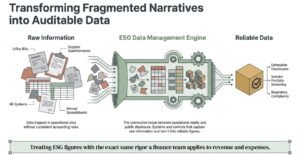
Essentially, ESG data management is the collection of systems, controls and processes that allow an organisation to gather environmental information—like emissions or energy consumption data—social information—such as labour practices and community impact—and governance information—like executive compensation and the makeup of the company’s board—then publish it in a way that’s reliable. While data on financial data comes from decades of standardized accounting rules, ESG data may be sourced from dozens of sources that are not connected, such as utility bills, supplier questionnaires, HR systems, facilities records, and manual spreadsheets kept by whichever team took ownership of the task first. The end goal is to build a cohesive and integrated ESG data management function – to add structure and consistency to this disorganized environment, establish common metrics, and establish a chain of custody that can withstand increased investor, auditor, or regulatory scrutiny at each reporting cycle. Making matters more difficult, reporting frameworks themselves are continually evolving; a company that designed its data processes around a disclosure framework two years ago may find that it must upgrade existing data processes to meet a new, more stringent disclosure framework while ensuring that the data remains comparable from a two-year perspective. This continuous change is a key factor that makes ESG data management roles shift further away from marketing and communications (where many sustainability roles started) and closer to finance and internal audit. The discipline can be considered the glue between what happens in the business and what is made public; if there were no discipline, then the company’s sustainability claims would be as credible as any of the people who have compiled it in that quarter.
Compliance is not the only reason why it matters. Therefore, poor ESG data management can actually cause business risk: one wrong number for an emissions figure could result in a regulatory penalty, one unnoticed labor issue in the supply chain could mar a brand in an instant, and poor governance disclosures may cause a red flag with institutional investors who use ESG scores to screen portfolios. At the same time, companies that act proactively on ESG data management can really gain insight, as clean data and documentation will make it much easier to respond swiftly when a customer, lender or rating agency requests proof over assurances. The most important skill for any junior professional starting in this space is not just sustainability knowledge — it’s the ability to hold sustainability data to the same standard as finance data relating to revenue and expenses. This shift in mentality, from telling stories about ESG to seeing it as a data-driven discipline with tangible financial impacts, is where a solid candidate often differs from a person who just knows the lingo. Employers are increasingly testing directly for this by asking candidates to follow a disclosed figure and trace it back to where it came from, instead of just asking candidates to provide a definition of one or more of the sustainability terms off the top of their head.
How Does ESG Data Management Support Intangible Asset Analysis?
There is a larger proportion of the value of the company in assets that cannot be held as tangible assets, e.g., brand reputation, customer trust, and regulatory goodwill, and this is more directly influenced by the ESG performance. In the past, intangible asset analysis has been confined to patents, trademarks, and customer relationships, but analysts are now discovering that a company’s actions with regard to the environment or governance can be enough to tip the scales on a brand or customer relationship. For instance, a consumer goods company that has a verified track record of ethical sourcing may keep customers even if it gets involved in a controversy that can make a competitor with less ESG track record lose its customers, and strength is a tangible, measurable part of brand value. It’s right here that ESG data management moves from the “sustainability” report that only the compliance team pays a close eye to the strategy table. Analysts who fail to account for this link run the risk of creating an intangible asset analysis that is “paper tough” but isn’t as “real” as it could be in categories where consumers are increasingly looking for sustainable values based on their ethical considerations. The same applies to employer branding as a form of intangible asset: When a company documents how it treats employees, it will begin to influence a company’s capacity to secure and retain specialized talent that will help secure future earnings. The intangibles, such as regulatory goodwill, that don’t show up in a footnote on the balance sheet can be attributed in part to the extent to which the company has been proactive and not reactive in complying with regulations—only become apparent through a consistent look at ESG over a number of years.
You need to synchronize two datasets that have typically resided in different departments in practice when integrating ESG data management with intangible asset analysis. Where a one relationship is intangible, such as valuing a customer relationship, a valuation team may now include a question about the possibility of future cash flows being affected by a target’s supplier risk or environmental issues, a question that would have been unimaginable 10 years ago. To get it right, ESG data must be structured like financial data, have definitions and consistent time periods, and be sourced to be put into an intangible asset analysis, not as a qualitative footnote. Firms that fail to do so tend to have surface-level intangible asset valuations but fail to uncover meaningful threats lurking within their operational and reputational data that no one could have predicted. The teams that do this well will have a joint review between sustainability and the valuation team before any big report is ready, before an external reader can possibly. The other way around is also valuable: Sustainability teams can get some good ideas from the valuation team, such as reduction in the churn of customers or concentration of suppliers that raise the alert to the valuation team to take dig deeper.
Table 1: Five Key Steps to Build an ESG Data Management Program
| Step | Key Action |
|---|---|
| 1. Map data sources | Identify every system and team currently producing environmental, social, or governance information, from utility invoices to HR records. |
| 2. Standardize definitions | Agree on consistent metrics and reporting periods so figures from different business units can actually be compared. |
| 3. Assign clear ownership | Give each data category a named owner accountable for accuracy, not a shared responsibility that nobody actually manages. |
| 4. Build an audit trail | Document sources, calculations, and assumptions so figures can be defended to auditors, investors, or regulators. |
| 5. Automate where possible | Reduce reliance on manual spreadsheets by connecting source systems directly to the reporting platform. |
Why Is ESG Data for Valuation Becoming Essential to ESG Data Management?
Investors and acquirers now expect ESG disclosures to be included in the valuation process, but not as a standalone report to be skimmed over after reading the numbers; they want to know how the ESG information for the valuation should actually influence the price they’re willing to pay. If a private equity firm is considering an acquisition of a manufacturing target, for instance, then changes to the cash flow projections might now include costs associated with carbon compliance, or potential liability for litigation under labor laws, or the sale of equipment that is inefficient in the use of energy. This change will render ESG data management no longer a communications department and create an annual report, but a department that generates numbers sufficiently accurate to defend in a discounted cash flow model or due diligence data room. Lenders have done the same, and are now increasingly basing the price of their sustainability linked loans on verified data, not just targets and commitments, so a poor ESG data management function now converts directly to higher cost of capital. Similarly, insurance underwriters are also following the path of incorporating ESG data in their valuation of climate-related risk in the pricing of property and casualty coverage for industrial clients. With a decade of additional experience, rating agencies have also started to take structured ESG inputs into credit assessments, and the data quality issues that used to clear the internal ESG review gates may now be pushing the price of borrowing up.
One example of a real-world scenario in renewable energy is when a utility firm buys a portfolio of solar assets and finds that some of the sites are missing environmental compliance information, which only became apparent when the buyers’ team asked for structured ESG data for valuation purposes instead of taking a summary narrative. The discovery resulted in an adjustment in price and a renegotiated indemnity clause which shielded the buyer from being liable for compliance obligations which would not have been apparent from the financial statements of the target company alone. As this example illustrates, it’s not only about reputation, it’s about negotiated price as well, and as the value of the professionals who can turn “ESG Data” into numbers that a finance team can trust becomes more obvious, so does the value of ESG data management. This is now happening in the public equity research world too, as analysts increasingly create models adjusting for ESG factors to determine why two companies with similar financial characteristics are trading at very different multiples. In valuation and research teams where this is not being done in-house, junior analysts who can create and explain this kind of adjustment – not be it an overlay added to the end of a model – tend to stand out quickly.
How Does ESG Data Management Connect to IP Sustainability Strategy?
Although intellectual property and sustainability may appear to be two completely different branches of work, companies are gradually developing an IP sustainability strategy, directly connecting patent portfolios to environmental and social performance targets. For a materials science company pursuing recyclable packaging technology, for example, the patents are less a competitive moat and more supporting evidence to prove the company’s sustainability commitments to customers and regulators – and for that the underlying ESG data management function is required to track the use of those patents, not just their existence on paper. This link is important because regulators and investors grow more and more sceptical of sustainability claims that are based on protected innovation and more sceptical of marketing language that doesn’t have much technical support. Patent filings have also become a direct measure for sustainability analysts: As more and more patents are filed on green technology, the portfolio’s composition can be a predictor of where a company is likely to be heading environmentally for the next few years. Companies who are taking IP sustainability seriously are increasingly seeking IP protection specifically where the environment is being regulated more aggressively, rather than it being a defensive legal action.
Like any well-managed ESG data management function, building a credible IP sustainability strategy requires the same data discipline: clear documentation of the technologies being used in which contexts and the proven data on the environmental impact technologies actually create, not just what they are supposed to, and a defensible approach to linking patent claims to measurable results, not aspirational statements. Organizations that do not do otherwise will incur a particular type of reputational damage, known as “greenwashing,” which involves a discrepancy between what they claim they are innovating and what they actually are achieving an impact on and will erode confidence in the sustainability initiative and the technology itself. Getting it right, however, transforms IP sustainability strategy into a real competitive advantage, as verified and data-based claims start to get harder to copy than a marketing slogan, and are more likely to withstand the kind of rigour and skepticism that journalists, regulators and short-sellers show to sustainability claims. Regular meetings between legal, R&D and sustainability groups ensure that patent strategy and disclosed environmental goals are aligned to prevent the awkward situation where the marketing claim runs ahead of the supporting technology.
What Lessons Improve ESG Data Management in Practice?
The few things that we repeatedly see in companies with more developed ESG data management departments are not opinions, but rather are recognized as lessons learned. The first and most important of these data quality issues is that metrics are rarely owned by more than one person; assign the named owner of each metric as the single most important data quality fix that will have the greatest impact. Second, businesses that collect ESG information at the reporting deadline often discover errors and inconsistencies that are difficult to correct in a timely fashion, whereas those who collect data year-round are able to identify errors earlier, and at a more affordable price. Third, manual spreadsheet consolidation is prone to failure – specifically, it is most likely to go awry during the periods of the company’s growth, when new business units, acquisitions, and geographies are likely to cause data definitions to spread. A mid-sized industrial firm got the hard way to learn this lesson when after a series of mergers, it ended up with five different definitions of the same emissions measure in its various business units, which had to be resolved almost year-long by dedicated cleanup efforts before the company could report a consolidated measure the company was confident they could stand up for before their auditors. The company now has a standard checklist to run on all acquisitions, which includes ESG data definitions, thereby preventing the same issue from happening again.
The most obvious takeaway, however, is that ESG data management should be a cross-functional effort and not something done exclusively by a sustainability team alone. Finance requires the data for intangible asset analysis and ESG data for valuation, whilst legal and compliance are seeking it for the management of regulatory risk, and product teams are looking for it to help them implement an IP sustainability strategy they can stand up to scrutiny. Those who grasp how these pieces fit together – and don’t view ESG reporting as a compliance task – are often the ones their organizations go to when investors and regulators ask tougher questions than a typical annual report can answer. It’s sometimes better to have a broad cross-functional skill set established at an early stage in a career, even if it means not being too specialized. It also makes that work much more interesting because when a professional knows both the sustainability context and the financial consequences, he can contribute meaningfully to the discussion that a broader specialist might not even be able to participate in at all.
Conclusion: Key Takeaways on ESG Data Management
From intangible asset analysis to the use of ESG data for valuing a deal, ESG data management has shifted from being a reporting requirement to a true company value creator. The next step for professionals looking to establish a career in this space is to become familiar with the mechanics of data governance, rather than sustainability concepts: The one skill that could make or break a credible ESG program is the same one that’s used to build a financial reporting program. Being able to map data sources, question the clarity of data sources, and link ESG statistics to real financial outcomes (e.g., an IP sustainability strategy or valuation adjustment) will develop career-relevant judgment more quickly than reading sustainability theory. Begin by selecting one sustainability report from an open company, then find a single value reported in the document and trace it back to a credible source, and then discuss the questions that an auditor or investor might ask if the value is objected to. When companies integrate ESG data management into their infrastructure, not as a communications afterthought, the professionals who help develop that infrastructure are in growing demand as the discipline matures and as they are needed.