How Does ESG Data Management Improve Sustainability Reporting?
In the past, sustainability report writing was more of a report in narrative form, with pledges and photos of tree-planting activities, but today investors and regulators demand numbers that can be tracked, verified, and compared to previous years. How Does ESG Data Management Improve Sustainability Reporting is a question that every finance, compliance, or sustainability professional will have to answer at some stage of their practice: the quality of the underlying data is what makes a report truly trustworthy or just well done. Good ESG data management provides consistency in scattered emissions data, supplier surveys, and HR data, and allows for a reporting team to stand behind it. This article takes you through how disciplined data practices can benefit reporting, the role ESG reporting systems can play in this process, practical examples of how to enhance reporting quality, and the challenges and lessons learned as companies create this capability.
How Does ESG Data Management Improve Sustainability Reporting From the Ground Up?
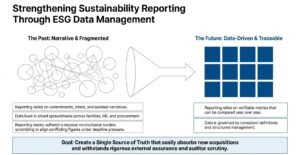
In essence, the idea behind How Does ESG Data Management Improve Sustainability Reporting is simple: Data is the foundation of areportr,t and the majority of sustainability data is spread out across departments and organizations that weren’t meant to communicate with each other. Environmental information may be in the hands of facilities management, labor information may be in the hands of the human resources departmentn,t and governance information may be in the hands of the company secretary’s office and be reported in different formats, at different time intervals, and sometimes in different definitions of the same metric. This fragmentation can be overcome by having strong ESG data management, which establishes clear metrics, assigns ownership, and creates a single source of truth that the sustainability reporting team can rely on and doesn’t have to seek out from five different spreadsheets each reporting season. If they don’t have this to rely on, the team that’s supposed to be reporting data finds itself spending more time verifying and cross-checking data than actually going through it and understanding what it means to the business. As a business ventures into new markets or a business merger takes place, this reconciliation burden can be exacerbated, rather than alleviated, because each new business unit generally comes with a different convention of how historical data is stored, and it must be adapted to the rest of the company. Businesses that plan ahead for this issue and create flexible, well-defined data structures from the ground up rejoin new acquisitions to their reporting system more readily than others that have to redesign their system each time they have an acquisition.
This structural upgrading directly impacts the plausibility of the final report. A disclosed emission number is not given much weight by investors, auditors, or rating agencies when a company can point to a documented calculation method to the original utility bill or meter reading. If it can’t, even a technically correct figure seems shaky when a well-considered follow-up query is thrown at it. Sustainability reporting on the back of a good data management process around ESG is much better able to withstand the critical gaze than reporting prepared in the final weeks of the year, trying to piece together ESG information. This gap is particularly apparent when giving a detailed answer to your external assurance team when they ask question after question – if your data management team has great internal controls in place and can answer all the questions with confidence, then they are much more likely to be able to explain basic data with confidence when they are given questions about it. The providers of the assurance themselves frequently state that the length and difficulty of an assurance engagement are directly related to the extentto whichf the organisation’s data management process is well organised, rather than the quality of the final assurance report.
What Role Do ESG Reporting Systems Play in How ESG Data Management Improves Sustainability Reporting?
ESG reporting systems are the real-world tooling that enables a reporting team to gather, collate, and present the data for ESG compliance daily. A system that is properly implemented can extract information directly from the source systems, like utility billing systems, HR systems, and supplier questionnaires, and calculate the information according to a consistent formula before it ever makes it to a final report, rather than passing it on via a manual spreadsheet that is maintained by hand via email. It is really important for the way ESDM can be used in practice to improve the results of Sustainability Reporting, because if the system can detect the spike in emissions information for an unusual month, it gives the reporting team enough time to investigate the cause of the anomaly, rather than finding out after the report is published and a reporting stakeholder asks a pointed question about the anomaly. Good ESG reporting systems also alleviate the burden on those making the entry at the source, as the automated pulling function from existing reporting systems means that much of the manual data re-entry needed for the data entry process is eliminated, thus minimizing the risk of data entry errors. This decrease in manual effort is typically the deciding factor for business unit leaders who are reluctant to embrace the new system because the system actually saves them from the manual burden of reporting, not just from reporting on something else. If such an adoption is built around the fact that a new system is being implemented to save time, not just to comply with a mandate from the central sustainability team, then it is more likely to get people on board with it.
But it’s not just a technology choice; it’s also a data governance choice that’s needed for any effective ESG data management function. The definitions and controls that a system has are its most important parts; companies that don’t spend time laying the groundwork can end up with a costly platform that still returns the wrong numbers, as each business unit lands data based on different interpretations of the same metric. Businesses that invest the time to set standards of definition before setting up their ESG reporting systems have a smoother rollout of the systems and far fewer data quality issues during their initial reporting cycle when compared with those that rush straight to implementation. This work is often not the focus of the sales presentation by the vendor and consequently is left to the internal team to handle the sequencing. From the start, a realistic rollout schedule that clearly considers this definitional work to be completed in addition to the technical rollout is one of the more realistic safeguards a project leader can implement.
Table 1: How ESG Reporting Systems Support Sustainability Reporting
| System Capability | What It Does | Impact on Sustainability Reporting |
|---|---|---|
| Automated data collection | Pulls figures directly from source systems | Reduces manual entry errors and saves time |
| Consistent calculation logic | Applies the same formulas across business units | Improves year-over-year comparability |
| Anomaly flagging | Highlights unusual data points automatically | Catches errors before publication |
| Audit trail | Records where every figure originated | Supports external assurance and verification |
| Centralized dashboard | Consolidates data across departments | Gives reporting teams a single source of truth |
What Five Steps Show How Does ESG Data Management Improves Sustainability Reporting in Practice?
The five elements outlined below are the practical steps that most companies take as they build up their ESG data management capability and consequently enhance the quality of their sustainability reporting. First, identify all the sources of ESG data throughout the organisation, rather than missing anything important and not being tracked anywhere else. Secondly, create a data category owner, as shared ownership with no clear accountable owner is one of the most common causes of data quality problems that are only discovered at the time of reporting. Third, ensure the definitions and measurement units are consistent, both within and between business units and across geographies, so that what one subsidiary measures and reports is indeed comparable to what another subsidiary measures and reports. Fourth, carry out annual data collection on a continuous basis, rather than a one-off annual effort, identifying errors at an affordable and manageable time and cost. Fifth, create an audit trail from all the figures disclosed back to the original sources, as this is what ultimately gives sustainability reporting its credibility to athird-partyy reviewer. The 5 steps, if followed in order, will ensure a more solid and lasting base for future reporting cycles. Organizations that rush through this process and buy a reporting platform first, only to replicate much of that work at a higher cost later, with less internal tolerance for it, are also likely to be doing it wrong. These 5 steps can also be made into a formal “new businessunit/acquisitionn checklist” to help keep the standard alive as the organization continues to expand.
A practical example is a manufacturing company, that experienced fluctuations in emissions data between its regional divisions for several reporting cycles, where Scope 1 emissions had been computed in each region with slightly different conversion factors. The group mapped all data sources and set clear data ownership per facility, standardized calculation methodology on company-wide level, and created a quarterly reconciliation process instead of a year-end data pull. The next sustainability reporting cycle was completed in a significantly shorter time frame, and most importantly, the reported emissions trend this year was truly a year-over-year change, and not just a result of the mix of different methods being used to measure emissions throughout the business. The most surprising thing for the finance team who became involved in the project later, was not the complexity of the standardization effort itself, but the degree of internal buy-in and the patient communication that was required to have the buy-in of all regional divisions to the new methodology.
What Challenges Arise When Building Strong Sustainability Reporting Through ESG Data Management?
One of the most frequent problems companies encounter is that business units that see the addition of ESG data management as an extra administrative task on top of their regular work and not something they can use for their own benefit. Facilities managers may view this as an additional burden with no direct impact on their own performance metrics, or procurement teams may view it as an additional task that results in non-standard or poorer quality energy returns.If n ot presented and supported correctly, this process could result in inconsistent or low quality energy returns from suppliers, or facilities teams may see it as an additional burden with no direct impact on their own performance metrics. The resistance is usually overcome by leadership to clearly make the link between good ESG data management and the business units’ objective, such as cost savings due to energy efficiency or reduced risk for supplier relations. If presented this way, as opposed to just a compliance need being handed down from on high, then it usually gets people to comply considerably more readily, and, over time, the quality of the data collected from the people who are closest to the operational issues gets a lot better. Sustainability teams which work to establish these relationships at an early stage, instead of waiting for a report call, will typically discover that the quality of the data improves over successive reporting cycles, without a need for continual, top-down corrections. Thisrelationship-\buildingg work is also often underappreciated by a leadership team that is solely technical, but it is often the factor that determines whether a data management effort is successful or quietly dead-ends after the first implementation.
The upside to these hurdles is that companies with well-established ESG data management and robust ESG reporting capabilities can respond nimbly and with assurance to investors, lenders, or customers when they request particular sustainability data, instead of having to scramble to create a one-off analysis in a rush. But that’s where the challenge comes in: It takes consistent investment across multiple reporting cycles to achieve that maturity, and that return on investment isn’t always immediately apparent to those looking for quarterly results. One good lesson that many sustainability leaders have learned is that an early, visible success (e.g., identifying a big data flaw before it is published in a report) is what makes it easier to get the hesitant stakeholders to believe that the effort to improve the quality of data was worth it. After the first real success is apparent, the budget and staffing needs for the sustainability data role are often less likely to encounter internal opposition than the initial investment.
What Lessons Explain How Does ESG Data Management Improve Sustainability Reporting Over Time?
Some of the lessons that emerge across companies that have managed to make their sustainability reporting more robust with better data practices do so often that they constitute very real help. First, do not try to develop a program that has all the data points possible if you do so at once; starting with the basic “must have” data points is more likely to lead to a deep and reliable program for your specific stakeholders and industry, rather than a broad and shallow program. Second, approach ESG data management not as a project that has a fixed and finite end date, but as a continuous business process where reporting specifications, stakeholder expectations and the business itself is constantly evolving once the first ‘mature’ report has been issued. Third, invest in training those who are entering and managing the underlying data, not only the systems and templates, for the best-designed ESG reporting systems produce poor results when the people using them do not understand the importance of data quality. Fourth, create regular checkpoints throughout the year to test data quality, instead of having one big push just before the data is published. Fifth, acknowledge and showcase internal efforts to enhance data quality as prominently as external sustainability efforts: Acknowledge the people behind the internal efforts to ensure high standards with accurate underlying data, which is necessary to keep standards high year after year as prominently as external efforts for sustainability.
The most obvious takeaway is that How Does ESG Data Management Improve Sustainability Reporting is not a quick fix, but an iterative process. With each reporting cycle that is based on cleaner data, clearer ownership and improved systems, the next is made easier and easier, and companies that do not develop the capability to make future seasons easier never actually do. Fellow professionals who know this compounding dynamic and who are in favor of effective expenditure of time and resources on building data infrastructure that are sustained over the long term, rather than on short-term quick fixes in preparation for a filing deadline, become valuable long-term assets for their organization’s sustainability initiative, and not just the person responsible for preparing the annual report. This bigger picture also has a tendency to lead to more senior strategic positions over time, as executives are more likely to seek sustainability professionals who not only know how the data works, but what it is ultimately serving as in their companies.
Conclusion: Key Takeaways on How Does ESG Data Management Improve Sustainability Reporting
Good sustainability reporting is not about writing or design – it’s about the result of disciplined ESG data management. The concrete next move for professionals developing a career in this field is to become familiar with the nuts and bolts of data governance, understand how these data governance systems in practice work, and practise connecting a disclosed sustainability metric back to its source data that an auditor or investor will eventually do. Learning from the best practice examples of leading companies in terms of how they present their sustainability reporting disclosures, and the level of detail they provide around their most important metrics, is one of the quickest ways of internalizing what good practice looks like. If ESG data management is an infrastructure, not a yearly exercise to complete a report template, then it is the companies (and professionals) that can best produce sustainability reporting that earns trust over time. Begin with a single metric that they are already disclosing, and go through each step of how the metric is calculated, and record where this process would fail if it were exposed to a close examination by the outside world; the solution to one of those gaps is a step-by-step, achievable start to creating the same kind of robust data infrastructure that the best sustainability reporting programs already depend on.