How to Calculate the Financial Impact of ESG Risks
How to Calculate the Financial Impact of ESG Risks
What used to be included in sustainability reports, is now being featured directly in balance sheets, credit ratings and insurance premiums. As carbon costs, regulatory fines, disrupted supply chains and reputation losses are all consequences with measurable cash flow impacts, the ability to calculate the financial dimension of ESG risk has become a fundamental capability for finance professionals, rather than an off-the-shelf add-on. This article provides a quick method of calculating the ESG risk impact tools using well proven financial approaches, outlines the financial consequences that ESG risks have on various business processes and then provides a step-by-step example of a financial calculation for ESG risk. It also explores how practitioners have begun to quantify the financial impact of ESGs in real transactions, and how an ESG risks cost calculation fares in the face of audit and investor scrutiny, providing a practical approach that anyone in junior and mid-level roles can use straight away. All of the techniques outlined in this document are not ‘novel’ as such, but rather have been adapted from existing financial risk methodology, and applied to a risk class that is traditionally considered too qualitative to be modeled rigorously.
What Does It Mean to Calculate ESG Risk Impact on Financial Statements?
The ESG risk effect on a company’s financial statements is how a qualitative risk, e.g. a risk of future carbon pricing or a risk of a labour dispute, is translated into a quantitative risk effect on revenue, costs, asset values, or the discount rate applied to the value of the business. This translation is usually done in one of four ways: a direct cost increase, such as a carbon tax, or higher insurance premiums; a revenue at risk, such as customers switching to companies with lower emissions; asset impairment, such as a stranded fossil fuel reserve that may no longer be economically exploited; or cost of capital, specifically when lenders and investors demand a risk premium from companies that have weak ESG performance. The four channels combine to make one complete view of the financial consequences of ESG risks to a business, and linking an individual risk to one or more of these channels is the first step of transforming a generic sustainability challenge into a number that a chief financial officer could act upon. Knowing the path of a risk through the channel is the first step towards any reasonable effort to calculate the impact of ESG risk, as the relevant financial tool varies by risk, whether income statement, balance sheet, or valuation multiple to future earnings. A common early career pitfall is that every ESG exposure is instead perceived as a general reputational risk, as opposed to understanding the exposure and breaking it down into a line item, a modelable exposure.
Due to its combination of sustainability expertise and traditional financial analysis, it is becoming more and more the responsibility of corporate finance and risk teams, rather than sustainability departments. A physical climate risk (e.g., more likely to be flooded at a manufacturing site) must be translated by an actuary or engineer into a probability and a cost, and then communicated to a financial analyst who models the cost into a discounted cash flow or an insurance reserve calculation. Newer professionals entering this space should be prepared to collaborate across functions as they’re likely to see the data they need to compute ESG risk impact is not going to come from within the finance function itself, and networking with operations, legal, and sustainability colleagues will more often be the slow step in generating a credible number for a model. Companies that do well at this often establish a formal process for the handoff, thus also providing finance with an official seat on the sustainability committee meeting and sustainability teams with an early view of which risks the finance function deems are material enough to warrant a full financial impact ESG risks assessment.
How Do Analysts Perform an ESG Risk Financial Calculation Step by Step?
The first step in a typical financial risk calculation for ESG risks is identifying risks and determining the materiality of what are likely to be a long list of potential exposures. From there, the likelihood of each material risk materializing within a specific time frame, typically within a regulatory timeframe, scenario analysis provided by organisations like the Network for Greening the Financial System, or internal engineering evaluation for physical risks. The next step involves converting the probability into an estimate of the financial cost: if it is a regulatory risk, this could take the form of a projected carbon price applied to a forecast of emissions; if it is a reputational risk, the financial estimate could be the revenue at risk from a percentage of customers who are proactively minded about the environment and may switch suppliers. The same uncertainty exists with each of these estimates and a credible ESG risk financial calculation, like a traditional financial risk assessment, will show a range of values and not just a single number. A lot of times the analyst doesn’t do this and just gives a single figure, which is then quickly peeled back when questioned because the stakeholders sense that an estimate has been done with more confidence than the underlying data may lend.
When individual risk estimates are available they are incorporated into the financial model as an adjustment to cash flow forecast, added to the discount rate or specific provision in the balance sheet, depending on the nature and timing of the risks. A carbon price risk within the operating cost line of a cash flow forecast is likely to be directly incorporated into the cash flow forecast, whereas a one-off regulatory fine risk would be likely to be captured as a probability-weighted contingent liability. Finally, sensitivity testing should be conducted: so many of the assumptions made in a financial risk calculation for an ESG risk are made about policy, technology and consumer behavior in the future, so it is important to present the results of how the conclusion would change under other scenarios in order to give decision-makers a realistic sense of the range of possible outcomes rather than false precision. It is a practice that is directly from traditional credit and market risk practice where a confidence interval is routinely provided with a headline number and it is a practice being adopted by ESG risk teams across the industry.
Table 1: ESG Risk Categories and Financial Impact ESG Risks Channels – How to Calculate the Financial Impact of ESG Risks
| Risk Category | Primary Financial Channel | Example Metric |
|---|---|---|
| Carbon and emissions pricing | Operating cost increase | Cost per tonne of CO2e applied to forecast emissions |
| Physical climate risk | Asset impairment or insurance cost | Probability-weighted repair or relocation cost |
| Regulatory and compliance risk | Contingent liability or fine | Probability-weighted penalty exposure |
| Supply chain and labor risk | Revenue or margin disruption | Estimated cost of supplier switching or remediation |
| Reputational and market risk | Revenue at risk or valuation multiple | Percentage of customer base at risk of attrition |
What Does It Take to Measure ESG Financial Impact Across a Portfolio?
Risk pricing is a challenge because investors and lenders do not just invest in one company, but need to assess the ESG financial impact on their entire portfolio of investments to understand the total exposure and to be able to price the risk consistently across very different businesses. It typically begins with a uniform scoring system, typically defined by a taxonomy that is widely accepted and adopted like that of the Task Force on Climate-related Financial Disclosures or a sector-specific taxonomy from the Sustainability Accounting Standards Board that provides similar frameworks for comparing a mining company’s physical climate risks with a retailer’s supply chain labour risks. Portfolio level analysis also needs a consistent way of converting these qualitative scores into dollars because the number of dollars in a portfolio at stake is very little information for an investment committee based on a five-point risk rating.
In reality, there are a number of asset managers today that are using a value-at-risk style calculation to measure ESG financial impact – which calculates the loss in portfolio value if a particular adverse ESG scenario comes to pass, such as a ten year time horizon rather than fifteen for the world to transition to a low carbon economy. This way of working promotes explicit assumptions on the amount of risk exposure for specific holdings and the extent of the risk, and results in a single number that can be contrasted with traditional financial risk measures the investment committee already utilizes. The main value of the finance role is converting a general issue on ESG exposure into a defensible number that can be added to the other risk metrics a board reviews quarterly, and that’s exactly what the ability to model the financial impact of ESG risks has become in finance and risk roles in the last couple of years. A main hurdle in practice will be consistency and availability of data: different companies report on the ESG aspects of their portfolio at widely varying levels of disclosure, which means that analysts will have to construct reasonable proxies for companies with less disclosure, clearly marking where a number is an estimate and not a number reported by the company. Portfolio managers who invest in establishing this consistency in the initial exercise reap the rewards beyond the first reporting cycle as the same standardized framework can be used for every reporting cycle instead of being rebuilt from scratch as disclosure practices across the portfolio continue to evolve over time.
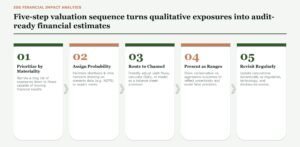
What Five Steps Help You Calculate ESG Risk Impact Reliably?
- Prioritize by materiality. Before even building any model, filter the long list of exposures that are ESG exposures into the risks that can actually influence financial results by more than a modest amount.
- Make an assignment for the probability and the time horizon. Use regulatory timelines, scenario data or company expert estimates to get an idea of the likelihood of each material risk crystallizing and over the time frame.
- Channel all risks to the appropriate financial means. Determine if a risk should be included in operating costs, included in a balance sheet provision, or in the discount rate; the technique used varies by channel.
- Give a range, not a point estimate. Demonstrate the financial effect of the conservative and aggressive cases as most of the inputs of the ESG are uncertain.
- Repeat the calculation over and over. Adjust expectations over time because the regulation, technology, and disclosure quality will change over time and a fixed ESG risk value is outdated and rapidly obsolete.
What Real-World Examples Show the Financial Impact of ESG Risks?
Take the example of a mid-sized power generation firm that has a large coal-fired asset portfolio such as Corrigan Energy Holdings. The company’s finance team decided to undertake due diligence to evaluate the potential impact of ESG risks on the company as it was preparing for a refinancing round, and they created a model of the impact of a progressive increase in the region’s carbon price over the next ten years. Application of that price to predict emissions had caused material reduction in projected free cash flow, and when added to the increased discount rate reflecting lenders’ increased reluctance to finance coal assets on favourable terms the exercise had shown that two of the company’s older plants had a real risk of becoming stranded assets well before their technical end of life. Using these results, the finance team advanced a planned closure date for the least efficient plant, rather than a larger, uncontrolled write down which would have happened at some time in the future in any event as lenders put the risk in the cost of future financing. The exercise also shifted the company’s thinking about future capital allocation decisions: With every major new investment proposal, the company now made a standardized effort to measure the impact of the prospective investment on ESG risk, alongside the company’s usual calculation of financial return.
The second example was a clothing maker, Bellweather Apparel Group, which had been using multiple overseas contract manufacturers who have faced labor compliance problems in the past. Following one of the many facilities it was reported that the company experienced on its supply chain, the company’s risk team calculated the cost of ESG risks on three channels: the direct cost of an emergency supplier audit and remediation program, the estimated revenue at risk from customers that had publicly indicated that they would reconsider the company’s brand, and a modest increase the company’s borrowing spread that its lender flagged during the next covenant review. Though the number is not exact, it was sufficient to warrant a multi-year study of supplier diversification and independent auditing, which the board had not given high priority, given the resulting investment priorities. Later, board members noted that having access to the ESG risks cost calculation in financial language, instead of being included as an additional sustainability appendix, was what finally got it from being a regular board agenda item to being an approved budget line. The thing that connected both of them was the financial exercise, not necessarily just the headline event itself, and this is why there is a disproportionate influence on the rate of response from finance professionals who can make sense of ESG exposure in terms of the money.
What Challenges Arise in ESG Risks Cost Calculation and What Have Practitioners Learned?
Data quality is typically the biggest hurdle in any ESG risks cost calculation, and many of the inputs, such as the conditions of labor practices in the supplier or the potential for physical assets to be exposed to future flooding, are not measured as rigorously or consistently as is traditional financial data – forcing analysts to accept estimates from third parties, industry averages or reasonable proxies. Smaller firms and private companies are most affected by this issue, as they do not typically have the reporting structure that larger listed firms have established over multiple disclosure cycles and therefore a cost calculation for an ESG is likely to be based on significantly less evidence than a cost calculation for an ESG of a large listed firm. The second challenge is horizon mismatch because, for example, many ESG risks, and especially climate-related issues, will have a time horizon of many years, whereas the typical financial model and investor reporting cycle will have a shorter view of three to five years. Finance teams that have come a long way on this score have usually two versions of their model side by side, one for the reporting cycle and a long-term, strategic, one that enables them to keep in mind risk factors that may materialize only much longer down the road. A third challenge is double counting or omission: in a poorly coordinated analysis, the same risk can be included twice (across various components of a model), or it could be entirely left out because each team believed that the other group was addressing the risk.
The most important thing practitioners who work in this field on a regular basis have been able to say is that the assumptions are far more important than the preciseness of the final number. By providing a financial impact estimate for each of the ESG risks, along with the certainty of that estimate, the time horizon and the data used to formulate the estimate, then if a stakeholder challenges one of the inputs the analysis would not simply be summarily dismissed and a defensible basis for action would have been provided. Risks that are regularly reassessed are also identified early, and those risks that are not reassessed every year are likely to come as a surprise in subsequent years – and at a higher expense. Practitioners learn that ESG risks should be integrated into the normal economic and financial processes – not treated as a special project – as risks identified on a periodic basis are identified at an earlier stage and are likely to be less expensive than those identified at a later stage. The third is important to anyone familiar with the basics of ESG financial impact measurement: the value of learning to measure financial impact grows with each reporting cycle, because as the history of measurement gets longer, the next cycle’s estimates will be increasingly defensible and more accurate.
Table 1: Common Challenges in ESG Risk Financial Calculation and Practical Mitigations – How to Calculate the Financial Impact of ESG Risks
| Challenge | Practical Mitigation |
|---|---|
| Inconsistent or missing ESG data | Use third-party benchmarks and clearly flag estimated inputs |
| Long risk horizons versus short reporting cycles | Run explicit long-term scenarios alongside standard forecasts |
| Double counting across cost, capital, and valuation | Assign clear ownership of each risk channel before modeling |
| Stakeholder skepticism about the final number | Disclose assumptions and present a range rather than one figure |
| Analysis treated as a one-off exercise | Embed ESG risk review into regular budgeting and impairment cycles |
Conclusion: How to Calculate the Financial Impact of ESG Risks
ESG risks are not a story that sits alongside the numbers, they are a story that sits inside of them. These are skills that will be increasingly important in finance careers as disclosure increases and investor interest grows in the financial impact of ESG risks – from cost, capital and valuation perspectives – and the ability to measure ESG financial impact consistently across a portfolio. The next step for those working on developing this capability is to select one material ESG risk facing a company they are familiar with, walk through each financial channel discussed in this note, and practice making the resulting ESG risk financial calculation credible, rather than a rough estimate that is just set in a footnote. Wherever disclosure is becoming tighter and more rigorous – in the major markets – those who have already developed this muscle will be well prepared, but those who haven’t may discover the learning curve will be quite a steep one when it’s no longer an option but a requirement of financial reporting.