Why Is ESG Transparency Critical for Business Success?

Understanding Why Is ESG Transparency Critical for Business Success

Environment, social and governance (ESG) issues have shifted from the margins to the heart of the business strategy. It’s no longer enough for organisations to say they’re doing something about sustainability, ethics and governance: Investors, regulators, customers and employees now expect them to prove it. The key to this change is the transparency of ESG reporting, which involves sharing ESG performance information in an unambiguous, consistent, and verifiable way. If it isn’t there, sustainability efforts can come across as being opportunistic or lacking in direction. In today’s regulatory environment and with growing investor attention, good stewardship of ESG reporting compliance is now about competitive differentiation, rather than compliance. In this article, the author will outline the reasons why transparency is important, a practical example of what best practices are for ESG disclosure, and how people at all career stages can help to build trust by providing credible and well-structured ESG reporting. 
Why Is ESG Transparency Critical for Business Success?

What Is ESG Reporting Transparency and Why Does It Matter?

ESG reporting transparency is the ability of a company to disclose information on its environmental, social and governance (ESG) footprint and the impact it has on people and society with clarity and accountability. This is not just about producing an annual sustainability report; it’s about sharing the methods, data sources, goals and year-by-year progress in a manner that third parties can check and verify independently, not just on the company’s own account. Structured frameworks like the Global Reporting Initiative (GRI), the Sustainability Accounting Standards Board (SASB) and the Task Force on Climate-related Financial Disclosures (TCFD) provide standardised templates that enable companies to communicate ESG information in a consistent way and allow investors, analysts and regulators to be able to compare performance across industries, geographies and reporting periods. A company that performs well on one framework and misses out on important data on another is a warning sign that it is promoting selective disclosure, not transparency, and increasingly sophisticated stakeholders catch on to it. In practice, even the style of disclosure is important: It’s easy to be sceptical of figures in a dense appendix without any context, but not so easy when they’re provided with clear methodology notes and multi-year trend lines.

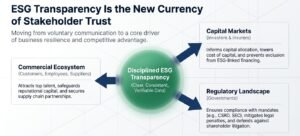
The importance of transparency is that ESG data is increasingly used at all layers of the financial system to make decisions on capital allocation. For example, institutional investors rely on ESG scores to gauge their exposure to long-term risk; insurers include ESG performance in underwriting processes; and lenders integrate ESG covenants into financing agreements. In the event that disclosures are incomplete, inconsistent, or difficult to verify, companies can be denied access to investment funds oriented towards ESG, they can pay higher prices for capital, or they can be excluded from access to some type of credit. In addition to the financial markets, transparency in reporting creates credibility with employees and customers, who are more likely to hire a company or the brand than to take the company’s word for it. Thus, transparency isn’t just a compliance matter; it’s a strategy to build trust—trust that will help maintain business stability in the long run, mitigate reputational damage in times of stress and controversy, and avoid costly restatements and public litigation over reported numbers. When assessing a potential employer, job seekers are increasingly taking the time to look at published ESG data as a symptom to investigate further prior to accepting an offer, provided the data is consistent and transparent. Job seekers also take the time to read published ESG disclosures when assessing a potential employer, viewing vague or inconsistent reporting as a sign to dig deeper into the situation before taking an offer. The transparency gaps can also impact commercial relationships before they even make it to a regulator’s desk, as supply chain partners are starting to demand ESG data as a condition of doing business, too. 

How Does ESG Compliance Reporting Build Stakeholder Trust?

ESG compliance reporting is the formal reporting requirement that a company must fulfill to comply with the ESG disclosure obligations set by the European Union’s Corporate Sustainability Reporting Directive (CSRD), or similar laws being adopted in Asia-Pacific markets. These tend to set out specific metrics, assurance levels and filing time limits, which transform ESG disclosure into a mandatory exercise, with actual economic and legal consequences of non-compliance, such as fines or delayed filing, as well as shareholder litigation in more severe scenarios. Companies that have a compliance department with staff and systems in place to report compliance rather than a “catch-up” activity for the administrative team to report on when asked by regulators or auditors than those that don’t will likely deliver more accurate, timely, and defensible compliance disclosures when the regulators or auditors ask questions. Beyond financial reporting, more and more boards are seeking regular updates on ESG reporting – a development that has elevated compliance reporting to its own level on the corporate governance agenda and brought it closer to the realm of finance and legal teams, and alongside other financial reporting mandates is likely to be more prevalent across jurisdictions over the next few years.

In a scenario that might be familiar to European consumer goods companies, institutional investors started to demand transparency in understanding the Scope 3 emissions of their companies after having had to rely on narrative disclosures for a few years. The company invested in a central data collection system and brought in an external auditor to confirm supply chain data from hundreds of suppliers, which enabled the company to release assured emissions data ahead of compliance requirements. This not only meant smoother compliance but also higher ratings from ESG rating agencies, higher analyst confidence and fewer follow-up queries at its annual general meeting. A similar situation exists at a North American energy provider, which, following a public quarrel over their emissions data, took steps to re-establish trust in the internal reporting system by having more detailed, auditable disclosures and a series of progress reports, but not a single annual overview. The two examples above show that strict compliance reporting, as an essential business process instead of a reactive one, can be used as a strategic competitive advantage, and the internal teams that develop compliance systems may be a useful example for other departments facing similar regulatory constraints. 

What Are the ESG Disclosure Best Practices Leading Companies Follow?

There are known ESG disclosure best practices, and companies with better ESG outcomes tend to practice most of them whether they’re in Europe or the U.S. or based in their respective industries. These include performing a formal materiality analysis, determining the most material ESG issues by industry and stakeholders, using known reporting frameworks to help make it comparable, and getting third-party assurance to validate reported information before it is published. Leading organisations also establish specific, time-bound targets with data that does not simply reflect their aspirations, but instead measure progress against the target and disclose year-on-year progress and progress shortfalls openly and transparently; otherwise, it undermines credibility and raises the risk of ‘greenwashing’ allegations from regulators, journalists or advocacy groups. Another good indicator of disclosure is to use plain, non-technical language that can get to the point without overly technical reports that may make it harder to understand actual performance. Similarly, consistency of definitions across reporting cycles is critical, as silently changing the way a metric is calculated can cause real progress to appear as if it is not happening, or even that it is a strategy to hide real performance. Including stakeholders via investor calls, employee surveys, etc., or supplier consultations, in prioritising reports can also help to make sure that the disclosures are relevant to what stakeholders ask questions about, not just what is easiest to collect.

One of the best examples of these principles in action is a global apparel brand. The company came under pressure for its supply chain, so it started to release its factory audit reports showing specific instances of non-conformance, a timeline for correction, and follow-up verification results. This sincere communication was not seen as a publicity stunt, as investors and consumer advocacy organizations welcomed it as a sign of a legitimate improvement process. A similar case showcases a medium-sized industrial manufacturer that was already using SASB metrics before the rules were mandated, so the firm had already put in place an infrastructure of data to make it easy and affordable for them to follow new mandatory rules when they came. Both examples highlight a consistent theme of ESG communication: Where it matters, people prefer to see the steps companies take, rather than only the results, and prefer to see companies be honest about their flaws, rather than only their successes.

ESG Disclosure Best Practices by Reporting Framework

The selection of an appropriate framework (or set of frameworks) is one of the first practical choices that a reporting team will need to make. The table below provides an overview of the most common frameworks used and how they facilitate the disclosure of consistent and comparable information on ESG issues to different audiences and for different purposes. 

Table 1: ESG Disclosure Best Practices by Reporting Framework – Why Is ESG Transparency Critical for Business Success?
Framework Primary Focus Typical Use Case
GRI Standards Broad environmental, social, and governance impact Public sustainability reports for multiple stakeholders
SASB Standards Industry-specific, financially material ESG issues Investor-focused disclosures and annual filings
TCFD Framework Climate-related financial risks and opportunities Climate risk disclosure in financial statements
ISSB Standards Global baseline for sustainability-related disclosure Cross-border reporting consistency

What Challenges Do Companies Face in Achieving ESG Reporting Transparency?

While the commitment is increasing, there is an issue for many organisations that they are unable to ensure the transparency of ESG reporting in practice. Often there are issues with data fragmentation: Environmental data could be stored with the facilities team, social data with human resources, and governance data with legal and compliance teams, and it can be challenging to pull it all together on a consistent schedule. Smaller enterprises or those recently starting to report on ESG may not have the in-house knowledge or systems in place to gather auditable data, which can create gaps, estimation mistakes, or inconsistencies that can raise doubts about the credibility of the report when examined. Regulatory requirements are also on a fast track, causing additional complexity because companies with business activities across jurisdictions often have to develop multiple versions of similar reports and disclosures for different regulators, facing the same requirement to keep up with the changing nature of regulations. Talent shortages add to the issue – with a growing number of professionals with sustainability knowledge and a growing number of professionals with formal reporting knowledge, but not enough people have both or are experienced enough in both to meet the demand, so reporting teams are often overwhelmed at peak filing times and the need for external consultants to fill capability gaps has risen.

Leaders must take these challenges seriously and consider the consequences of not exploiting these opportunities. In order to build strong data infrastructure, train employees and implement assurance processes, significant upfront investment and cross-functional coordination are necessary, which can be challenging to show a near-term return on. But firms that under-invest in transparency risk higher costs down the road, such as fines and penalties for regulatory violations, greenwashing and reputational damage, as well as the cost of harking back to reconstruct the past to meet new disclosure requirements or avoiding being excluded from ESG-related financing altogether. What many companies have found the hard way is that investing in a reliable reporting system before regulation formally requires it is significantly easier to find and not nearly as disruptive as adding reporting in at the last minute. Many companies also report that the most difficult aspect of the process wasn’t the technology itself but getting the heads of departments to agree to keeping the ESG data requests a priority, which typically becomes more manageable once leadership links the data to performance reviews or executive compensation takes place. 

ESG Compliance Reporting Challenges and Practical Solutions

Whether in the public sector, private industry, or the non-profit world, most organisations face the same set of challenges as they construct their reporting function. The following table details common compliance reporting issues, their root causes, and some suggested solutions that have proven successful in various industries. 

Table 2: ESG Compliance Reporting Challenges and Practical Solutions – Why Is ESG Transparency Critical for Business Success?
Challenge Underlying Cause Practical Solution
Fragmented data sources ESG metrics owned by different departments Centralized ESG data management platform
Inconsistent metrics across regions Multiple regulatory regimes with different requirements Adopt a global baseline framework, then localize
Greenwashing risk Selective or overstated disclosure of achievements Disclose targets, shortfalls, and corrective actions
Limited internal expertise ESG reporting is a relatively new discipline Upskill staff and engage external assurance providers

How Can Early-Career Professionals Contribute to Strong ESG Compliance Reporting?

ESG reporting is a fast-expanding and increasingly niche area for careers in finance, sustainability, or corporate strategy for new entrants to the profession. Employers prioritize candidates who can grasp the environmental and social aspects of ESG in addition to the technical and reporting aspects of ESG compliance reporting, including the definition, collection, and assurance of metrics. While years of hands-on sustainability experience are valuable, a key distinction for junior hires in a competitive job market may be developing fluency in core frameworks, basic data analysis skills, and a working understanding of assurance processes. Many companies now employ dedicated ESG analysts, sustainability reporting specialists and ESG audit associates, which, a decade ago, were scarce positions and were often filled by people from a variety of academic disciplines, such as finance, environmental science, law, and communications, as long as they showed they had the right level of natural fluency when it comes to the collection and verification of reporting data.

Experience is important as well as education in establishing a career in this area. Experts who volunteer for cross-functional data projects in the area of environmental, social, and governance issues, practice in the field of environmental sustainability, seek appropriate qualifications, or participate in materiality projects gain valuable insights that cannot be gained in the classroom, which is very noticeable on their resumes. It’s also a low-cost approach to learning about ESG disclosure before getting an on-the-job job to create ESG disclosure fluency by following in the footsteps of the leading companies’ methodology sections of their public reports or by comparing method sections across competitors, or reviewing how disclosures evolve year by year. The professionals who project sustainability knowledge and understanding into financial and legal disclosure, reporting and practice will continue to be in high demand, especially as the knowledge of both is becoming increasingly sophisticated and regulatory demands are growing on a global level, particularly when a company is first faced with a challenging disclosure question in the media or by shareholders. 

Five Key Steps to Strengthen ESG Reporting Transparency

  1. Do a materiality assessment: Determine which of the environmental, social and governance issues are most relevant to the business and the stakeholders before deciding what to measure and report. This will help to reduce the amount of resources being invested in measuring metrics that are not necessarily decision-useful to the business, and should be regularly reviewed as the business develops and as its risk profile changes.
  2. Centralize data collection: Move ESG data from operations, HR and governance to a single system to cut down on duplication and inconsistencies. Having a common data owner and consistent definitions across business units can make it much easier to compare this year’s year-to-year results and minimize the frantic last-minute rush before annual filing dates.
  3. Align with recognised frameworks: Ensure that disclosures are comparable across industries and reporting periods by aligning with recognised frameworks like GRI, SASB and TCFD. It also avoids the possibility of rework if the regulatory requirements change by mapping internal metrics to multiple frameworks in the early stages.
  4. Get independent assurance: Have third-party auditors review the data reported, enhancing credibility with investors, regulators, and the public. Limited assurance is a reasonable first step for new companies to external assurance, and reasonable assurance will be a longer-term objective when internal data quality is developed.
  5. Be honest, report successes as well as failures: Don’t hide your shortcomings or only share your successes, because withholding information raises the likelihood of reputational and regulatory problems over time. Corrective Action Plans clearly link each shortfall to a corrective action plan which resolves the issue and establishes evidence of a credible improvement process. 

Conclusion: Why Is ESG Transparency Critical for Business Success?

ESG transparency has moved from being a ‘nice to have’ to a regulatory, investor and public ‘must ‘, and this trend is not going to change, with reporting requirements now proliferating in key markets. Firms that invest early in centralized data systems, tie up with recognised systems and share progress as well as setbacks in a transparent manner, tend to gain better trust, financing terms and fewer surprises when it comes to compliance issues. Those who procrastinate will end up regretting it, be it in haste with compliance projects, problems with investors’ confidence, or the public’s doubts about the figures. Understanding ESG frameworks and reporting practices is a real differentiating factor for professionals in a sector that is rapidly expanding into various finance, operations and corporate strategy roles. For any organisation, large or small, across any sector, the first steps are to conduct a materiality assessment, to establish reporting frameworks that can expand as needs change, and to make disclosure a recurring process, not an annual, rushing-to-completion task. When done well, ESG transparency is not a burden of compliance, but a lasting source of trust for all stakeholders that rely on the business, be they investors, regulators, employees, or customers. 
Frequently Asked Questions

Q1. What is ESG transparency?

ESG transparency is the practice of openly disclosing a company’s environmental, social, and governance performance, policies, risks, and sustainability initiatives. It enables investors, regulators, customers, and other stakeholders to understand how the company manages ESG-related risks and opportunities.

ESG transparency builds stakeholder trust, strengthens investor confidence, improves regulatory compliance, enhances corporate reputation, and supports long-term business growth through better governance and decision-making.

Transparent ESG reporting provides investors with reliable information about a company’s sustainability performance, governance practices, and risk management. This helps them make informed investment decisions and evaluate long-term value creation.

Businesses commonly improve ESG transparency by following globally recognized frameworks such as the Global Reporting Initiative (GRI), IFRS Sustainability Disclosure Standards (ISSB), Sustainability Accounting Standards Board (SASB), and the Task Force on Climate-related Financial Disclosures (TCFD).

Companies can improve ESG transparency by collecting accurate ESG data, adopting recognized reporting standards, conducting independent assurance, engaging stakeholders regularly, and publishing clear, measurable, and consistent sustainability reports.

Why Is ESG Transparency Critical for Business Success?

Understanding Why Is ESG Transparency Critical for Business Success

Environment, social and governance (ESG) issues have shifted from the margins to the heart of the business strategy. It’s no longer enough for organisations to say they’re doing something about sustainability, ethics and governance: Investors, regulators, customers and employees now expect them to prove it. The key to this change is the transparency of ESG reporting, which involves sharing ESG performance information in an unambiguous, consistent, and verifiable way. If it isn’t there, sustainability efforts can come across as being opportunistic or lacking in direction. In today’s regulatory environment and with growing investor attention, good stewardship of ESG reporting compliance is now about competitive differentiation, rather than compliance. In this article, the author will outline the reasons why transparency is important, a practical example of what best practices are for ESG disclosure, and how people at all career stages can help to build trust by providing credible and well-structured ESG reporting. 

Why Is ESG Transparency Critical for Business Success?

What Is ESG Reporting Transparency and Why Does It Matter?

ESG reporting transparency is the ability of a company to disclose information on its environmental, social and governance (ESG) footprint and the impact it has on people and society with clarity and accountability. This is not just about producing an annual sustainability report; it’s about sharing the methods, data sources, goals and year-by-year progress in a manner that third parties can check and verify independently, not just on the company’s own account. Structured frameworks like the Global Reporting Initiative (GRI), the Sustainability Accounting Standards Board (SASB) and the Task Force on Climate-related Financial Disclosures (TCFD) provide standardised templates that enable companies to communicate ESG information in a consistent way and allow investors, analysts and regulators to be able to compare performance across industries, geographies and reporting periods. A company that performs well on one framework and misses out on important data on another is a warning sign that it is promoting selective disclosure, not transparency, and increasingly sophisticated stakeholders catch on to it. In practice, even the style of disclosure is important: It’s easy to be sceptical of figures in a dense appendix without any context, but not so easy when they’re provided with clear methodology notes and multi-year trend lines.

The importance of transparency is that ESG data is increasingly used at all layers of the financial system to make decisions on capital allocation. For example, institutional investors rely on ESG scores to gauge their exposure to long-term risk; insurers include ESG performance in underwriting processes; and lenders integrate ESG covenants into financing agreements. In the event that disclosures are incomplete, inconsistent, or difficult to verify, companies can be denied access to investment funds oriented towards ESG, they can pay higher prices for capital, or they can be excluded from access to some type of credit. In addition to the financial markets, transparency in reporting creates credibility with employees and customers, who are more likely to hire a company or the brand than to take the company’s word for it. Thus, transparency isn’t just a compliance matter; it’s a strategy to build trust—trust that will help maintain business stability in the long run, mitigate reputational damage in times of stress and controversy, and avoid costly restatements and public litigation over reported numbers. When assessing a potential employer, job seekers are increasingly taking the time to look at published ESG data as a symptom to investigate further prior to accepting an offer, provided the data is consistent and transparent. Job seekers also take the time to read published ESG disclosures when assessing a potential employer, viewing vague or inconsistent reporting as a sign to dig deeper into the situation before taking an offer. The transparency gaps can also impact commercial relationships before they even make it to a regulator’s desk, as supply chain partners are starting to demand ESG data as a condition of doing business, too. 

How Does ESG Compliance Reporting Build Stakeholder Trust?

ESG compliance reporting is the formal reporting requirement that a company must fulfill to comply with the ESG disclosure obligations set by the European Union’s Corporate Sustainability Reporting Directive (CSRD), or similar laws being adopted in Asia-Pacific markets. These tend to set out specific metrics, assurance levels and filing time limits, which transform ESG disclosure into a mandatory exercise, with actual economic and legal consequences of non-compliance, such as fines or delayed filing, as well as shareholder litigation in more severe scenarios. Companies that have a compliance department with staff and systems in place to report compliance rather than a “catch-up” activity for the administrative team to report on when asked by regulators or auditors than those that don’t will likely deliver more accurate, timely, and defensible compliance disclosures when the regulators or auditors ask questions. Beyond financial reporting, more and more boards are seeking regular updates on ESG reporting – a development that has elevated compliance reporting to its own level on the corporate governance agenda and brought it closer to the realm of finance and legal teams, and alongside other financial reporting mandates is likely to be more prevalent across jurisdictions over the next few years.

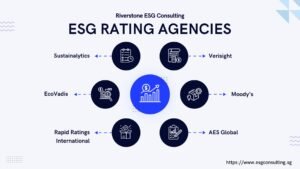
In a scenario that might be familiar to European consumer goods companies, institutional investors started to demand transparency in understanding the Scope 3 emissions of their companies after having had to rely on narrative disclosures for a few years. The company invested in a central data collection system and brought in an external auditor to confirm supply chain data from hundreds of suppliers, which enabled the company to release assured emissions data ahead of compliance requirements. This not only meant smoother compliance but also higher ratings from ESG rating agencies, higher analyst confidence and fewer follow-up queries at its annual general meeting. A similar situation exists at a North American energy provider, which, following a public quarrel over their emissions data, took steps to re-establish trust in the internal reporting system by having more detailed, auditable disclosures and a series of progress reports, but not a single annual overview. The two examples above show that strict compliance reporting, as an essential business process instead of a reactive one, can be used as a strategic competitive advantage, and the internal teams that develop compliance systems may be a useful example for other departments facing similar regulatory constraints. 

What Are the ESG Disclosure Best Practices Leading Companies Follow?

There are known ESG disclosure best practices, and companies with better ESG outcomes tend to practice most of them whether they’re in Europe or the U.S. or based in their respective industries. These include performing a formal materiality analysis, determining the most material ESG issues by industry and stakeholders, using known reporting frameworks to help make it comparable, and getting third-party assurance to validate reported information before it is published. Leading organisations also establish specific, time-bound targets with data that does not simply reflect their aspirations, but instead measure progress against the target and disclose year-on-year progress and progress shortfalls openly and transparently; otherwise, it undermines credibility and raises the risk of ‘greenwashing’ allegations from regulators, journalists or advocacy groups. Another good indicator of disclosure is to use plain, non-technical language that can get to the point without overly technical reports that may make it harder to understand actual performance. Similarly, consistency of definitions across reporting cycles is critical, as silently changing the way a metric is calculated can cause real progress to appear as if it is not happening, or even that it is a strategy to hide real performance. Including stakeholders via investor calls, employee surveys, etc., or supplier consultations, in prioritising reports can also help to make sure that the disclosures are relevant to what stakeholders ask questions about, not just what is easiest to collect.

One of the best examples of these principles in action is a global apparel brand. The company came under pressure for its supply chain, so it started to release its factory audit reports showing specific instances of non-conformance, a timeline for correction, and follow-up verification results. This sincere communication was not seen as a publicity stunt, as investors and consumer advocacy organizations welcomed it as a sign of a legitimate improvement process. A similar case showcases a medium-sized industrial manufacturer that was already using SASB metrics before the rules were mandated, so the firm had already put in place an infrastructure of data to make it easy and affordable for them to follow new mandatory rules when they came. Both examples highlight a consistent theme of ESG communication: Where it matters, people prefer to see the steps companies take, rather than only the results, and prefer to see companies be honest about their flaws, rather than only their successes.

ESG Disclosure Best Practices by Reporting Framework

The selection of an appropriate framework (or set of frameworks) is one of the first practical choices that a reporting team will need to make. The table below provides an overview of the most common frameworks used and how they facilitate the disclosure of consistent and comparable information on ESG issues to different audiences and for different purposes. 

Table 1: ESG Disclosure Best Practices by Reporting Framework – Why Is ESG Transparency Critical for Business Success?
Framework Primary Focus Typical Use Case
GRI Standards Broad environmental, social, and governance impact Public sustainability reports for multiple stakeholders
SASB Standards Industry-specific, financially material ESG issues Investor-focused disclosures and annual filings
TCFD Framework Climate-related financial risks and opportunities Climate risk disclosure in financial statements
ISSB Standards Global baseline for sustainability-related disclosure Cross-border reporting consistency

What Challenges Do Companies Face in Achieving ESG Reporting Transparency?

While the commitment is increasing, there is an issue for many organisations that they are unable to ensure the transparency of ESG reporting in practice. Often there are issues with data fragmentation: Environmental data could be stored with the facilities team, social data with human resources, and governance data with legal and compliance teams, and it can be challenging to pull it all together on a consistent schedule. Smaller enterprises or those recently starting to report on ESG may not have the in-house knowledge or systems in place to gather auditable data, which can create gaps, estimation mistakes, or inconsistencies that can raise doubts about the credibility of the report when examined. Regulatory requirements are also on a fast track, causing additional complexity because companies with business activities across jurisdictions often have to develop multiple versions of similar reports and disclosures for different regulators, facing the same requirement to keep up with the changing nature of regulations. Talent shortages add to the issue – with a growing number of professionals with sustainability knowledge and a growing number of professionals with formal reporting knowledge, but not enough people have both or are experienced enough in both to meet the demand, so reporting teams are often overwhelmed at peak filing times and the need for external consultants to fill capability gaps has risen.

Leaders must take these challenges seriously and consider the consequences of not exploiting these opportunities. In order to build strong data infrastructure, train employees and implement assurance processes, significant upfront investment and cross-functional coordination are necessary, which can be challenging to show a near-term return on. But firms that under-invest in transparency risk higher costs down the road, such as fines and penalties for regulatory violations, greenwashing and reputational damage, as well as the cost of harking back to reconstruct the past to meet new disclosure requirements or avoiding being excluded from ESG-related financing altogether. What many companies have found the hard way is that investing in a reliable reporting system before regulation formally requires it is significantly easier to find and not nearly as disruptive as adding reporting in at the last minute. Many companies also report that the most difficult aspect of the process wasn’t the technology itself but getting the heads of departments to agree to keeping the ESG data requests a priority, which typically becomes more manageable once leadership links the data to performance reviews or executive compensation takes place. 

ESG Compliance Reporting Challenges and Practical Solutions

Whether in the public sector, private industry, or the non-profit world, most organisations face the same set of challenges as they construct their reporting function. The following table details common compliance reporting issues, their root causes, and some suggested solutions that have proven successful in various industries. 

Table 2: ESG Compliance Reporting Challenges and Practical Solutions – Why Is ESG Transparency Critical for Business Success?
Challenge Underlying Cause Practical Solution
Fragmented data sources ESG metrics owned by different departments Centralized ESG data management platform
Inconsistent metrics across regions Multiple regulatory regimes with different requirements Adopt a global baseline framework, then localize
Greenwashing risk Selective or overstated disclosure of achievements Disclose targets, shortfalls, and corrective actions
Limited internal expertise ESG reporting is a relatively new discipline Upskill staff and engage external assurance providers

How Can Early-Career Professionals Contribute to Strong ESG Compliance Reporting?

ESG reporting is a fast-expanding and increasingly niche area for careers in finance, sustainability, or corporate strategy for new entrants to the profession. Employers prioritize candidates who can grasp the environmental and social aspects of ESG in addition to the technical and reporting aspects of ESG compliance reporting, including the definition, collection, and assurance of metrics. While years of hands-on sustainability experience are valuable, a key distinction for junior hires in a competitive job market may be developing fluency in core frameworks, basic data analysis skills, and a working understanding of assurance processes. Many companies now employ dedicated ESG analysts, sustainability reporting specialists and ESG audit associates, which, a decade ago, were scarce positions and were often filled by people from a variety of academic disciplines, such as finance, environmental science, law, and communications, as long as they showed they had the right level of natural fluency when it comes to the collection and verification of reporting data.

Experience is important as well as education in establishing a career in this area. Experts who volunteer for cross-functional data projects in the area of environmental, social, and governance issues, practice in the field of environmental sustainability, seek appropriate qualifications, or participate in materiality projects gain valuable insights that cannot be gained in the classroom, which is very noticeable on their resumes. It’s also a low-cost approach to learning about ESG disclosure before getting an on-the-job job to create ESG disclosure fluency by following in the footsteps of the leading companies’ methodology sections of their public reports or by comparing method sections across competitors, or reviewing how disclosures evolve year by year. The professionals who project sustainability knowledge and understanding into financial and legal disclosure, reporting and practice will continue to be in high demand, especially as the knowledge of both is becoming increasingly sophisticated and regulatory demands are growing on a global level, particularly when a company is first faced with a challenging disclosure question in the media or by shareholders. 

Five Key Steps to Strengthen ESG Reporting Transparency

  1. Do a materiality assessment: Determine which of the environmental, social and governance issues are most relevant to the business and the stakeholders before deciding what to measure and report. This will help to reduce the amount of resources being invested in measuring metrics that are not necessarily decision-useful to the business, and should be regularly reviewed as the business develops and as its risk profile changes.
  2. Centralize data collection: Move ESG data from operations, HR and governance to a single system to cut down on duplication and inconsistencies. Having a common data owner and consistent definitions across business units can make it much easier to compare this year’s year-to-year results and minimize the frantic last-minute rush before annual filing dates.
  3. Align with recognised frameworks: Ensure that disclosures are comparable across industries and reporting periods by aligning with recognised frameworks like GRI, SASB and TCFD. It also avoids the possibility of rework if the regulatory requirements change by mapping internal metrics to multiple frameworks in the early stages.
  4. Get independent assurance: Have third-party auditors review the data reported, enhancing credibility with investors, regulators, and the public. Limited assurance is a reasonable first step for new companies to external assurance, and reasonable assurance will be a longer-term objective when internal data quality is developed.
  5. Be honest, report successes as well as failures: Don’t hide your shortcomings or only share your successes, because withholding information raises the likelihood of reputational and regulatory problems over time. Corrective Action Plans clearly link each shortfall to a corrective action plan which resolves the issue and establishes evidence of a credible improvement process. 

Conclusion: Why Is ESG Transparency Critical for Business Success?

ESG transparency has moved from being a ‘nice to have’ to a regulatory, investor and public ‘must ‘, and this trend is not going to change, with reporting requirements now proliferating in key markets. Firms that invest early in centralized data systems, tie up with recognised systems and share progress as well as setbacks in a transparent manner, tend to gain better trust, financing terms and fewer surprises when it comes to compliance issues. Those who procrastinate will end up regretting it, be it in haste with compliance projects, problems with investors’ confidence, or the public’s doubts about the figures. Understanding ESG frameworks and reporting practices is a real differentiating factor for professionals in a sector that is rapidly expanding into various finance, operations and corporate strategy roles. For any organisation, large or small, across any sector, the first steps are to conduct a materiality assessment, to establish reporting frameworks that can expand as needs change, and to make disclosure a recurring process, not an annual, rushing-to-completion task. When done well, ESG transparency is not a burden of compliance, but a lasting source of trust for all stakeholders that rely on the business, be they investors, regulators, employees, or customers. 
Frequently Asked Questions

Q1. What is ESG transparency?

ESG transparency is the practice of openly disclosing a company’s environmental, social, and governance performance, policies, risks, and sustainability initiatives. It enables investors, regulators, customers, and other stakeholders to understand how the company manages ESG-related risks and opportunities.

ESG transparency builds stakeholder trust, strengthens investor confidence, improves regulatory compliance, enhances corporate reputation, and supports long-term business growth through better governance and decision-making.

Transparent ESG reporting provides investors with reliable information about a company’s sustainability performance, governance practices, and risk management. This helps them make informed investment decisions and evaluate long-term value creation.

Businesses commonly improve ESG transparency by following globally recognized frameworks such as the Global Reporting Initiative (GRI), IFRS Sustainability Disclosure Standards (ISSB), Sustainability Accounting Standards Board (SASB), and the Task Force on Climate-related Financial Disclosures (TCFD).

Companies can improve ESG transparency by collecting accurate ESG data, adopting recognized reporting standards, conducting independent assurance, engaging stakeholders regularly, and publishing clear, measurable, and consistent sustainability reports.

Related Posts

Transform Data Into Impact With Expert ESG Reporting

Ensure transparency, meet compliance, and build stakeholder trust-connect with us today.