What Are the Benefits of ESG Reporting?
A practical guide for finance, sustainability, and strategy professionals
Understanding What Are the Benefits of ESG Reporting
Environmental, Social, Governance (ESG) reporting is no longer a mere compliance requirement and is now expected as a basic part of business by investors, regulators, and employees. ESG reporting benefits go far beyond “checking the compliance box”,and are felt in access to capital, brand equity, risk management and future resilience. In the world of finance, sustainability, and corporate strategy, corporate ESG reporting is no longer a luxury – it’s an expectation. Those firms that use a credible ESG reporting framework are likely to be able to attract investors, keep employees and avoid regulatory action. You will get a real-world, career-ready grasp of the concept after reading this article, which explains the details of ESG reporting, the frameworks that shape it, the actual impact it has, and the lessons that have been learned.
What Is Corporate ESG Reporting and Which ESG Reporting Framework Should Companies Follow?
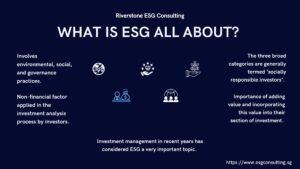
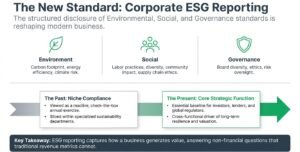
Corporate ESG reporting involves a formal process of communicating a company’s environmental, social, and governance (ESG) policies and practices to its shareholders, regulatory bodies, customers, and employees. Unlike conventional financial reporting, which measures only revenue and profit, ESG reporting measures the way in which these values are created — carbon footprint, labour practices, board diversity, etc, supply chain ethics, and risk oversight. This wider perspective is now more important, as investors are increasingly considering non-financial factors during valuation and lending processes, and regulators in parts of Asia, the UK and the EU have implemented disclosure requirements.
The first big decision that a company will make is often the type of ESG reporting framework to use, since there are different frameworks for different audiences, for different purposes. Global Reporting Initiative (GRI) is a popular structure for stakeholder-oriented sustainability reporting, and Sustainability Accounting Standards Board (SASB) standards are geared toward investors and industry-specific financial materiality. The Task Force on Climate-related Financial Disclosures (TCFD) focuses on climate risk, while the newer International Sustainability Standards Board (ISSB) seeks to harmonise the global standards. Many companies eventually find themselves mixing frameworks, or changing frameworks as regulations change.
Table 1: Common ESG Reporting Framework Options
| Framework | Primary Focus | Best Suited For |
|---|---|---|
| GRI | Broad stakeholder impact (environment, social, economic) | Companies prioritising public transparency |
| SASB | Industry-specific financial materiality | Investor-focused disclosures |
| TCFD | Climate-related financial risk | Companies with high climate exposure |
| ISSB | Unified global sustainability standards | Multinational firms seeking consistency |
What Are the Five Key Benefits of ESG Reporting for Businesses?
Understanding the benefits of ESG reporting is easier when broken into distinct, practical The advantages of ESG reporting are more easily understood when separated into specific, practical outcomes that companies experience at the point of when disclosure practices are realised.
- Easier access to capital. As more investors and lenders begin to consider the ESG performance of prospective investments, businesses that report and present their ESG performance in a transparent and credible way have a better chance of securing financing terms that are favourable.
- Improved brand reputation and trust with stakeholders. Organisations that show accountability on environmental and social issues are more likely to engage consumers and business partners and build long-term brand loyalty.
- Better risk management. By requiring companies to consider risk systematically, including what can happen if they fail to comply with regulation or encounter supply chain interruptions, ESG reporting allows companies to identify risks before they become major crises.
- Cost efficiency and efficiency. Much of the information gathering involved in ESG disclosures reveals inefficiencies within energy usage, waste management or resource allocation and can result in cost savings.
- Attracting and keeping talent. A key factor in the shift is that as a metric, sustainability is becoming part of the employment decision-making process for those who are looking for jobs, especially for younger candidates – making a strong ESG track record a recruitment advantage.
How Does the Corporate ESG Reporting Process Work in Practice?
The correct way to do ESG reporting in a company demands a structured and repeatable process—no one wants to be doing it for the first time every year. Most will start by completing a materiality assessment to determine which issues are most material for their business sector and stakeholders, and then data will be gathered in various parts of the organisation – sustainability, HR, legal and finance departments provide input. After data is consolidated, the company compares that information to the selected ESG reporting framework, prepares disclosures, and (more and more) receives third-party assurance to confirm that the information published is accurate.
The first few cycles of this process are seldom linear. Cross-functional collaboration is crucial because data from various ESG dimensions may reside in isolated systems – emissions information with facilities management, diversity information with HR, governance policies with legal, etc. Those companies that do well tend to have a specific person or committee designated to oversee ESG reporting, ensuring a consistent approach from year to year and not leaving it to one department to handle.
Table 2: The Corporate ESG Reporting Process, Step by Step
| Stage | Description |
|---|---|
| Materiality Assessment | Identify ESG issues most relevant to the business and stakeholders |
| Data Collection | Gather metrics from operations, HR, finance, and supply chain |
| Framework Alignment | Map data to the chosen ESG reporting framework |
| Drafting and Review | Prepare disclosures and validate with internal stakeholders |
| Assurance and Publication | Obtain third-party verification and release the report publicly |
What Real-World Examples Show the Benefits of ESG Reporting?
One of the best-known transformation stories in ESG reporting is the Danish energy company, Ørsted. The company began as a fossil-fuel-based utility, then shifted its focus to offshore wind and renewable energy and is now supporting the shift with a strong commitment to transparent and aggressive sustainability disclosures. Its steadfast reporting of emissions reductions and renewable capacity enabled it to restore investor confidence and demonstrated that it was a global leader in clean energy, rather than just a way to report on current practices.
Consumer goods group Unilever has also established a reputation for its long-term sustainability plans, having released detailed ESG reporting to monitor progress on targets to reduce packaging waste, supply chain labour standards, carbon targets, and more. It has been said to have gained greater credibility with analysts and NGOs, who tend to be sceptical of sustainability statements for over-optimism. The examples demonstrate how the value of ESG reporting is best realised when it is seen as an accountability tool, rather than a marketing tool.
What Challenges and Lessons Have Companies Learned from Corporate ESG Reporting?
While there are benefits to corporate ESG reporting, it also has its challenges, especially for companies at the beginning of their sustainability journey. One consistent problem is data quality, as there are many organisations without a unified information system for measuring emissions, labour information or governance information consistently across regions and business units. Then there is the possibility of greenwashing complaints wherein ‘green’ language is either exaggerated or ambiguous enough to be subject to review by regulators, news reporters or activist investors, resulting in a loss of credibility compared to no report whatsoever.
One of the biggest takeaways from more mature companies is that the sooner they invest in data infrastructure, the greater the return will be later. Companies that establish strong tracking systems as part of their strategy from the start don’t have to implement the same systems as part of an afterthought process when they have to scramble to catch up with their inconsistent reporting. Getting third-party assurance providers involved in the process even before mandatory has helped to raise stakeholder trust and identify errors before going public. Companies that view ESG reporting as a strategic discipline as opposed to a compliance afterthought are more likely to realise the benefits of ESG reporting more fully and sooner.
What Are the Benefits of ESG Reporting: Conclusion
The value of ESG reporting is growing more tangible, ranging from improved access to capital, enhanced reputation, operational efficiencies, and improved risk oversight, and is directly dependent on the ESG reporting approach taken by the organisation. To develop credibility in this area, there are three steps that all professionals should take: learn about the key frameworks, such as GRI, SASB and TCFD, and gain the ability to discuss ESG reporting framework selection in an interview or on the job; realise that the quality of the information is essential to every credible report; and learn from other company examples, both successful and unsuccessful, to understand how corporate ESG reporting drives real business results. As expectations for ESG issues keep tightening across the world, it is professionals who are already familiar with the space who will be best suited for the jobs this area keeps creating.