OJK Regulation No.51/POJK.03/2017 on Sustainable Finance
Introduction to OJK Sustainable Finance Regulation Training Indonesia
The financial sector of Indonesia is passing through a transformational stage with sustainability being a priority in the country. As the world recognises the dangers of climate change, the threat of environmental degradation, and the need to ensure social inclusion, the Indonesian government, via its financial regulator, Otoritas Jasa Keuangan (OJK), has decided to have a gradual transition of responsible finance. OJK Regulation No.51/POJK.03/2017 on Sustainable Finance is the key to this transformation, as a holistic policy incorporating the notions of sustainability into the banking and capital market, as well as the non-bank financial sectors. This rule is not merely a regulatory measure but rather a strategic plan that will steer financial institutions to sustainable development, risk resilience as well as competitiveness in the long term.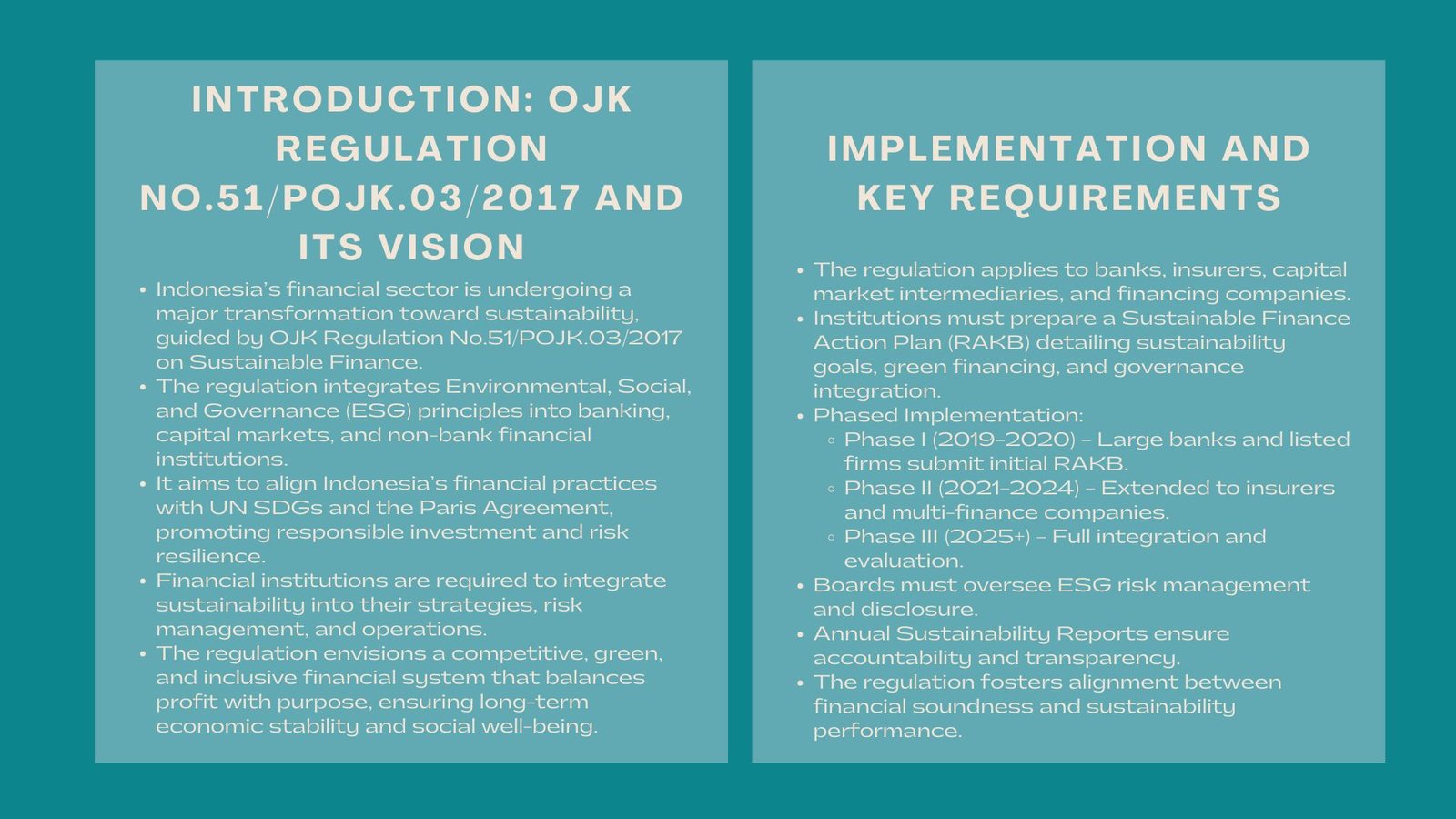
The Vision of Sustainable Finance Framework at OJK.
The regulation of OJK was the result of the increasing understanding that the financial system should be more active in terms of the environment and social issues. Indonesia being an economy that was growing fast and had a lot of exposure to climatic risks like flooding, deforestation and carbon emissions required a prospective regulation strategy that would compel banks and investors allocate their capital in a responsible manner. The OJK sustainable finance regulation and ESG compliance framework in Indonesia establishes a clear foundation for integrating environmental, social, and governance (ESG) principles into financial decision-making. It mandates financial institutions to integrate the sustainability risks in their policies, strategies and operational procedures and promote the investments in green and inclusive sectors. This regulatory change is in line with international efforts, including the UN Sustainable Development Goals (SDGs) and the Paris Agreement, in that the financial sector can and will play a key role in making Indonesia transition to sustainable economic development.Critical Aims of OJK Reg. No.51/POJK.03/2017.
The sustainable finance regulation of OJK attempts to attain a number of important goals that would strike a balance between financial development and the sustainability needs:- Incorporating ESG principles in business procedures – Financial institutions must ensure that they incorporate sustainability risks in lending, underwriting, and investment activities.
- Responsible financing – The regulation will encourage credit and investment to be made in environmentally friendly, low-carbon, socially inclusive projects.
- Improving disclosure and transparency – Institutions should also present their sustainability performance yearly and be accountable and show improvement.
- Capacity and awareness building – OJK promotes training and education so that financial professionals can be aware of sustainable finance principles.
- In line with the national sustainable development agenda – The regulation will fit the financial sector with the pledging of Indonesia in respect to climate resilience and green growth.
Applicability of the Regulation.
The OJK Regulation no.51/ POJK.03/ 2017 is applicable to a large variety of financial institutions such as:- Commercial and rural banks
- Insurance companies
- Financing companies
- Capital market intermediaries.
- Non-bank financial institutions Pension funds.
Implementation of the Regulation: A Phased Approach
The implementation of OJK Regulation No.51/POJK.03/2017 for financial institutions in Indonesia follows a phased timeline to allow institutions to adjust to the new sustainability standards.- Phase 1 (2019-2020): Massive commercial banks and publicly listed institutions had to prepare and file their initial RAKB.
- Phase II (2021-2024): The regulation was gradually integrated into the work of broader financial institutions, insurance companies and multifinance ones.
- Phase 3 (2025 and further away): Implementation and evaluation When graduation occurs in full, the integration of sustainability start being a mandatory element of the supervisory assessment.
The ESG Risk Integration and Governance.
The central point of the regulation is the need to ensure that financial institutions are integrated into their governance system in the sense that they include ESG risks. This implies that boards and top management should assume the responsibility of managing sustainability strategies, where risk management frameworks put into consideration the environment and social aspects. As an example, banks are supposed to determine the effects of loaning on the environment, the exposure to high-emitting sectors and develop mitigation measures. Likewise, underwriting risks related to climate should be considered by insurance companies, and investors are encouraged to consider long-term trends in ESG when determining their portfolio. Through integrating the ESG oversight into the governance, OJK will guarantee the establishment of the culture of accountability and future-oriented decision-making that would allow making the profitability and sustainability mutually supportive.Sustainable Finance Action Plans (RAKB): Moving towards Accountability.
One of the most innovative points of the regulation of OJK is the RAKB. It changes the sustainability as an abstract objective into a quantifiable action plan. The RAKBs need to have particular initiatives, timelines, and performance measures, which should address the following areas:- Green lending and investment objectives.
- Social inclusion programs (e.g., providing the financially underserved groups access to financial services)
- Sustainable financial product development.
- Employee and management training.
- Alliances with government/ international sustainability programs
Obstacles during Implementation.
The adoption of sustainable finance framework as developed by OJK is experiencing a number of issues:- Data and measurement gaps: Lots of institutions find it difficult to obtain quality ESG data to be able to measure impact.
- Capacity constraints: Smaller organisations are not necessarily technologically savvy to design and execute detailed sustainability plans.
- Incongruent perception of ESG risks: Although financial leaders have become more aware of ESG risks, they continue to see them as a liability and not as a business opportunity.
- Weak green investment pipelines: There are still some sectors where there are not enough bankable sustainable projects.