Why Do Most ESG Programs Fail
Understanding Why Do Most ESG Programs Fail
Environmental, Social, and Governance (ESG) initiatives are a common aspect of corporate life, and a surprising number of them seemingly fail to get off the ground after a few years. Put simply, most ESG programs are not effective: they are viewed as a communications initiative, without ownership or measurable goals or budget, and not aligned to the day-to-day business decisions that ultimately impact environmental and social factors. This article dissects the true underlying causes of ESG programs’ lackluster performance, briefly reviews key ESG compliance challenges in the early, mid-, and late stages of the program, and outlines how a more effective corporate ESG strategy—sometimes through external ESG consulting services—can transform an underperforming program into one that yields tangible outcomes. Written for early- and mid-career professionals seeking to learn more about ESG in practice, rather than in “pretty” sustainability reporting.
What Causes ESG Compliance Challenges in Corporate Programs?
It does not seem like most companies start out to fail at ESG. They have a good idea to begin with – typically, a directive from the board, a demand from an investor or a push from a large customer. The problem is when the directive is given to a small group that has no authority, resources, or technical resources to put it into practice. The first place where ESG compliance issues arise is in the reporting frameworks, data requests from various parties, and the time ESG spends chasing spreadsheets rather than doing better. When there is no dedicated owner in the business, ESG becomes an ancillary activity instead of a priority duty and is sacrificed whenever budgets get cut or priorities change.
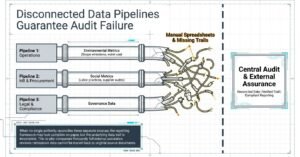
The second challenge is inconsistencies in data. Social metrics (like labour practices or supplier audits) and environmental metrics (like emissions or water use) are typically stored in different systems from operations or HR/Procurement. Typically, governance data is spread throughout legal and compliance departments. If there is no one who is accountable for reconciling these sources, then companies are likely to find that the numbers reported don’t stand up to the rigour of regulators, auditors, or rating agencies. One of the most frequent ESG compliance issues that professionals face in the early stages of their careers is the apparent on-paper fullness of the framework, but the data trail is incomplete, manually created, or simply missing.
Why Does Corporate ESG Strategy Fail Without Leadership Buy-In?
ESG initiatives must be part of the core business strategy. Senior leadership who treat ESG as a reporting requirement and not a value driver is unlikely to invest in the program to deliver on that value. Sustainability teams are typically small, pay-for-performance and ESG alignment processes are lacking, and there is no accountability for business units for their progress. The outcome is that there is a strategy in a document that is not actually implemented in the company: the procurement function still chooses the lowest price, even if this does not meet the required labour standards; the product teams still design for minimum costs, instead of circularity.
Let’s take a medium-sized manufacturing firm with a bold sustainability roadmap in place as a result of investor pressure. Let’s take a medium-sized manufacturing firm that embarked on a bold sustainability roadmap in response to investor pressure. It seemed like a good plan on paper – emissions targets, supplier codes of conduct and a diversity hiring goal. Two years later, there was still no significant progress toward any of the goals. Simple: No one executive was responsible for the results, so everyone said, “No”, it’s someone else’s job. The example shows what is often observed in various sectors: A corporate ESG strategy, if not owned by someone, does not get integrated into performance reviews and will eventually stall.
What Are the Five Key Steps to Building an ESG Program That Actually Works?
While the specifics of each industry and starting point may vary, companies that are successful with ESG implementation tend to go through a similar process. The 5 steps outlined below are the minimum program structure that most functioning programs that function have in common.
- Secure executive ownership. A named senior leader (not just a committee) with accountability for ESG outcomes and progress, who reports directly to the board.
- Carry out a materiality assessment. Don’t solve for all of them, but rather only solve for the issues that really matter to the business and its stakeholders in regard to their environmental, social, and governance issues.
- Construct an effective data infrastructure. Have all ESG data collected in a central location, where emissions, labour and governance data can be consistently tracked and audited.
- Establish clear and actionable goals with clear timelines. Instead of using a vague term such as ‘reduce our footprint’, a specific, measurable, achievable, realistic, and timely goal with a budget should be used.
- Incorporate accountability into operations. Connect ESG to departmental key performance indicators and, where feasible, executive remuneration – to drive real action, not just a report.
Any one of these steps is likely to cause a weakness, which may become apparent at some point later, typically during an audit, rating review, or a regulatory filing deadline.
How Can ESG Consulting Services Help Fix a Broken Program?
Many companies will seek out ESG consulting services in an effort to understand the issue and then to rebuild the program from scratch when there is a lack of technical skill or time on the part of internal teams. The initial phase of a good consulting engagement is done by conducting a gap analysis, which involves analyzing current policies, data systems, and reporting outputs and comparing them to the relevant frameworks like the Global Reporting Initiative (GRI) or the International Sustainability Standards Board (ISSB). Often, this process shows that this is not a lack of ambition; it’s a lack of process (no data owner, no audit trail, no consistent method of calculating KPIs such as Scope 3 emissions).
One of the things that I found useful in the real world is that a medium-sized retail store had been publishing sustainability reports for 3 years, but when they were audited by an external company, they failed because they were unable to trace back the emissions to their source documents. External ESG consulting services were engaged to revamp the data collection process, to train staff across departments, and to set up a repeatable audit trail, rather than to create a new report. The company was able to identify real energy use savings in a year based on the cleaner data. This demonstrates the importance of developing in-house capacity with support – not a one-off deliverable.
What Lessons Can Junior Professionals Learn From ESG Failures?
For those still entering the workforce, ESG failures provide a hands-on learning experience about the workings of sustainability efforts within organizations. The first is that anyone who masters technical expertise on the frameworks is not as important as anyone who can work across the departments—finance, operations, HR, and legal all have pieces of the ESG puzzle, and those who can coordinate across the departments are moving ahead faster than those who are just report writers. The second lesson is that data literacy is a new skill in ESG, and knowing how to trace back to the origin of a number, know that it is accurate, and understand a methodology is more valuable to the employer than knowing the most current ESG framework terminology.
The third lesson is “slow and steady. There are many professionals who go into the game thinking that they’ll transform their companies overnight, but most of those who manage to actually make a change are the ones who have set modest and achievable goals and are going to get the job done. It is better to have some programs that are realistically planned and carefully executed, as opposed to programs that are advertised in terms of a promise, than to establish a reputation for that. It pays off for ESG professionals—both in the performance of their programs and their career paths—to build a reputation for realistic planning and careful execution, rather than aspirational messaging.
Common ESG Compliance Challenges and Corporate ESG Strategy Fixes
| Common Challenge | Underlying Cause | Practical Fix |
|---|---|---|
| Incomplete or inconsistent emissions data | No centralized data system | Standardize collection across departments |
| ESG targets never move | No executive accountability | Assign named owner, link to KPIs |
| Reports fail external assurance | No audit trail for source data | Document methodology, retain evidence |
| Supplier ESG risks go unnoticed | No supplier due diligence process | Build a supplier code of conduct with audits |
| Program loses funding during downturns | ESG seen as cost center, not value driver | Tie ESG metrics to risk and cost savings |
Benefits and Challenges of a Strong Corporate ESG Strategy
ESG is beneficial not just for compliance but also for companies that get it right. As investors increasingly consider ESG performance when making capital allocation decisions, a credible corporate ESG strategy can reduce the cost of capital, enhance relationships with large customers with their own supply chain requirements, and boost employee retention – especially among younger workers who take ESG performance into account as a criterion when choosing an employer. But well-governed programs also bring efficiencies to the fore, and energy audits often generate cost savings; effective governance also minimises legal and reputational risks.
Meanwhile, the obstacles are very real and cannot be glossed over. Regulatory requirements are evolving rapidly by region, data gathering can be a challenge, and even more difficult for smaller companies, especially to justify the initial investment. The danger of greenwashing is also present when a company’s public statements are greater than its actions, which’s why many organizations are opting to be more conservative and specific when disclosing their practices. One of the biggest challenges facing ESG today is the need to strike the right balance between ambition and credibility, which is likely to persist as both regulators and the public are increasingly conscious of and critical of ESG.
Why Do Most ESG Programs Fail: Conclusion
The reasons the majority of ESG programs fail are not because the companies are not trying to do the right thing; they fail because they don’t recognize the effort it will take to implement them as a consistent and measurable practice. The journey will be less dramatic and more practical: real ownership, investment in reliable data infrastructure, clear goals, specific enough to be measurable, and viewing ESG compliance challenges as operational issues, not reporting burdens. It would be unwise for companies not to incorporate ESG consulting services to fill the data, methodology, and assurance readiness gaps they may have. As with any company, consistency trumps announcements for professionals looking to develop their careers in this area, and a well-drafted report that lacks the follow-through of a corporate plan on ESG will always be second to a well-done corporate ESG plan.