Bank Negara Malaysia’s Climate Change and Principle-Based Taxonomy (CCPT)
Introduction: Professional CCPT Implementation Training for Banks
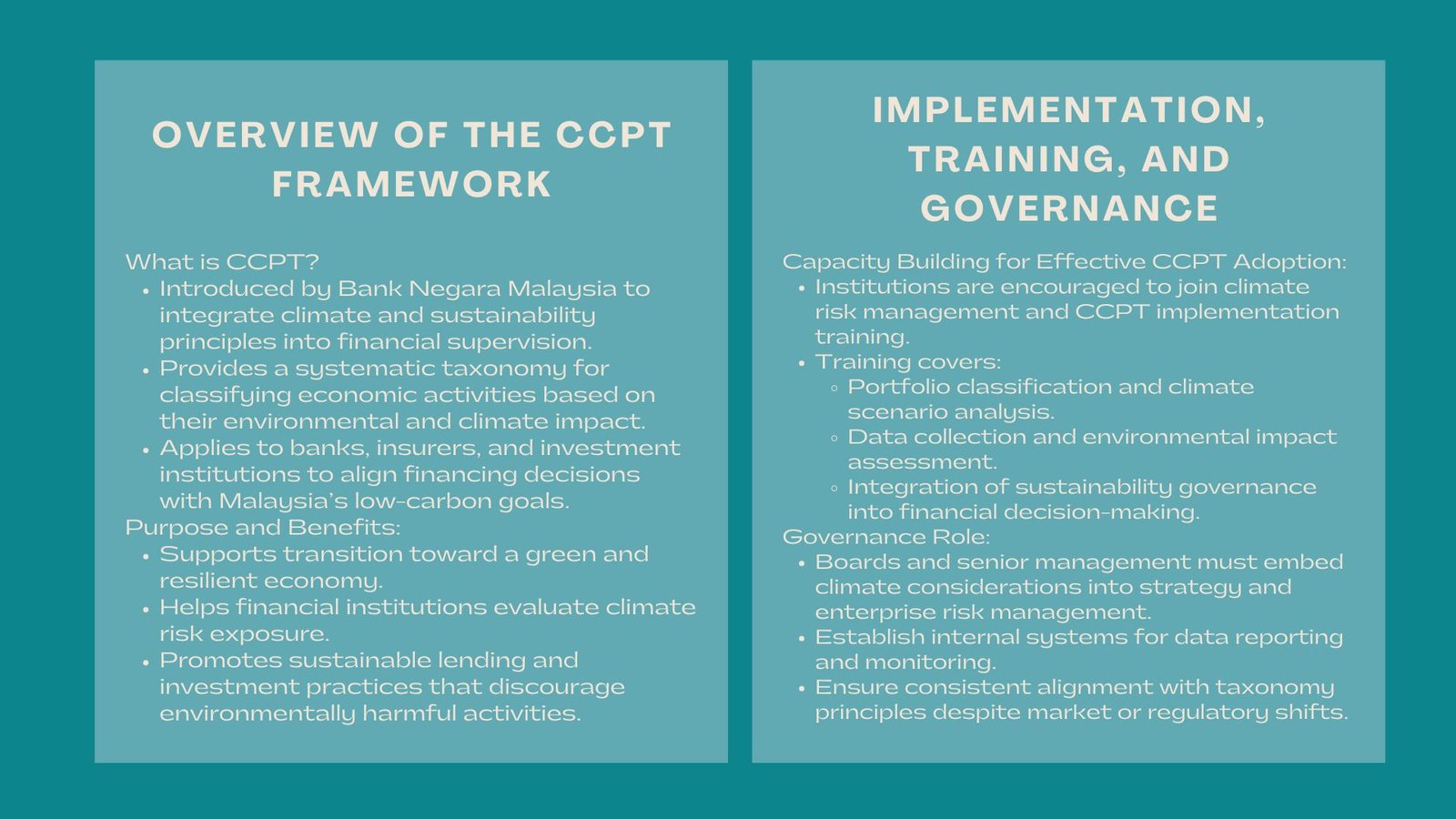
With the growing risks of climate impacts in the financial sector, financial supervision regulators are incorporating the concept of sustainability into financial supervision. The Climate Change and Principle-Based Taxonomy (CCPT) of Bank Negara Malaysia is the foundation of the alignment of financial activities and the targets of sustainable development in Malaysia. CCPT was introduced to offer a systematized method of categorizing the economic activities according to their effect on the environment and climate goals to the banks, insurers and investment institutions.
The taxonomy does not only assist financial institutions in evaluating their risk exposure to climatic hazards, but also aids the general shift of the Malaysian economy towards a low-carbon economy. CCPT promotes a financial system which rewards sustainable practices and which discourages environmental damage by incorporating environmental considerations in lending and investment decisions.
Knowledge on the Framework of CCPT.
The CCPT has five levels of economic activities, which include climate-supporting, harmful, etc. The classification of each of them relies on the contribution of the given activity to climate mitigation, climate adaptation, and sustainability in general. Financial institutions must evaluate their portfolios and calculate which areas are in line with the principles of sustainability, which will make it more visible and responsible.
The taxonomy essentially assists the banks and the investors to determine the projects or clients heading towards the environmental goals. As an example, the financing of renewable energy or sustainable agriculture would be in the category of supporting whereas funding of the areas with high emissions without transition plans would be in the category of harmful.
This systematic solution will enable the financial ecosystem in Malaysia to be more consistent in the allocation of capital as a priority to the environmental concerns of the country, and thus, diminish the exposure to climate risk and enable a green economy.
The Capacity Building is required to implement it effectively.
In most cases, the taxonomy is complex and requires expert knowledge to learn and utilize it in financial institutions. To address this, organizations are increasingly participating in climate risk management and ccpt implementation training for financial institutions, designed to equip risk officers, sustainability teams, and compliance professionals with the skills to operationalize CCPT effectively.
Such programs generally include practical uses like climate scenario analysis, portfolio classification and data collection methods. The participants are made aware of how to recognize environmentally-sustainable activities, match with the internal risk structures, and come up with transition plans of clients in high-emission industries.
Training also focuses on governance patterns – making sure senior management and boards know their place in making climate aligned financing decisions. Institutions can overcome the challenge between regulatory compliance and strategic sustainability integration through a structured learning process and practical workshops.
Inclusion of CCPT to Sustainable Finance Strategies.
Enhancing the integration of climate considerations in all the financial decision-making processes is one of the most significant goals of CCPT. It involves the inclusion of environmental analyses in credit granting, investment analysis and insurance analysis.
With the adoption of the taxonomy, the financial institutions can better operate in the years of the long-term climate risks, and identify new opportunities in green and transition financing. The taxonomy also promotes harmonized reporting and disclosure, which makes regulators and investors aware of the contribution of institutions towards climate objectives.
Through bank negara malaysia principle-based taxonomy workshop for sustainable finance teams, financial institutions gain practical insights into embedding taxonomy principles into their sustainability frameworks. Such workshops offer practical case studies, which allow teams to offer conceptual ideas on regulation into operational processes leading to quantifiable environmental results.
The Risk Management and Governance Role.
Governance is a major success factor in the implementation of CCPT. The financial institutions are supposed to create a clear role and responsibility of managing the climate related risks. This involves the incorporation of CCPT tests within the enterprise risk management systems and that sustainability goals are put into strategic consideration.
Moreover, the financial institutions need to come up with internal policies and systems of data management, which facilitate proper classification and reporting. Also, this is achieved through constant observation so that the activities are still on track with the taxonomy despite changes in market conditions and regulations
Financial Sector Opportunities.
Implementation of CCPT has massive innovation and expansion possibilities. Those financial institutions able to successfully incorporate the taxonomy are able to establish a competitive advantage by providing green financing products, attracting sustainability-minded investors, and improve their reputation as responsible lenders.
The framework further encourages the cooperation between the financial ecosystem. Banks, regulators and corporations can collaborate to align methodology on the issue of environmental assessment, best practices and scale up climate aligned investment flows. In the long term, it will promote Malaysia as a sustainable financial powerhouse in the ASEAN.
The Problems of CCPT Implementation.
In spite of its advantages, the implementation of CCPT does not go without any challenges. Most organizations have a challenge accessing reliable environmental information among clients especially the small and medium size enterprises. It is also necessary to establish more clarity on measures and procedures of classifying transition activities.
In order to address these challenges, there is a need to join hands between regulators, financial associations and the private sector. Data-sharing platforms and standardized reporting templates will be among the keys to having consistent and transparent CCPT adoption.
Conclusion
The Climate Change and Principle-Based Taxonomy (CCPT) of the Bank Negara Malaysia is a radical move towards the implementation of sustainability into the financial system of Malaysian. With the help of climate risk management and implementing training on financial institutions and taking part in a bank negara malaysia principle-based taxonomy workshop on sustainable finance, organizations can enhance their ability to manage climate risks and take responsibility in new opportunities in sustainable finance.
Under the ongoing transformation of the Malaysian economy towards a low-carbon economy, CCPT can act as a guide as well as a catalyst to achieve a resilient, sustainable, and inclusive future; to make sure that the financial flows are credited with the future.