ESG Rating Agencies Explained: Meaning, Overview, Key Players, and the Singapore Landscape
Introduction to Master ESG Rating Agencies Explained
The modern investment, risk management, and corporate strategy have been driven by environmental, Social, and Governance considerations. With sustainability leaving its voluntary reporting phase and becoming a regulatory requirement, ESG rating agencies have become highly important in evaluating how businesses operate their non-financial risks and value creation over the long term. To investors, regulators, and corporations alike, it is more important to know what is meant by ESG rating agencies, their methodology, and their applicability in the local markets like Singapore.
This article presents a well-defined and professional discussion of the overview of ESG rating agencies, the definition of ESG rating agencies, which are the most popular in the world, and the role of ESG rating agencies Singapore in the Asian sustainable finance ecosystem.
Understanding ESG Rating Agencies Meaning
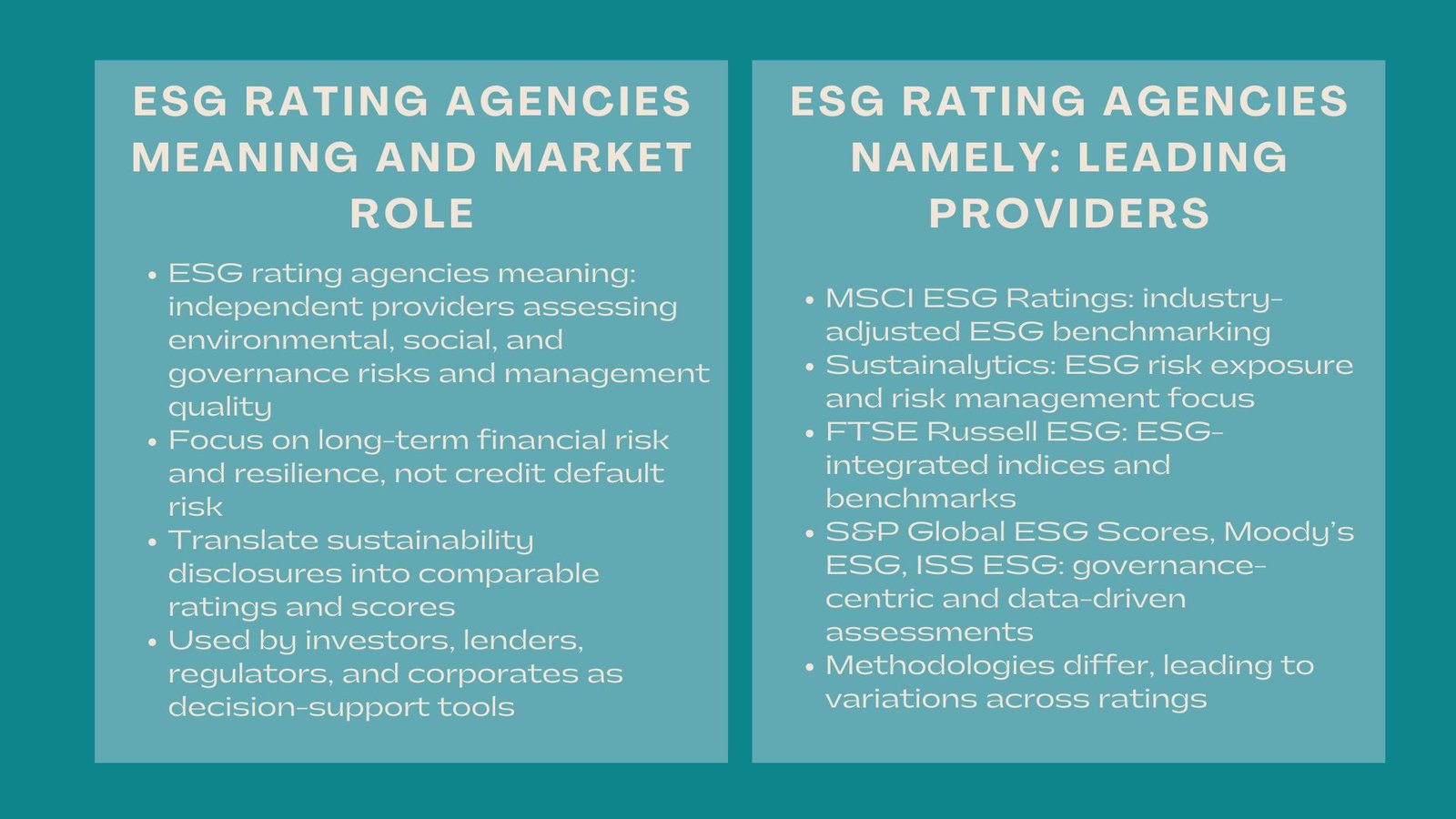
ESG rating agencies also denote specialized agencies that do assess companies on the basis of their environmental effects, social responsibility and corporate governance. The meaning of the ESG rating agencies is not merely scoring, these agencies are evaluating the effectiveness with which a business entity identifies, controls, and reports sustainability-based risks and opportunities that will potentially impact the long-term financial performance of the business entity.
In contrast to credit rating agencies, ESG rating agencies do not concentrate only on the default risk. Rather, they examine exposure to climatic change, work ethics, supply chain ethics, board independence, regulatory compliance, and transparency. Institutional investors, asset managers, lenders and, more and more, regulators use their outputs in their investment decisions, portfolio constructions and engagement strategies.
ESG Rating Agencies Overview and Their Market Role
The impact of an effective ESG rating agencies overview is that the agencies can be seen as bridges between corporate sustainability information and capital markets. Sustainability reports, annual reports and regulatory filings are one of the ways in which companies disclose information regarding ESG. This information is collected, standardized and analyzed by ESG rating agencies to generate ratings, scores, or rankings.
These ratings enable investors to compare companies in industries and geographic markets, uncover ESG risks, and set portfolios in accordance with responsible investment requirements. It should be noted, though, that ESG ratings are subjective ratings. Providers greatly differ on methodologies and this results in variation in scores of the same company. Because of this, ESG ratings should be regarded as decision-supporting tools but not some judgment.
ESG Rating Agencies Namely: Key Global Providers
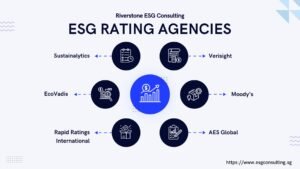
In reference to ESG rating agencies particularly, investors and regulators always refer to some global providers. MSCI ESG Ratings is popular in institution investor screening and benchmarking and provides industry adjusted ESG ratings. Sustainalytics specializes in the exposure and management of ESG risks, and the company offers risk-based ratings that are especially useful in the case of asset managers and lenders.
FTSE Russell ESG Ratings is a leader in passive investment strategies as it incorporates the ESG elements in the index construction and benchmarking. Based on the Corporate Sustainability Assessment, S&P Global ESG Scores are commonly used to compare performance and to include the indexes. The ESG Solutions by Moody and ISS ESG also have significant roles since they integrate the analysis of governance with a wider range of sustainability information.
All these ESG rating agencies have different methodologies, weighting mechanisms, and data sources. These differences are important to comprehend ESG scores properly and not to be dependent on a particular rating authority.
ESG Rating Agencies Singapore and the Regional Context
The contribution of the ESG rating agencies Singapore needs to be interpreted in the framework of the city-state being a major sustainable finance centre in Asia. Singapore has also been proactive in encouraging ESG integration via regulatory efforts, taxonomy and disclosure models that are either international, including TCFD and ISSB.
Although it is home to several global ESG rating agencies or those that are involved in Singapore-listed firms, regional research providers and data firms with great knowledge in Asia-Pacific are also present in the market. These providers provide regional intelligence on the regulatory compliance, supply chain risks, as well as governance practices that are specific to Southeast Asia.
In the case of companies operating in or out of Singapore, interaction with the ESG rating agencies is becoming strategic. Good ESG ratings may facilitate access to sustainable finance instruments, enhance investor perception and comply with SGX sustainability reporting provisions. This has led to the ESG rating agencies Singapore becoming a part and parcel of the capital market participation and not optional assessors.
How ESG Ratings Are Used by Investors and Companies
Regarding the investor point of view, ESG ratings assist with screening of a portfolio, risk management and regulatory compliance. ESG rating helps asset managers to fulfill responsible investment requirements, disclosure policies and show stewardship to clients. Banks and lenders include ESG analysis as a part of credit analysis and sustainable lending systems.
To businesses, ESG ratings have an impact on reputation, cost of capital, and investor participation. Several companies closely track their ESG ratings and talk to rating agencies to explain disclosures, address information gaps, as well as enhance transparency. Such interaction is an indication of the increased awareness that ESG ratings are not fixed ratings but dynamic ratings that are dependent on governance practices and the quality of disclosure.
Limitations and Challenges of ESG Rating Agencies
There should also be a balanced ESG rating agencies overview that recognizes their shortcomings. Poor correlation between ratings by different providers is usually caused by differences in methodologies, poor consistency of data quality and variance in the materiality assumptions. This presents a problem to those investors that would like to have standardized benchmarks and the companies that have been subjected to divergent assessment.
Moreover, ESG ratings are usually concerned with risk management as compared to real-life impact. The high ESG score does not imply positive environmental or social results but the successful management of the ESG-related risks. This difference is the key to comprehending the meaning of ESG rating agencies in practice.
Future Direction of ESG Rating Agencies
With the transformation of sustainability regulation, the ESG rating agencies will be more likely to facilitate standardized disclosures and regulatory reporting. An improved comparability and credibility will probably be achieved by making their methods more aligned with global sustainability requirements and more transparent.
The further evolution of the regulation and market need of sustainable finance in Singapore implies that ESG rating agencies Singapore will increase in scale. The necessity to incorporate the ESG ratings into the strategic decision-making process, governance structure, and capital allocation schemes will grow among the companies and investors working in the region.
Conclusion
It is important to understand the meaning of ESG rating agencies and how they are practically applied in the current financial world that is fuelled by sustainability. The overview of comprehensive ESG rating agencies demonstrates that these entities are one of the key interpreters of ESG data, which defines the way investors evaluate risk and the way companies establish their position in the capital markets. Stakeholders can apply ESG ratings in a more effective and responsible way by realizing the fact that the ESG rating agencies are most popular in the world by the leaders as well as by valuing the fact that the ESG rating agencies have become increasingly important in Singapore.
Finally, the ESG rating agencies are not the judges of the sustainability success, but the participants of the conversation of long-term value creation and responsible business conduct between corporations and investors, as well as regulators.