ESG vs Sustainability Reporting: What’s Different?
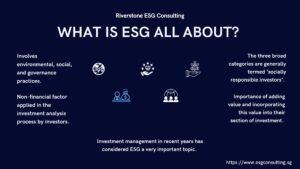
Including environmental, social and governance (ESG) considerations in business decisions is becoming more critical, and businesses are being pressured to disclose non-financial information to investors, regulators, customers and employees. The concept of ESG reporting and sustainability reporting are used interchangeably. They both have similar objectives but are not the same. To ensure transparency, compliance, and long-term value creation, it is crucial to understand the difference, especially for companies looking to do the right thing.Companies that want to do the right thing need to understand the difference, as it is vital for transparency, compliance, and value creation in the long-term. Understanding the differences between these reporting methods can help develop expertise and inform organizational reporting strategies for professionals entering the ESG field, finance teams and compliance officers, and job-seekers looking into sustainability careers.
Undertanding ESG vs Sustainability Reporting: What’s Different?
ESG reporting’s key objective is to identify and report on environmental, social and governance elements that can impact the results, risk management and investment decisions of any business. Sustainability reporting can have a wider scope than already mentioned, as it includes an organization’s overall impact on society, the environment and the sustainable development goals.
ESG reporting typically focuses on the metrics that investors rely to assess risk and financial performance, whilst sustainability reporting conveys a company’s overall social and environmental impact. In reality, there are a number of organizations that adopt a mix of the two approaches with the help of well-known ESG reporting guidelines and a framework for sustainability reporting that guides them to satisfy stakeholder expectations.
Key Takeaways
- ESG reporting is primarily investor-focused and risk-oriented.
- Sustainability reporting addresses broader stakeholder concerns.
- Both approaches require reliable data collection and governance processes.
- Regulatory requirements are increasingly driving ESG disclosures.
- Organizations often integrate sustainability and ESG reporting into one reporting strategy.
- Strong reporting improves transparency, reputation, and access to capital.
- Professional support from ESG reporting consulting services can accelerate implementation and compliance.
Why Do Companies Need Both ESG and Sustainability Reporting?
Organizations run in a context with increased stakeholder accountability demands. Investors are interested in a range of information that can have an impact on long-term investor returns, including information related to climate risks, governance practices and workforce management. The communities, customers, employees and regulators are also seeking to learn more about the role of businesses in sustainable development and answering environmental and social issues. This gives rise to the need for ESG and sustainability reporting.
The two reporting methods are complementary, but not one or the other. The ESG reports may emphasize on the measurable data that are relevant to investment decisions, whereas the sustainability reports tell a more comprehensive story about corporate responsibility and long-term impacts. Together, they enable organizations to communicate performance, control risks and show their commitment to sustainable growth. Combining both practices can foster greater trust among stakeholders and give businesses a more competitive edge in the market.
Table: ESG Reporting vs Sustainability Reporting
| Aspect | ESG Reporting | Sustainability Reporting |
| Primary Audience | Investors, lenders, regulators | Employees, communities, customers, regulators |
| Main Purpose | Risk and performance assessment | Impact and sustainability communication |
| Focus Areas | Environmental, social, governance metrics | Economic, environmental, and social impacts |
| Reporting Style | Quantitative and metrics-driven | Quantitative and qualitative |
| Business Objective | Investment and risk evaluation | Long-term sustainability strategy |
How Do ESG Reporting Standards Influence Corporate Disclosures?
Consistency and comparability are essential and reporting frameworks and standards are important to ensure these. Standardized ESG metrics are used by investors to make industry and region comparisons. With the growing regulatory demands, companies are turning to the widely accepted reporting frameworks for ESG disclosure, in order to boost transparency and meet the information needs of investors, customers and other stakeholders. Standardized reporting adds clarity and enables reliable information to be presented.
Frequently, several frameworks are implemented at the same time at a company because various stakeholders need different information. The climate team may have a finance team or a sustainability team may have a focus on environmental and social impacts. The challenge is getting these needs in one reporting process. Having a clear governance model and data management system will give organizations a better opportunity to serve the increasingly complex reporting needs and ensure compliance to various jurisdictions.
What Does a Sustainability Reporting Process Look Like?
The process of sustainability reporting usually starts with finding the material topics, which are the most important topics for the organisation and its stakeholders. Firms evaluate environmental, employee, corporate governance, community and supply chain factors. The assessment enables identification of what information should be made public and what performance indicators should be consistently measured over time.
Once material issues are identified, the organisation gathers information, checks, validates information, prepares disclosure and secures internal authorisation for publication. A number of companies are adopting a formal sustainability reporting framework guide for reporting activities and to ensure alignment with the expectations of stakeholders. It can sometimes require the involvement of teams from finance, operations, human resources, legal, risk management and sustainability. Coordinating is critical as data on ESG and sustainability often comes from different departments within the company.
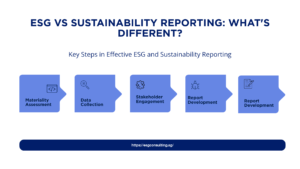
Five Key Steps in an Effective Reporting Process
| Key Step | Purpose |
| Materiality Assessment | Identify the most important ESG and sustainability topics |
| Data Collection | Gather reliable metrics and supporting information |
| Stakeholder Engagement | Understand expectations and reporting priorities |
| Report Development | Prepare disclosures and performance narratives |
| Continuous Improvement | Enhance reporting quality year after year |
What Challenges Do Organizations Face When Implementing ESG Reporting?
Data quality is one of the most common issues that is faced. ESG information is generally not reported in the same manner as financial reporting, and is typically provided from a variety of systems and departments, with each using different methodologies to measure ESG. Completeness of records, the ability to perform the calculations, and the lack of historical data are often a problem for organizations. These can undermine stakeholder confidence, and make it difficult to benchmark.
The other difficulty is being able to keep up with the evolution of regulations and stakeholder expectations. Reporting requirements are still developing as governments and standard-setting bodies keep introducing new requirements for reporting. It is important for companies to invest in technology, employee training and governance structures to ensure they stay compliant. To overcome these challenges, many organisations take the help of ESG reporting consulting services to create reporting systems, enhance data management activities and create reporting strategies aligned with the business goals.
What Can Businesses Learn from Real-World ESG and Sustainability Reporting Examples?
A practical example would be a multinational company that has set a goal of decreasing its carbon footprint across the supply chain in the field of consumer goods. Initially, the organisation concentrated on sustainability reporting, and made its environmental impact data and progress towards emission reduction targets public. Investors however, demanded more detail about the risks arising from climate change and the governance framework. This led the company to broaden its disclosures to incorporate ESG metrics that were directly linked to the financial performance and risk management.
An example in the energy industry is the possibility of creating a related industry. A stakeholder raised concerns about environmental impacts and operational safety in a large energy producer, which led to the implementation of an in-depth reporting program to solve these concerns. The company has introduced recognized ESG reporting standards, and has incorporated an in-depth sustainability reporting framework guide into its annual reporting cycle. Through the years, increased transparency further fostered confidence among investors, improved stakeholder communication and allowed the organization to pinpoint ways to be way more efficient and cut costs and environmental impacts at the same time.
Lessons Learned from Real Cases
| Lesson | Impact |
| Strong governance improves reporting quality | Better accountability and oversight |
| Reliable data systems reduce reporting errors | Increased stakeholder confidence |
| Stakeholder engagement improves relevance | More meaningful disclosures |
| Continuous monitoring supports compliance | Reduced regulatory risks |
| Integration across departments improves efficiency | Stronger reporting outcomes |
Benefits and Challenges of ESG and Sustainability Reporting
Reporting benefits aren’t limited to regulatory compliance. Effective reporting can lead to an increased availability of investment funds, better reputation, customer loyalty, and better operational transparency in organizations that report well. Reporting can also be used to highlight inefficiencies, emerging risks, and to aid strategic decision-making. Reporting programs are an effective way to show the value of responsible business activity to employees and job seekers and can make the employer more attractive.
While these are the advantages, there are a number of challenges to implementing them. Even data collection is labor-intensive, especially for companies that have a complex operation or have a global supply chain. Reporting teams face a host of stakeholder expectations, evolving laws and regulations, and constrained internal resources. It can also be challenging to ensure uniformity of reporting within the same reporting period. Leadership commitment, cross-functional cooperation and a structured reporting strategy with an appropriate technology and expertise are necessary for success.
ESG vs Sustainability Reporting: What’s Different? – Conclusion
Knowing about the difference between ESG reporting and sustainability reporting is becoming more significant than ever for business and professionals. ESG reporting is about investor-relevant risks and performance indicators, while sustainability reporting is about the bigger picture of environmental, social and economic impacts. Their goals are different, but they are best combined into a single reporting program.
Companies that practice established ESG reporting guidelines, abide by a structured sustainability reporting framework, and use ESG reporting consulting when needed are more likely to meet the expectations and requirements of stakeholders. Having an understanding of the ESG and sustainability reporting landscape can present career opportunities for professionals looking to build their careers in sustainability, finance, risk management, and corporate governance, among other arenas, in a rapidly changing business landscape. The best way to do this is to develop hands-on experience with reporting frameworks, data management processes and interactions with stakeholders that facilitate clear and meaningful reporting.