ESG Data Systems for Accurate Reporting
A Practical Guide for Sustainability and Finance Professionals
Introduction to ESG Data Systems for Accurate Reporting
ESG reporting has moved from a “nice to do” to a “must do”. Now more than ever, stakeholders – investors, regulators, customers and employees – want to see reliable, standardised, and verifiable ESG information. The key to doing that is one simple skill: effective ESG data systems for sustainable reporting. Without these, no matter how good your sustainability strategy is, your data will be questionable, making it difficult to communicate to stakeholders.
For entry- and mid-level professionals working in ESG – be it in corporate sustainability management, finance, audit, or operations – having a grasp on data collection, verification, and reporting processes is a critical skill. It’s not sufficient to understand what to measure; you must understand how to get those measurements right. This piece explains how companies can build their ESG data collection, validation, and reporting practices to enable accurate and useful reporting.
The game is getting serious. Thousands of companies are now required to have third-party assurance on their sustainability data under the European Union’s Corporate Sustainability Reporting Directive (CSRD). And the International Sustainability Standards Board (ISSB) has released the first set of global standards that are being taken up in Asia, the Americas, and beyond. This means that knowledge of how to design ESG data management systems for reporting purposes is no longer specialised – it is essential.
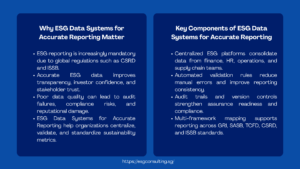
Why ESG Data Systems for Accurate Reporting Depend on High-Quality ESG Data
The authenticity of an ESG report is dependent on the data. The best sustainability narrative based on inaccurate and incomplete data will fail external assurance, regulatory audits, and the eyes of a savvy investor. We are talking about quality data – it is accurate, complete, consistent, traceable, and timely. These are all aspects of data quality that must be controlled.
Consider this example of a Dutch-based multinational consumer goods firm. In the first year of carbon reporting, the sustainability team found that data on the energy use of its Asian manufacturing plants was manually gathered by plant managers on monthly spreadsheets. Data reports were delayed by as much as three months, inconsistent unit conversions were used, and they couldn’t be traced. It led to a reported Scope 1 and 2 emissions figure that external auditors deemed materially uncertain, delaying the company’s annual report and harming its score with one of the largest ESG data companies.
It’s a common enough occurrence. The takeout here is that there’s no narrative cover-up to fix structural problems with data collection. Those organisations that take the time to design data quality assurance strategies up front (automated data validation, data owners, data collection schedules) find the reporting process quicker and more credible each year. Those that don’t are likely to be faced with expensive remediation tasks each year.
Core Architecture of ESG Data Systems for Accurate Reporting and Compliance
An ESG data system is not “a system”. It’s an architecture – a system of technology, processes, people, and governance that enables raw data from the business to be “transposed” to disclosure. It’s important to consider this architecture if you’re working to establish ESG data management systems for reporting in your organisation.
Typically, at the centre of these systems is a data platform – which is either a stand-alone ESG software platform (such as Workiva, Persefoni, Sphera, or Watershed) or a purpose-built module of an existing enterprise resource planning (ERP) software system (such as SAP or Oracle). These systems provide a single repository of ESG data, in contrast to the myriad spreadsheets still widely used in many smaller companies. They support data imports from other systems, in-built calculation rules (such as emission factors for greenhouse gas emissions), workflows for data approvals, and pre-configured report templates for various frameworks (such as GRI, TCFD, SASB, and CDP).
But it’s not enough to have the technology. They have robust data governance – policy definitions for each metric, data stewards in each business function, and data review sign-offs prior to locking data for reporting. An example is in financial accounting: every line item on an income statement has an associated accounting policy and a preparer – and so should every ESG metric. The process flow table below shows an example of the data collection and validation process.
Table 1: ESG Data Systems for Accurate Reporting – Data Collection and Validation Process Flow
| Step | Activity | Owner | Output |
| 1. Identify | Outline the scope of data: GHG emissions, water, energy, and social measures. | Sustainability Team | Data inventory list |
| 2. Collect | Collect raw information of operations, HR, finance, and supply chain. | Department Leads | Raw data files |
| 3. Validate | Compare source documents and thresholds to cross-check data. | ESG Analyst | Validated dataset |
| 4. Aggregate | Unify information between subsidiaries and business units. | Data Systems Team | Aggregated report data |
| 5. Report | Disclose in accordance with GRI, TCFD, SASB, or CSRD. | Head of Sustainability | Final ESG Report |
Five Steps to Implement ESG Data Systems for Accurate Reporting Successfully
ESG data system development or upgrades are a project that needs to be carefully sequenced. Many companies that jump to purchase software before they have defined their data needs often end up with costly, but not fully functional, software. These five steps offer a plan of action for implementing a system, whether starting from scratch or enhancing an existing system.
Step 1 – Map your Data. Prior to system selection, identify all the ESG metrics you report or are considering reporting, and how the data is sourced. Uncover weaknesses: estimated (rather than measured) metrics, late data, and sources without verification. This exercise will help you to define your system needs better than anything else.
Step 2 – Governance is First. Have a data owner for each metric category. In a manufacturing firm, energy data could be the responsibility of the facilities manager, employee turnover of HR waste operations. Without this, even with the right software, you’ll have poor-quality data in the system. Create an ESG Data Dictionary to define the data, how to collect it, and how to ensure quality control.
Step 3 – Choose the right tool. Consider your framework requirements, number of data points, supplier data collection and IT systems. Don’t choose a platform just because you have heard of it or it’s the cheapest. Trials should be done with data from two or three of your most challenging business units. Be especially interested in the platform’s capabilities for mapping to multiple frameworks, as most organisations report to multiple standards.
Step 4 – Connect Data Feeds. Typing in data is the number one source of ESG reporting errors. If at all possible, integrate ESG software with the underlying systems – electricity & gas billing systems, human resources information systems, enterprise resource planning (ERP) systems, procurement expenditure software, and utility management systems. This will eliminate delays, the need for manual data entry, and provide a strong audit trail.
Tip 5 – Design for Assurance. Build the system as if all data will be scrutinised by an auditor. That is, documenting how figures were calculated, leaving the raw source data as it is, documenting changes made to reported data or figures, and ensuring internal sign-offs are complete prior to publishing data. Companies that establish these processes early in the design phase are less affected by the assurance process.
Table 2: ESG Data Systems for Accurate Reporting – Implementation Roadmap
| Phase | Timeline | Key Actions | Milestone |
| Foundation | Months 1–2 | Identify current data, chart sources, and establish KPIs. | Data map approved |
| Selection | Months 3–4 | Test ESG platforms, pilot, and test integration needs. | Platform selected |
| Integration | Months 5–7 | Relate ERP, HR, and energy systems; set up data flows. | Active live data feeds. |
| Training | Month 8 | Own data on trains, run tests, and clean up. | Staff certified |
| Go-Live | Month 9+ | Publicate initial certified ESG report, plan audits. | Report published |
Common Challenges When Building ESG Data Systems for Accurate Reporting
Even with sufficient resources, organisations face many challenges in implementing ESG data systems to report sustainability data accurately. Awareness of these issues – and how other companies have overcome them – can help professionals deal with issues before they arise.
The most commonly reported issue is the reporting of Scope 3 emissions – indirect emissions across a business’s value chain – such as the goods and services purchased, business travel, and the use of products sold. One European retail group was embarking on its first full Scope 3 inventory when it realised that more than 60 percent of its data was held by suppliers who did not have standardised reporting procedures. The company overcame this issue by establishing a supplier engagement portal (an online platform that facilitated a step-by-step data submission process for suppliers) and providing smaller suppliers with emissions factor databases (data sets of emissions factors needed for calculations). After two reporting cycles, the company was able to produce accurate data, and this proved successful when they undertook a third-party limited assurance review.
Another typical problem is pushback from data governance initiatives. After a medium-sized Canadian financial services company provided data submission deadlines and a new ESG platform, some divisions initially considered the exercise a compliance exercise and felt it increased their reporting burden. The sustainability team managed to overcome this by reframing the exercise: instead of ESG data collection being seen as a compliance exercise, it was tied to the performance scorecard of each business unit, and managers were shown how good data could help them report to group heads. This resulted in a much greater engagement of data owners as they saw a direct link between their actions and business outcomes.
The table below outlines the typical data management challenges faced in implementing ESG reporting, and some solutions that work across different sectors. .
Table 3: ESG Data Systems for Accurate Reporting – Common Challenges and Solutions
| Challenge | Impact on Reporting | Recommended Solution |
| Isolated interdepartmental data. | Inaccurate numbers and errors in hand reconciliation. | Centralise using a central ESG platform. |
| Absence of ownership of data. | Late submissions, lack of responsibility. | Have ESG data custodians at each business unit. |
| No audit trail | Problems in defending figures to auditors. | Allow versioning and logging of changes. |
| Supplier data gaps | Unfinished Scope 3 emissions and social information. | Utilize Data templates in supplier portals. |
| Changing frameworks | Re-do all reporting periods. | Select platforms that have multi-framework mapping. |
How to Choose the Best ESG Data Systems for Accurate Reporting and Corporate Compliance
ESG systems have become a big business, and those in the market for a new system can be overwhelmed by the choices. When selecting the best ESG data system for accurate corporate reporting, it is important to consider not the features and functions of the system but the fit: will this system work for our organisation and will it support the reporting requirements of our stakeholders?
There are a number of attributes that make a system better than others. First, multi-entity consolidation: essential for firms with subsidiaries, joint ventures, and/or multiple locations around the country. Manual consolidation should not be necessary – that defeats the purpose of automation. Second, robust version control and audit trails: a history of every piece of data should be maintained, specifying who entered it, when it was changed, and from what. Third, mapping to frameworks: as standards and regulations develop (ISSB standards, CSRD, and national standards are all in development at the same time), the system should be flexible and adapt to new reporting requirements without being replaced.
Finally, technology isn’t a panacea, and is not always the solution for everyone, all of the time. An organisation starting out in the world of ESG reporting – such as a listed mid-cap organisation that just released its first ESG report – may benefit more from investing in governance and process design first, before embarking on enterprise software. Effectively designed spreadsheet processes with appropriate controls can generate audit-ready data, as long as the company outgrows these before they become too unwieldy. The trick is to build for the future: organise your processes so that it will be an upgrade in the future to move to a platform or software solution.
Table 4: ESG Reporting Frameworks Supported by ESG Data Systems for Accurate Reporting
| Framework | Primary Focus | Key Data Required | Common Users |
| GRI Standards | Extensive stakeholder disclosure of ESG. | Power, pollution, work, politics. | Listed & large firms |
| TCFD | Climate-related financial risk | Physical and transition risk data, scenario data. | Financial sector |
| SASB | Industry-specific material sustainability | Sector-tailored operational metrics | US-listed companies |
| CSRD (EU) | EU sustainability reporting (compulsory). | Full value chain, double materiality. | EU & EU-exposed firms |
| CDP | Disclosure to investors of the environment. | Data on GHG, forest risk, and water. | Investor-facing companies |
Conclusion: Building ESG Data Systems for Accurate Reporting That Drive Better Decisions
With increasing calls for trusted and assured sustainability disclosures, ESG data systems for reliable sustainability reporting are no longer just “nice to have” – they are essential. ESG data systems are essential for everyone in the field, whether you are a sustainability analyst, finance professional, or just starting your career: having a basic understanding of how this data flows from collection to disclosure will help you be more effective in your job.
The best thing you can put in place today is a mapping of the data that supports your organisation’s existing reporting. Identify its source, ownership, validation, and the likelihood of it standing up to an external audit. This exercise (which is free of charge) will tell you more about how ready you are for data management than a product showcase. It will also identify the areas that need to be fixed.
When assessing or arguing for a budget to invest in ESG data management systems for reporting, focus on the business risks and efficiencies rather than compliance. High risk from inaccurate ESG data includes fines, reputational risk, and mispricing of capital. By contrast, good data that can be audited informs better internal decision-making, quicker compliance, and improved relationships with the growing number of investors and customers who care about ESG.
Finally, keep in mind that the best ESG data technology for accurate corporate reporting is that which is properly used, not necessarily that with the greatest functionality. Technology facilitates good reporting; it doesn’t substitute for human judgment, processes, and organisational will that are needed to produce good sustainability reports. Experts with both the technological and human understanding of the importance of ESG data management will be some of the most valuable to their organisations of the future.