ESG Strategy in the Automotive Sector: Building a Competitive, Compliant, and Future-Ready Industry
Introduction to Certified ESG Strategy Automotive Training
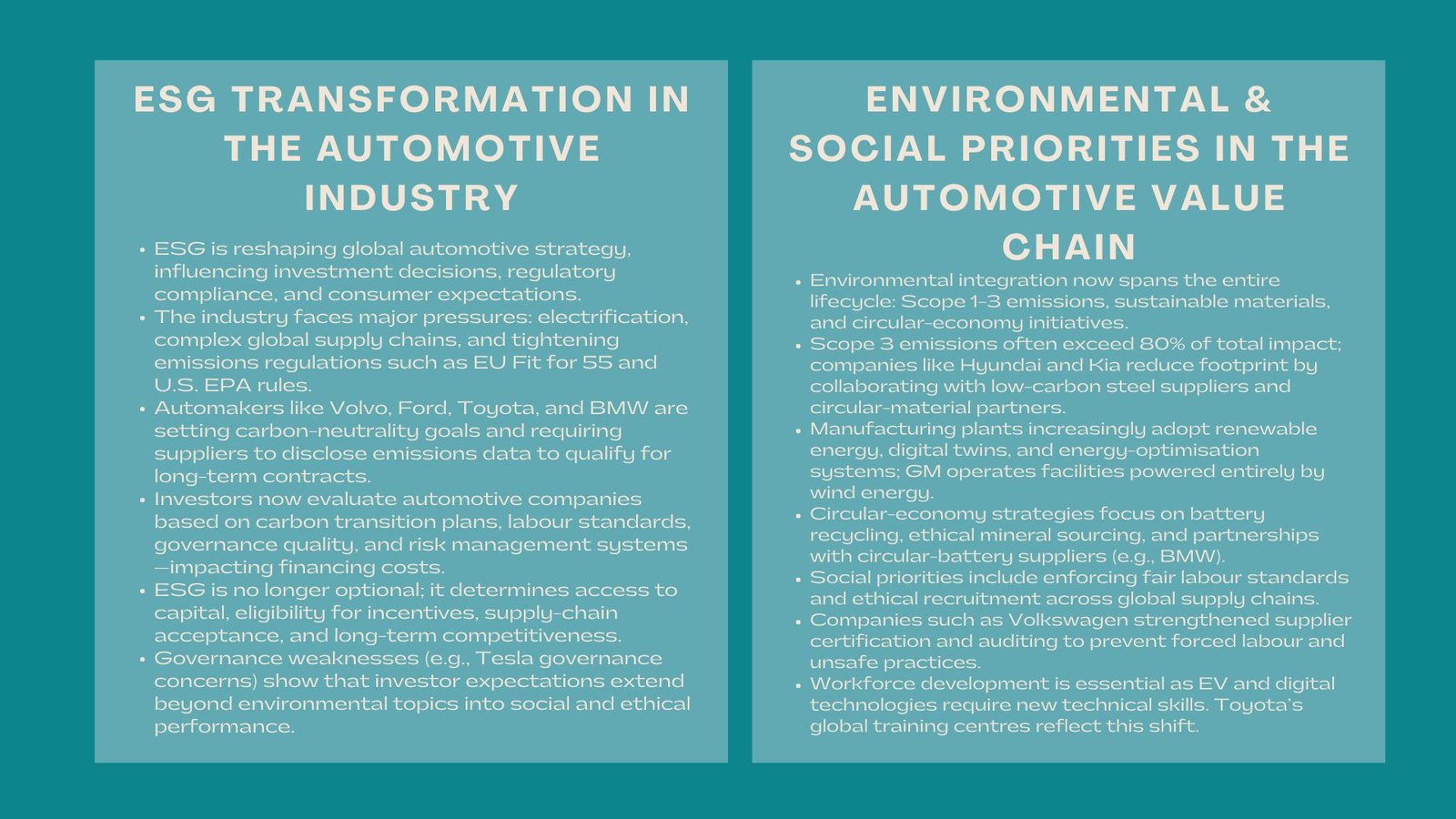
Environmental, Social and Governance (ESG) is transforming the world automotive industry, changing investment choices, regulatory demands and consumer patterns. With the auto industry facing a shrinking supernumerary constraint, accelerating electrification, and intricate world supply chains, ESG execution has become a key determinant in rivalry and long-term value co-creation.
In this broader change, strategic formulation of ESG capacity within the automotive operation has become a very important issue. The industry has particular challenges in terms of reporting, compliance and risk management because it has carbon-intensive production processes, has a large supplier base, and dynamically changing product technologies. Knowing how to incorporate ESG into manufacturing, procurement, and lifecycle management has become a necessity to continue growing and addressing the expectations of the stakeholders.
1. The Strategic Change to the ESG-led Operations.
1.1 Regulatory Intensities and Industry Revolution.
The automotive firms in the current world are experiencing a growing environment policy of both environmental emissions, resource efficiency, and lifecycle impacts. The Fit for 55 by the EU, the U.S. EPA emissions rules, and the emerging need of Asia to increase carbon reporting all put pressure on manufacturers to clean up and become more transparent in their operations. Firms like Volvo and Ford already set carbon neutrality goals with formal reporting systems that portray how a compliance is becoming more and more intertwined with what the market expects.
These pressures mean that building an effective Automotive ESG reporting strategy is no longer optional.There is a need to obtain financing, be eligible to receive government incentives, and have visibility of supply-chain. In one example, Tier 1 suppliers collaborating with Toyota or BMW should reveal data on emissions and show advances towards decarbonisation to be included in the long-term purchasing agreements.
1.2 The Surge of Investor Expectations.
ESG performance is one of the areas where institutional investors dedicate a large amount of capital in automotive companies because it is a risk performance criterion in their portfolio strategy. Shareholders desire to know about their concerns like carbon conversion strategies, working conditions in overseas plants, and their management systems on risk management. A firm that does not have strong ESG reporting faces the risk of increased costs of financing or cannot secure financing at all.
An example of Tesla illustrates that its environmental performance is not the main focus of scrutiny by its investors, but rather governance and social matters- which demonstrates that the expectations associated with ESG extend beyond emissions or energy.
2. Integrating Environmental Priorities in the Automotive Value Chain.
2.1 Emission of vehicle lifecycle reduction.
In the case of automotive companies, tail-pipe emissions are only the most material environmental issues. Manufacturers are nowadays, more likely to consider scope 1, 2 and 3, with scope 3 frequently indicating more than 80 per cent of total influence. This consists of steel, aluminium, batteries, and plastics that are used in the manufacturing of vehicles.
Health Care Industry Companies known as Hyundai and Kia have publicly pledged to lessen emissions in their material supply chains by collaborating with tariff-carbon steel distributors and adjusting to circular-economy. These initiatives directly support ESG compliance for automotive industry regulations emerging globally.
2.2 Energy Efficiency in Manufacturing Facilities
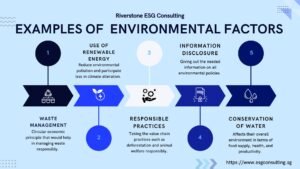
Traditionally, automotive plants are energy-consuming facilities, consuming tremendous amounts of water, electricity, and heat. The implementation of renewable energy, optimised heating systems, and smart-factory technologies contribute greatly to the minimisation of the environmental footprint and to a decrease in the cost of operations. An illustrative example of the application of wind power in a facility of General Motors is the use of wind power in the U.S. facilities; the company currently has some plants which completely use renewable energy.
Digital twins and energy-optimisation software are also installed by manufacturers to track the carbon intensity in real time. These inventions show that ESG alignment does not contradict operational efficiency and long-term sustainability.
2.3 Approaches to Circular Economy and Sustainable Materials.
The trend toward the introduction of electric vehicles (EVs) has aggravated the situation with battery materials, including cobalt and lithium. The automotive related companies are reacting by using responsible dug materials, using more recyclable materials and reducing reliance on high risk suppliers. The collaboration with circular battery suppliers is an indication of this trend that BMW implemented and emphasizes the material sourcing as a component of the wider operations ESG strategy.
3. Social Priorities Workforce, Safety, and Community Impact.
3.1 Labour Standards on Global Supply Chains
The automotive industry has a large supply structure, most of which is in the emerging markets. ESG compliance has everything to do with ensuring uniform labour standards, namely, fair pay, safe working conditions and ethical recruitment. The manufacturers can detect forced labour or unsafe subcontracting as examples of risks with the assistance of audits and digital supply-chain traceability systems.
As an example, Volkswagen has enhanced its supplier certification program, demanding intensive disclosures of labour practice, and conducting routine on-site audits. The programs of the same nature are now a norm in the industry.
The health and safety of the workforce at Cochrane Middle School will be included in the program.
3.2 Health, Safety and Workforce Development
The Cochrane Middle School will incorporate the health and safety of the working population. The technological transformation to EVs and high-tech production demands the development of new technical competencies. Businesses are also spending on upskilling initiatives, which guarantee that its employees are able to work safely and adjust to the emerging machinery and digital environments. The international training centers of Toyota serve as an example of how workforce may be developed within the ESG priorities.
Critical role is also played by safety metrics. A company with good performance in terms of workplace safety tends to experience a high level of productivity, less time taken off work, and also improved employee morale.
The concept of community engagement and local impact is closely connected to the previously mentioned measures of the sustainable environment.
3.3 Community Engagement and Local Impact
The theme of community engagement and local impact is highly related to the above measures of the sustainable environment.
Automobile factories tend to transform the economies of the host countries. Open community participation, employment of locals and environmental management ensures that the companies are granted the social license to operate. The fact that Nissan has had a long history of community investment within the UK and the U.S. shows that social commitment is one of the factors that enable long-term continuity of operations.
4. Governance: Enhancing Oversight and Decision-Making.
4.1 The strength of ESG strategy is anchored on the governance structures.
Good ESG performance needs good governance structures, board supervision and incorporation of sustainability KPIs into the leadership performance. Most automotive firms today have Chief Sustainability Officers, who work with the finance, operations and risk departments to harmonize reporting with operating strategy.
Preserving corporations such as Mercedes-Benz have formed top-level sustainability committees that assess carbon-transition advancement, supply-chain peril, and stakeholder anticipations.
4.2 Ethical behavior, transparency, and Anti-corruption practices.
Compliance risks, such as fraud in the supply-chain or the manipulation of emissions are susceptible to the automotive industry. Enhancing internal controls, whistleblowing policies and compliance training will help avoid reputational and regulatory harm. The aftermath of dieselgate changes is an excellent lesson on how the mismanagement can translate into financial and operational costs.
Conclusion: ESG as the Long-Term Automotive Competitiveness Catalyst.
The future of the automotive industry will be determined by the ability of the companies to incorporate ESG in their operations, reporting, and strategic planning. With increasing electrification and complexity of supply chains, ESG strategy will have a greater impact on investment decisions and regulatory compliance and customer trust. Manufacturers that embrace effective ESG infrastructures, transparent reporting and responsible supply-chain operation would not only satisfy the present expectations but also enhance their sustainability in an industry that is quickly changing.
The opportunities are in digitalisation, the innovation of the circular economy, renewable production, and the system of advanced reporting that should give a real-time ESG image. Car executives who make ESG the center of their operational strategy, will have a competitive edge, mitigate risk, and bring long-term value to stakeholders in a world where sustainability will be an imperative requirement, rather than an option.