ESG Strategy for Retail Banking Sector
Introduction to Certified ESG Retail Banking Strategy
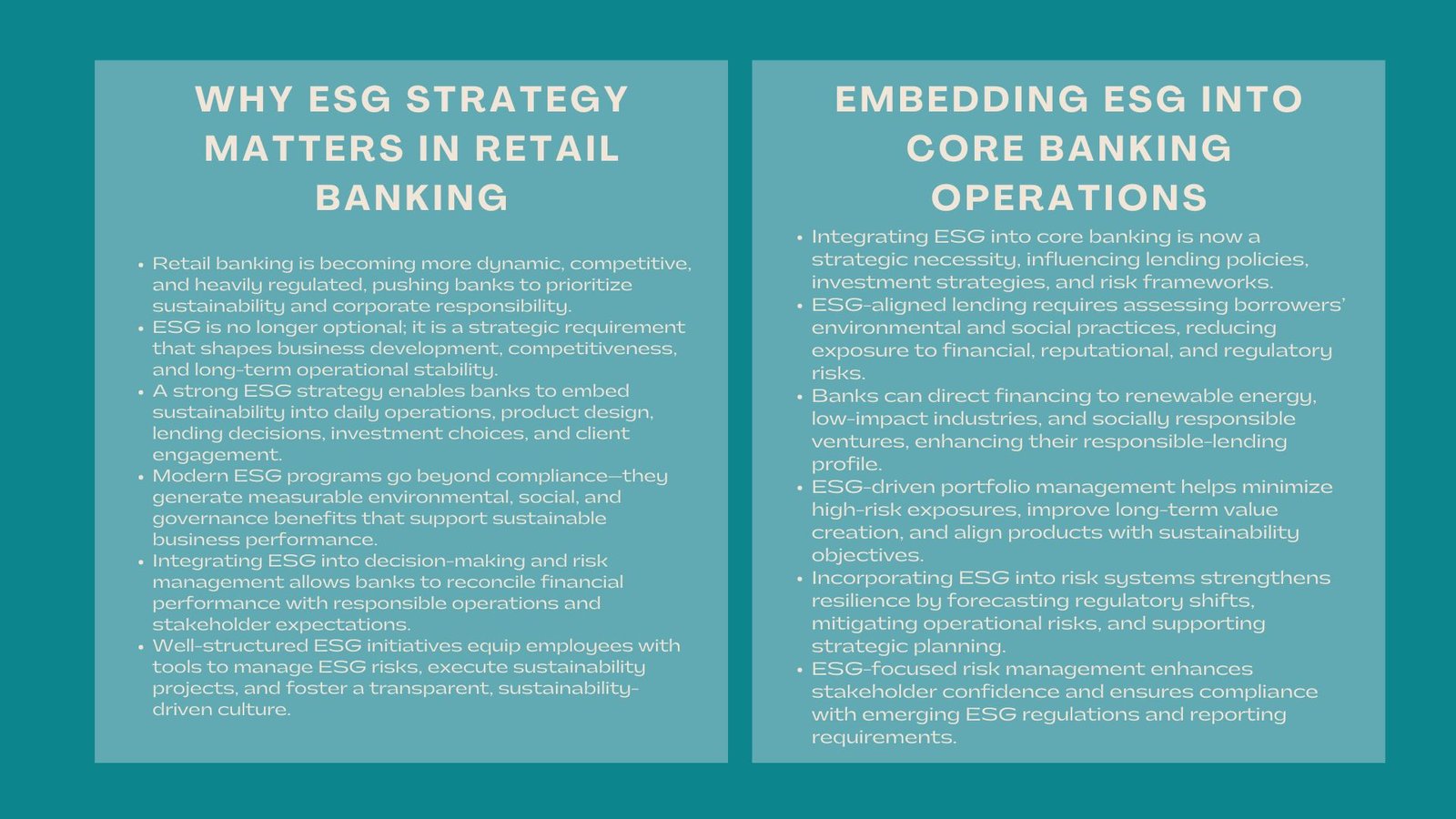
The retail banking sector is increasingly a dynamic, competitive and heavily regulated financial sector with customers and investors, as well as with regulators, paying close attention to the issues of sustainability and corporate responsibility. In this regard, the idea of the Environmental, Social, and Governance (ESG) is no longer a choice or a peripheral concept but has become a key strategic priority which determines the business development, business stability and competitiveness.
A robust retail banking ESG strategy empowers financial organizations to incorporate sustainability in their daily business, products, investment choice, and their approach to clients. ESG proceedings are no longer merely compliance oriented, but rather they are about producing quantifiable beneficial effects to the environment, the society and the form of governance in an organization. The retail banks need to reconcile financial performance with sustainable operation, and the consideration of ESG principles in the day-to-day decision making, risk management structure, and strategic planning.
Orchestrated ESG initiatives equip banking employees with effective tools, methods, and models that help assess risks on ESG, initiate projects successfully and evaluate improvement in relation to predetermined programs of sustainability. Moreover, such programs enhance internal governance, develop an organizational culture that is geared towards sustainability and enhance transparency and accountability towards external stakeholders such as regulators, investors and consumers.
As the concept of sustainability and accountable financing gains increased attention, introducing a clear and specific ESG strategy and hiring ESG reporting frameworks in the banking industry are the essential steps towards excellence in operations and preservation of a competitive edge. Retail banks who actively embrace ESG as part of the strategy are in a better place to stem sustainable investment, stronger client relationships, and root to the emerging market expectations.
Driving Sustainability in Retail Banking Operations
Embedding ESG into Core Banking Practices
The inclusion of ESG into the operations of core banking is ceasing to be a choice but a strategy. ESG principles should be integrated at the lending policies, investment strategies, risk management process, and decision-making frameworks.
Aligning ESG with Lending Policies
Banks can integrate ESG in their credit risk measurement and lending, where the borrowers are bound to ensure they practice and apply social norms which are environmentally friendly. The methodology would aid in averting the possible financial, reputational, and regulatory threats and foster sustainable growth. Retail banks are also able to focus their financing on low environmental impact projects, renewable energy projects or socially responsible businesses, one way in which they can become responsible lenders of small business.
ESG-Driven Investment Strategies
Retail banks are looking forward to incorporating ESG factors in the portfolio management to a great extent. ESG-based investment policy enables a bank to find sustainable investment, minimize risks to high-risk areas, and provide shareholders with the long-term value creation and positively influence the local community and the environmental state. ESG integration workshops offer practical advice on how to screen the investments, measure their effectiveness in ESG and match the investment products to the sustainability goals.
Strengthening Risk Management with ESG
Incorporating the ESG in the risk systems would help banks foresee the changes in regulations, limit operational risks, reputational risks, and safeguard long-term resilience. The risk management that is ESG-oriented will facilitate the strategic planning, increase the confidence of stakeholders, and guarantee their adherence to the emerging ESG regulation and reporting standards.
Enhancing Environmental Responsibility
Any ESG strategy is partial to environmental sustainability. Retail banks also have direct and indirect responsibilities to mitigate their existence on the environment as well as promote environmentally friendly practices on their clients.
Operational Environmental Initiatives
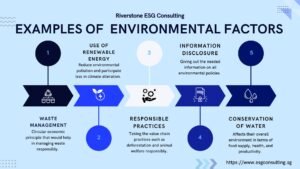
Retail banks also had possibilities to achieve energy efficient uses like cutting down on the use of energy in branches, use of paperless procedures and an adoption of the sustainable supply chain policy. The digital banking systems decrease the physical infrastructure dependence, which also leads to the lower environmental imprint of the system and the ecologically conscious banking activities.
Green Financing and Sustainable Products
It is possible to promote green loans, sustainable mortgages, and ESG-related financial products to allow banks to serve environmentally aware clients and projects. These initiatives not only help the global sustainability efforts but also help the bank to stand out in the market, especially with clients that have ESG values as a priority.
Measuring Environmental Impact
ESG workshops can empower the professionals to ensure they have the ability to cast the environmental impact on a quantitative basis. This involves the measurement of carbon footprint, energy consumption and waste management and other KPI that are environmental in nature. Strong measurement is a way of keeping the environment programs transparent, accountable, and constantly improving to maintain environmental initiatives.
Advancing Social Responsibility in Retail Banking
Strengthening Community Engagement and Financial Inclusion
The aspect of social responsibility in retail banking extends beyond the profit making aspect; it includes making a positive contribution to the society.
Promoting Financial Literacy
Retail banks are also able to contribute to the development of a community by offering financial literacy to the underserved community. These programs contribute towards the knowledge of the customers on the banking products, usage of personal finances in a good way, and informed decision making on investments. The financial literacy program will also lead to economic empowerment and promote the social impact profile of the bank.
Inclusive Banking Practices
The banks are able to adopt lending policies and financial products that are specialized to SMEs, women entrepreneurs and the marginalized communities. With the prerogative of financial inclusion, the banks are able to increase their markets at the expense of social sustainability.
Community Investment Initiatives
An engagement on local projects, charity programs and community development programs enables banks to build strong ties with local communities, build stronger brands and as well as benefit local communities by creating sustainable social value. These investments also aid the ESG reporting requirements of the bank through proving practical contributions of the social world.
Promoting Workforce Wellbeing and Ethical Practices
The social component of ESG is also spread to the inner processes so that employees are accompanied, stimulated, and morally oriented.
Employee Engagement and Diversity
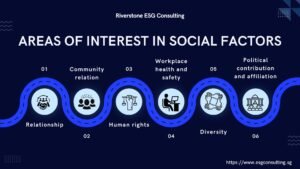
Creating a diverse, equitable, and inclusive workplace motivates innovativeness and level of ESG reporting banking sector employee contentment along with effectiveness of the operations. To develop a favorable organizational culture, banks can establish mentorship programs, career progression, and inclusion programs.
Ethical Conduct and Compliance
Embracing ethics in corporate governance will make all employees follow professional values, labor laws, and corporate codes of practices. Ethical behavior is supported by workshops and training programs, as well as the culture of integrity is developed in order to reduce the exposure to risk.
Training and Professional Development
Sustained ESG training programs enable the employees to learn about the principles of sustainability, ethical codes and the social responsibilities. With ESG knowledge, employees are able to play their role in enhancing sustainability of the organization and reinforce internal organization.
Strengthening Governance and ESG Reporting
Enhancing Transparency and Accountability
Effective ESG implementation is based on good governance. The retail banks should make sure that ESG data are up-to-date, complete, and that they are available to the stakeholders.
Standardized Reporting Frameworks
The method of reporting ESG should strive to adopt GRI, SASB, and TCFD to ensure that the reporting is consistent. Standardization enables the stakeholders to measure the level of performance with other players in the industry and increases the level of credibility in the minds of investors, regulating bodies and customers.
Audit-Ready ESG Data
Keeping proper records of ESG is obligatory to the internal audits, regulatory, and external checks. Professionals are inducted to produce the documentation that evidences the compliance with the ESG policies and measures the outcomes efficiently.
Stakeholder Communication
Being honest in reporting on ESG efforts, activities and performance builds credibility with investors, customers and regulatory organizations. Frequent reporting will keep the stakeholders informed of the ESG strategy used by the bank, which will build credibility and reputation.
Integrating ESG Data into Decision-Making
ESG information should be operational to provide strategic business activities.
Data Analytics for ESG Performance
The retail banks may use ESG dashboards and analytics to monitor the KPIs, trends, and risks. These data-related methods will help to make efficient decisions and improve the efficiency of these operations.
Strategic Planning and ESG Alignment
By including the insights gained with the help of ESG in strategic planning, one will make sure that the priority of sustainability is incorporated in business priorities and resource distribution as well as long-term growth strategies.
Scenario Analysis and Risk Forecasting
Through the ESG data, the bank can use it to do scenario planning in order to predict environmental, social, or regulatory risks. The scenario analysis assists in decision making in lending policies and investment strategies to reduce vulnerability as well as operational changes.
Tailoring ESG Strategy for Retail Banking
Customizing Initiatives for Banking Segments
Retail banking covers several segments, such as personal banking, SME lending, wealth management, and corporate services and each of these segments has different ESG considerations.
Segment-Specific ESG Approaches
ESG programs are used in establishing sustainability initiatives which are specific to the client requirements and operation reality of the different banking segments.
Learning from Best Practices
Reports on case studies and benchmark examples of the best world banks are useful in illustrating how to operationalize the ESG in a manner that would lead to quantifiable outcomes in risk management, client engagement, and reporting.
Integrating ESG Across the Banking Value Chain
Integrating ESG into every operation brings in coherence and is maximizing.
Cross-Functional Collaboration
Workshops help in the teamwork of the risk, compliance, operations sector, product, and development and marketing users to ensure that the ESG principles are regularly in use.
Continuous Monitoring and Improvement
On-going improvement is encouraged by feedback, regular reviews, and optimization of the processes, so that the retail banks could change the strategies connected with ESG according to the latest risks, regulations, and market expectations.
Conclusion
The creation of a strong and comprehensive ESG framework of retail banking has turned not only into the strategic benefit, but a necessity to stay competitive, reduce operational and reputational risks, and to have sustainable growth over the long term in the ever more complicated financial environment.
Through infused strategic ESG programs and resourcing internationally accepted ESG reporting frameworks to the banking sector would provide these retail banks with the knowledge, tools and methodology they need to incorporate ESG principles into their daily decision making process, to monitor and evaluate the long run results of their sustainability and to report the performance to all the relevant parties including investors, regulators, customers and the employees.
An effective ESG strategy is not just about compliance and reporting. It enhances the sustainability of the environment by promoting the responsible use of resources, minimizing operational carbon footprint, and green finance programs that help to achieve the global climate goals.
At the same time, it also encourages social responsibility through promoting financial inclusion, even-handed access to banking services, cultivating workforce diversity and inclusion as well as community development initiatives. Good governance practices are part of the ESG strategy, and this would make sure that all levels of the organization will be held accountable, transparent and make decisions that are ethical with the reputation of the bank intact and make the stakeholders gain confidence.
The incorporation of the principles of ESG into the key spheres of the banking business presents actual business advantages. The retail banks enjoy an improved operational efficiency because sustainability-related processes tend to streamline any workflow, decrease waste, also improving the allocation of resources. ESG strategies are also beneficial in financial inclusiveness, as they assist the banks to reach out to the underserved segments and come up with products that can meet the demands of a wider variety of customers.
Moreover, employee engagement and retention will improve among organizations as employees will appreciate more employers that are ethical, responsible and environmental custodians. Increased stakeholder trust leads to improved relationships with investors, regulators and clients which makes the bank a trusted and responsible stakeholder in the market.
The integration of the ESG principles into all levels of banking activities including lending and investing decisions, risk management, communication with customers and corporate governance makes retail banks the leaders in sustainable finance.
This type of leadership brings in wholesome and long-run investment, innovation in product development, builds brand loyalty as well as market differentiation. Operationalizing ESG initiatives, retail banks not only develop measurable good differences in the environment and the society but also guarantee the capacity against the changing regulatory force, market anticipations, and the threat of global risks.
Additionally, a well-coordinated ESG will help the development of the culture of constant development and the creation of long-term values, where decisions are selected with references to the environmental, social, and governance factors, and the results are monitored, and assessed and improved over time.
The retail banks that embrace this mentality are more likely to be well placed to gauge the future voltage of incoming challenges and make the best out of opportunities that can enable sustainable growth; their competitive advantage is meaningful enough to overcome a downfall in the market trend and a fluctuating economic cycle.
Conclusively, incorporating ESG into the essence, the business model of retail banking provides financial institutions with a chance to be successful in the holistic manner, benefitting both customers and employees, shareholders and society in general, and at the same time enjoying resilience, differentiation, and sustained competitive edge in the ever-sustainability-aware financial environment.
The emphasis on the use of ESG strategy for retail banking sector sustainability and risk management as a key strategic goal can help the retail banks to make sure that the concept of sustainability is not a mere regulatory task, but rather the source of innovation, expansion, and long-term influence and become the trusted leaders of the world trend toward responsible and sustainable finance.