ESG Compliance in the Banking Sector
Introduction to ESG Compliance Trends in Banking
Over the past few years, the principles of Environmental, Social and Governance (ESG) have ceased to be a voluntary ethical guideline, but a compulsory compliance policy of all international financial systems. To banks, this is not merely a reputation issue, but an issue of regulatory survival, investor trust and permanence. Banks are under increasing pressure on the part of regulators, stakeholders and investors demanding that they transparently incorporate ESG into credit policies, lending practices, and governance practices.
With the world economy turning towards sustainable finance, the capability of the banking industry to adhere to the ESG sets will dictate the competitiveness of the financial industry, capital accessibility, and credibility. This paper discusses the most vital aspects of ESG compliance in banks, the current changes in regulations, and their strategic consequences to financial institutions across the globe.

1. The ESG Compliance History in Banking.
1.1 Between Voluntary and Mandatory Governance.
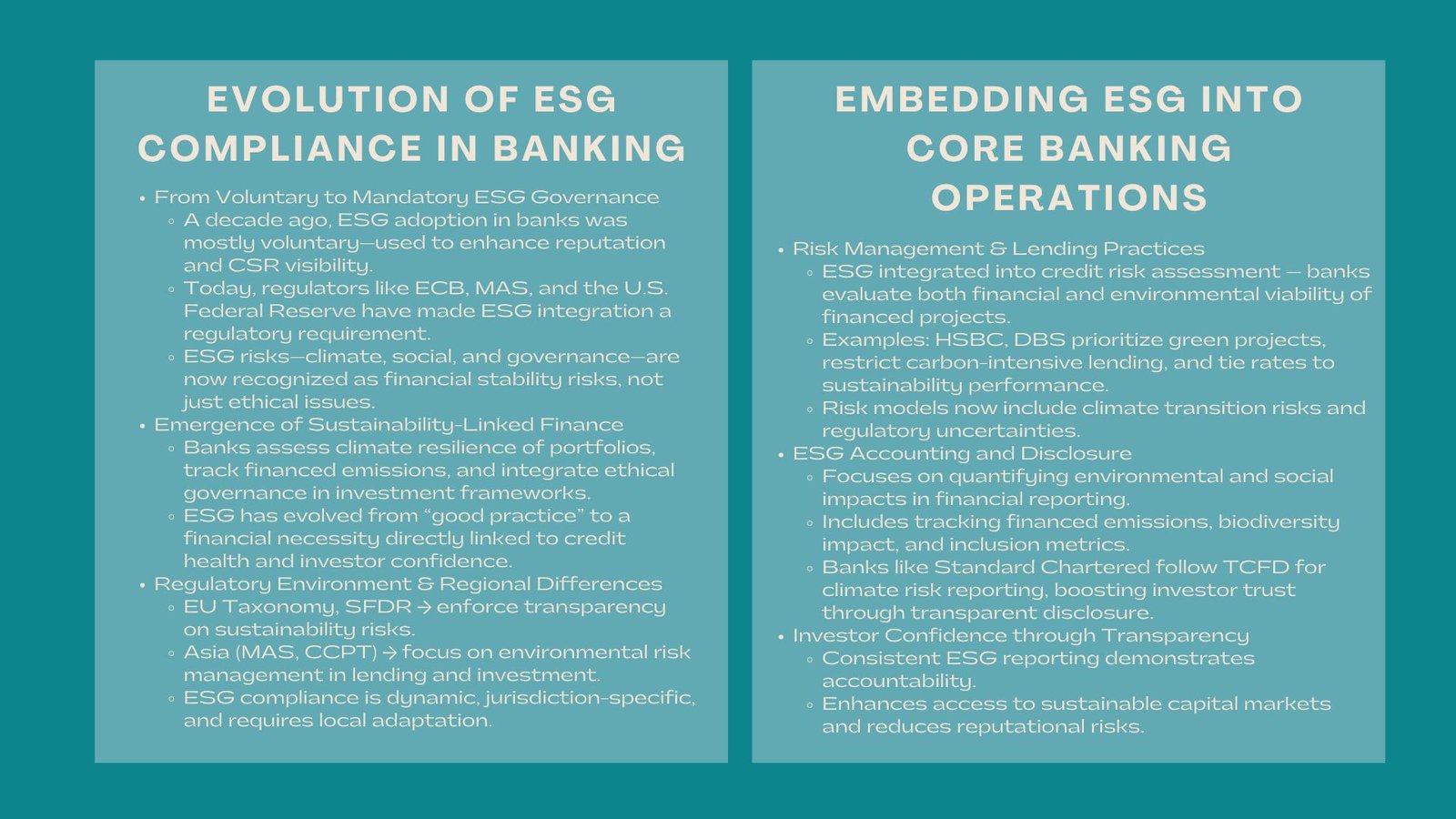
ESG principles were voluntary to a great extent a decade ago. Banks which were involved in sustainability projects did it mainly to gain respect. The regulatory bodies, such as the European Central Bank (ECB), the Monetary Authority of Singapore (MAS), and the U.S. Federal Reserve, are integrating the ESG into financial regulation systems today. The transition to regulatory enforcement is the result of the acknowledgement of the fact that climate, social, and governance risks are directly connected to financial stability.
Sustainability-linked financing has brought to the fore the compliance in ESG as part of financial health. Banks have been forced to evaluate the climate resilience of their portfolio loans, track the amount of emissions linked to their projects being financed, and finally maintain ethical governance in their investments frameworks. This is the strong departure between ESG as a good practice to ESG as a financial need.
1.2 Regulatory Environment, and Regional differences.
Varied jurisdictions have incorporated different models of ESG regulations, yet the objective remains the same; to incorporate the concept of sustainability in the management of financial risk in banking. The EU Taxonomy and Sustainable Finance Disclosure Regulation (SFDR) are financial reporting regulations implemented in Europe; they mandate financial institution to report risks and effects to sustainability. The Asia region has frameworks such as MAS Guidelines on Environmental Risk Management by Banks Singapore and the CCPT by Malaysia that focus on the consideration of climate in the credit and investment processes.
These rules show ESG compliance is not a checklist but instead a flow that should be adjusted over time and that is jurisdiction-specific and should be localised by banks.
2. Embedding ESG into Core Banking Functions
2.1 Risk Management and Lending Practices
One of the most critical components of banking sector ESG compliance is risk management. There has been the expectation that banks consider environmental and social issues during their credit risk analyses. An example is that a bank that finances a coal mining project will not only have to evaluate the creditworthiness of the borrower but also the long-term environmental viability of the project, future regulatory environment and transition risks as the world shifts to using renewable energy.
This strategy changes the conventional risk modeling in that it introduces a sustainability aspect. Banks like the HSBC and the DBS have already included ESG requirements in their loan issuance policies. They are more interested in green projects and limiting lending to industries that are very carbon-intensive and connecting the rates charged to borrowers to their sustainability.
2.2 ESG Accounting and Disclosure
Equally vital is the integration of ESG accounting for banks, which focuses on quantifying sustainability impacts and incorporating them into financial reporting. In contrast to traditional accounting, ESG accounting has measures on financed emissions, biodiversity effects, and social inclusivity in lending.
Other banks, such as Standard Chartered, have now started to create climate-related financial disclosures in accordance with the Task Force on Climate-related Financial Disclosures (TCFD). Such reports disclose the exposure to climate risks as well as the manner in which the risks are addressed. Moreover, considering ESG factors will increase the confidence of the investors as it will show the bank trying to be responsible in the realm of financing.
3. Technology, Data, ESG Reporting.
3.1 Within the international business environment, it is necessary to leverage digital solutions to capture ESG information
ESG data gathering and analysis is a significant undertaking in the case of the banks as it is convoluted and qualitative. Nevertheless, the new technologies, including AI-based analytics, blockchain tracing, and ESG data solutions, transform compliance reporting.
The example is the digital platform such as Refinitiv and Bloomberg ESG Data Services assisting banks to monitor the sustainability metrics of its clients in real-time. These instruments are useful in identifying the risks of ESG at an earlier stage and making sure the reports are accurate and auditable.
In addition, fintech partnerships are also allowing banks to automate data collection, evaluate carbon footprints, and implement portfolio reporting in line with the global sustainability frameworks like GRI, SASB, and IFRS S2.
3.2 Accuracy and Consistency of ESG Disclosures.
The regulators are more than ever insisting that banks be consistent with both financial reports and ESG reports. Data misreporting or lack of data integrity may put institutions in reputational and legal dangers. Therefore, assurance procedures like third-party audit of ESG reports are becoming the norm.
Internal ESG assurance methods are also embraced by banks whereby sustainability officers and compliance teams are collaborating in checking data accuracy prior to publication. This will make the information disclosed show actual improvement and not greenwashing.
4. Corporate governance in ESG Compliance.
4.1 Enhancing Supervision and Responsibility.
Corporate governance has a central role in making sure that the ESG commitments are converted to practical results. Board of directors are now mandated to manage the implementation of the ESG strategy, track the progress of the strategy, and ensure that the goals are prepared to meet the long-term profitability.
Most of the major banks in the world have already developed board-level ESG or Sustainability Committees. These committees look into the exposure to environmental risks, monitor green lending arrangements and promote transparency in sustainability reporting.
4.2 Executive Compensations and ESG Performance Indicators.
Even progressive banks are also linking executive pay to ESG performance. As an example, BNP Paribas and Citi base a portion of executive compensation on carbon reduction objectives or gender diversity. These incentives that are based upon performance will promote accountability and make ESG values penetrate all organizational levels.
These practices do not only ensure that leadership objectives reflect the corporate sustainability goals, but they also provide an assurance to the investors that the incorporation of ESG is not just something on the surface- it is incorporated in strategic and financial decisions.
5. Greater Effect of ESG Compliance.
5.1 Improving Investor and Stakeholder Trust.
Well-built ESG compliance systems boost investor confidence to a great extent. The institutional investors are also using ESG more and more to choose banking partners or even buying bonds. Consequently, well-operating banks that are sustainably managed can easily access capital markets and have reduced funding cost.
The more stakeholders such as the customers, regulators etc will be willing to believe in the financial institutions, which are more concerned about sustainability. To illustrate, financial institutions that are actively engaged in green financing or programs that are community- Oriented have a better brand and market differentiation.
5.2 Investing in National and Global Climate Objectives.
In integrating ESG into their operations, banks become direct contributors to the national sustainability goals like the green plan 2030 in Singapore or the low carbon nation vision in Malaysia. Investing in renewable energy, assisting SMEs to receive sustainable funds, and encouraging responsible investments can all help in the larger global processes of carbon neutrality.
Conclusion
The compliance of banking industry with ESG is no longer a choice, it is a competitive and regulatory necessity that defines the future of finance. When financial institutions effectively incorporate the ESG into their governance, accounting and risk management systems they are leaders in sustainable finance.
The process of reaching the ultimate stage of ESG compliance requires constant innovations, effective data management, and open governance. Banks adopting these principles not only protect their reputations but also open up the possibilities of growing and making impacts on the society in the long run.
As the international regulations keep changing, the institutions that consider ESG as a strategic asset and not as a reporting liability will shape the future of responsible banking.