Case Study: Step-by-Step ESG Reporting and Disclosure Supporting Transparency and Business Readiness
Background on Case Study Step by Step ESG Reporting
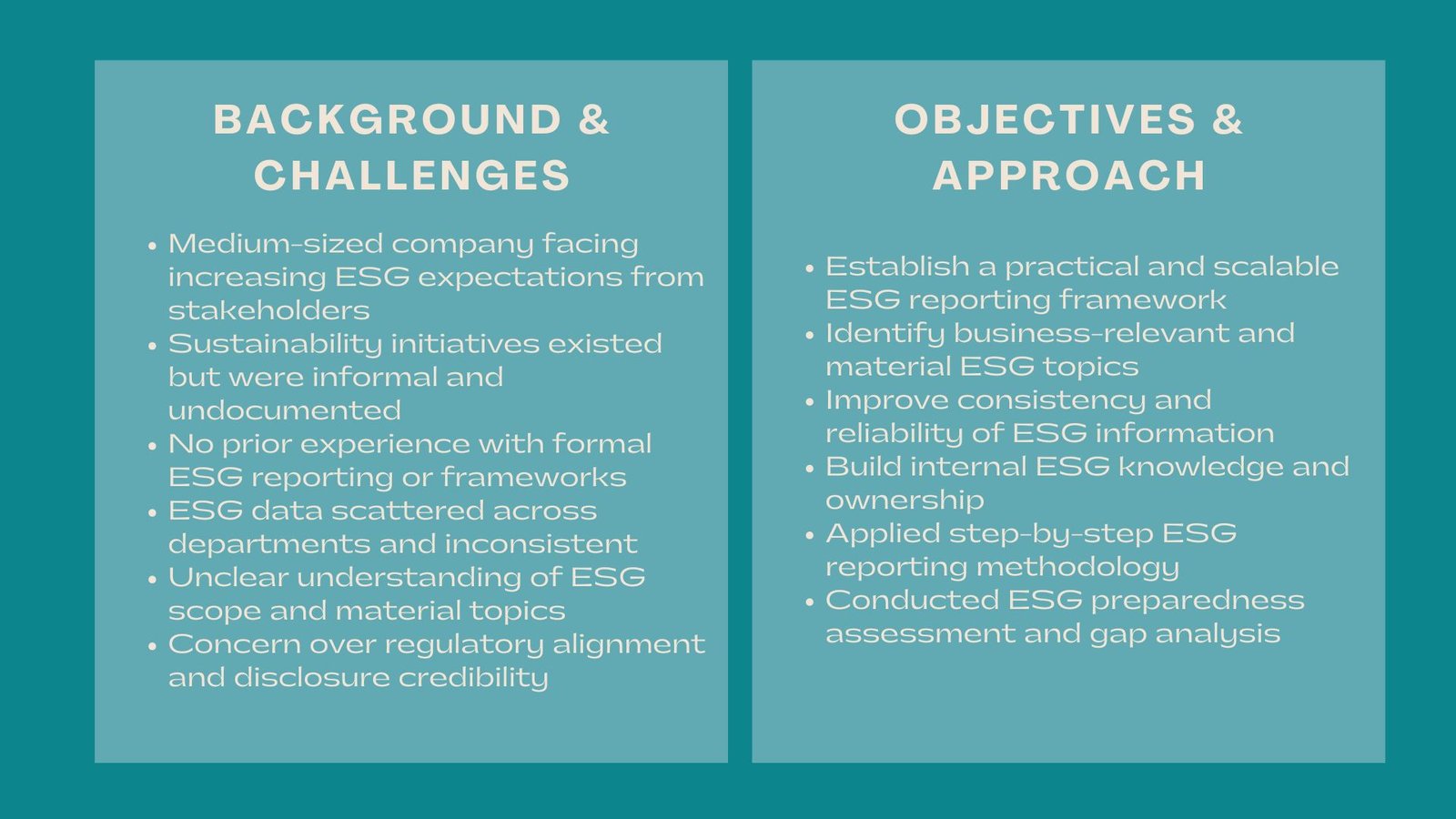
A medium-sized privately owned company was slowly growing to experience the ESG-related demands of stakeholders, such as customers, business partners, investors, and regulators. Although the company had undertaken several initiatives in the areas of sustainability throughout the years, they were not systematically documented and reported, and were informal and scattered. The management realized that the ESG considerations were emerging as a significant constituent of the business credibility, risk management, and long term competitiveness.
The company did not have the former experience of creating an organized ESG report or aligning the disclosures with the established ESG frameworks. Having little knowledge in-house and fearing regulatory congruence, as well as the validity of data, the management turned to our Step-by-Step Guide to ESG Reporting and Disclosure to build a transparent, possible, and sustainable ESG reporting platform.
The interaction was meant to assist the company to transition between inconsistent sustainability actions and a formalized ESG reporting model that can facilitate communication with the stakeholders, governance, and compliance requirements in the future.
Issues and Challenges
The firm had a number of typical problems that are faced by companies during the initial phases of ESG reporting.
To begin with, it was not clear what actually ESG reporting entailed. The management was at crossroads as to what the environmental, social and governance issues pertinent to the business were and how the management could differentiate among issues of materiality and general sustainability dreams. The risk here was of coming up with incomplete or non-decision-useful disclosures with the absence of a clear framework.
Second, the ESG-related information was not collected centrally. The data concerning the environmental practices, workforce, and governance policies were found in the various departments in varying formats. Part of the data were qualitative and other measures were either incomplete or not historically tracked, which was a concern with regard to comparability and reliability.
The other impending issue was compliance with accepted ESG standards and disclosure requirements. The company did not know what to do with the widely used ESG systems and how to make reporting large without overwhelming the company resources. The management needed some advice on how to begin with a practical base and be lenient to expansion in the future.
Lastly, credibility and transparency were of concern. The company did not want to have generic or marketing-led ESG statements but rather focused on disclosures that were genuinely representative of its existing practices, risks and priorities.
Objectives
The major aim of the engagement was to lead the company through a systematic, stepwise ESG reporting and disclosure process that was feasible, plausible, and business realities.
In particular, the client wanted to:
- Create an effective ESG reporting framework and plan.
- Determine ESG material topics in the business.
- Enhance consistency and reporting of information related to ESG.
- Bring about clear and justify ESG disclosure.
- Establish internal knowledge and ownership of responsibility of ESG.
The ESG reporting system was to be reasonable to the size and complexity of the company and should be scalable to future reporting needs.
How We Helped
We used a step-by-step ESG reporting strategy that would lead to the demystification of ESG requirements and align them with the current business processes.
We have started our interaction with an initial ESG preparedness analysis to get to know the business model, the environment the company operates in, and the expectations of its stakeholders. This contributed to setting the background and defining the areas, in which ESG considerations were already entrenched, and gaps that needed to be addressed.
The second step was to assist the company in formulating and prioritizing material ESG topics. This process had business activities, industry dynamics, regulatory expectations and considerations of the stakeholders. The resultant effect was a narrow set of ESG themes that were decision-relevant, manageable and relevant.
We then collaborated with the management in mapping the current policy, practices, and data sources to the stipulated ESG topics. In the absence of data, we assisted in the formulation of practical measures and qualitative disclosures, which was competent to the company. A focus was made on the accuracy, consistency, and traceability instead of excessively complex metrics.
In our efforts to facilitate reporting and disclosure, we took the team of the company through the procedure of creating ESG stories that gave a clear explanation of how the company managed the risks and what was currently being done. Such disclosures were transparently and in a balanced sense, that is, both what had been achieved and what could have been done better.
In the course of the engagement, we gave step wise advice regarding the structure of the ESG, role of governance and internal responsibility. This meant that the ESG reporting did not become a one-time event, but rather a continuous process which became part of the governance and management structure of the company.
Value Delivered
This involvement describes how a systematic stepwise ESG reporting model could assist businesses in moving out of the informal sustainability reporting to the area of respectable ESG disclosure.
Our services assisted the company to minimize uncertainty, improve internal coordination, and enhance transparency because they allowed ESG reporting to be broken down into manageable steps. The management was more confident to communicate with the stakeholders on ESG issues and the disclosures were based on real business operations.
The ESG reporting framework that was created with the help of this engagement gave the company a viable starting point that could be developed over time to help it to have a better governance system, communication with the stakeholders, and be able to withstand the business over time.