How is ESG Performance Measured and Tracked?
How is ESG Performance Measured and Tracked?
Environmental, Social, and Governance (ESG) performance measurement and reporting is a multi-faceted process that involves standardized frameworks, data-driven ESG performance indicators that are data-driven, and dedicated ESG measurement tools that gather, validate, and report sustainability data. Measuring ESG performance is not one-off or a single report; it’s a process of defining material objectives, collecting the right information, comparing performance, and communicating results to investors, regulators, and staff. Though it’s important to know any one framework, knowing the cycle is more important for professionals entering this field; most companies don’t care as much about which acronym you know as they do if you understand how data transforms into a decision.
Key Takeaways
- Appropriate ESG performance measurement requires the selection of material performance measures, rather than collecting everything possible.
- There are options for ESG measurement, from spreadsheets to AI-powered platforms, and the type of tool that would be the best fit for the company would depend on the size of the company and the regulatory exposure.
- ESG performance indicators should be linked to business outcomes – not be isolated sustainability numbers.
- Common frameworks (GRI, SASB, TCFD, ISSB, CSRD) are commonly used in clusters.
- Companies most often cite data quality, not data volume, as their challenge.
- Junior professionals are the most valuable contributors in ensuring data accuracy, documentation and inter-departmental coordination.
- Disclosure requirements around ESG are increasing, and so is the need to be up to speed on how to measure it, so it’s becoming a real career asset.
Why Does ESG Performance Measurement Matter for Businesses Today?
Ten years ago, ESG reporting was more of a communication initiative and voluntary. This is now very different. Sustainability rules now mandate structured reporting of sustainability information for companies exceeding specific size thresholds in Europe, the UK and parts of Asia-Pacific, while investors are increasingly looking at companies’ long-term risk – not their short-term reputation – to determine their investments. The change is that ESG performance measurement is no longer a side project for the sustainability team, but a part of the board’s agenda and is regularly discussed with financial results.
This issues of importance for professionals, as they are more and more involved in ESG-related activities, mostly in the intersection of ESG with finance, operations, supply chain, and legal functions. Companies without reliable and verifiable ESG data are at risk of losing funding, not being able to meet tender requirements, or being sanctioned by the regulators. ESG reporting is no longer just about transparency – it’s about strategy, resilience, and creating value over the long-term. It’s not enough to know what is reported; it’s important to know how it is measured, and this is a skill that can be transferred from one department to another and industry to industry.
What Are the Core Steps in Measuring ESG Performance?
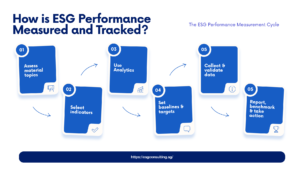
While the tools and terminology may vary, most of the companies that effectively measure ESG do so in a similar way. Here are five steps that are generally a part of a working ESG performance measurement process:
- Conduct a materiality assessment. Companies first determine what issues they are interested in covering as part of the environmental, social, and governance (ESG) agenda, selecting topics that are truly relevant to their business and stakeholders, typically with a double materiality approach that takes into account both financial and social impact.
- Select relevant ESG performance indicators. After identifying material topics, enterprises and companies select specific and measurable indicators to monitor, instead of industry checklists, such as emissions per unit of output, employee turnover or board diversity.
- Establish baselines and targets. Companies use indicators only in comparison to a starting point and a goal, and establish baseline and short- and long-term goals based on the indicators.
- Collect and validate data using ESG measurement tools. Data is collected from internal systems such as HR, finance, operations, and external systems such as suppliers and utilities and is verified for accuracy before being utilized for any report.
- Report, benchmark, and act on results. The final data is published in sustainability reports or in regulatory reports and is benchmarked against peers or previous years and then used in decision-making, creating a closed-loop system between measurement and action.
How Do ESG Measurement Tools Support Accurate Tracking?
For years, tons of ESG data were tracked on spreadsheets, and many smaller companies continue to do it because it is easy. But with increasing reporting requirements, spreadsheets become increasingly difficult to audit and also vulnerable to versioning issues, which is why more and more companies are turning to specific ESG measurement tools. ESG software can integrate all data into a single, centralized database, which is easier to analyze and understand; it can also identify trends, benchmark performance, and identify areas for improvement.
These are platforms that have different scales. Others are more focused on carbon accounting and emissions tracking, enabling companies to measure Scope 1, 2 and 3 emissions (including supplier data), which helps in the process of target setting and decarbonisation planning. Others span the entire ESG spectrum and incorporate workforce information, governance documents, and environmental measurements all within a single framework, which translates to multiple disclosure frameworks at once. When information is aligned to the reporting frameworks like CSRD, GRI, ISSB, and TCFD, the same data can be used to fulfil various disclosures, without implementing the same effort across them. A junior professional who is able to use one of these types of platforms—or who knows how data moves from source systems to a reporting dashboard—can easily transfer these skills into a reporting position at a sustainable company, a finance job, or an operations position.
Which ESG Performance Indicators Should Companies Prioritize?
Not all indicators are equal, and this is one of the more common missteps that companies make on their ESG journey early on. Good ESG Reporting is on material, decision-useful measures, and metrics measured in isolation are of limited value. The table below shows a generalisation of how ESG performance indicators are clustered on the three pillars of ESG.
Table 1: ESG Performance Indicators by Pillar
| Pillar | Example ESG Performance Indicators | Common Data Source |
|---|---|---|
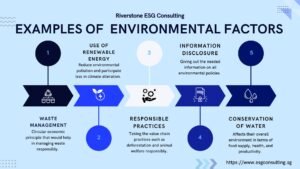
| Environmental | Reduce greenhouse gas emissions, energy usage, water consumption and waste diverted from landfill. | Additional data from utility bills, facilities management systems, and supplier reports. |
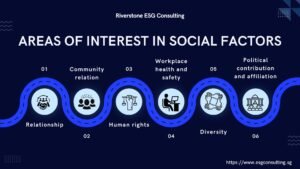
| Social | Turnover, Pay Equity, Incidents of workplace safety, Training Hours, Supply chain labor standards | Human Resource systems, Payroll, Safety Logs, Supplier Audits. |
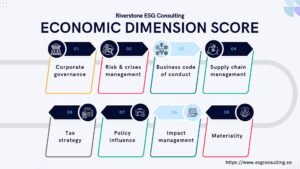
| Governance | The three most critical factors in board diversity, executive compensation structure, anti-corruption policies and data ethics practices. | Add Board records, compliance and legal teams, internal audit. |
For a mid-sized manufacturing company, emissions and worker safety may be more financially and operationally risky indicators than data governance or pay equity, for example, while a technology company might have other indicators that are more significant to it. The core of the discussion of carbon emissions is the manufacturer and data ethics the tech company, and a one-size-fits-all checklist is not likely to be very useful in this cross-industry context.
What Challenges Do Companies Face When Tracking ESG Data?
Despite having the necessary resources, companies face a common set of challenges as they develop their ESG measurement process, and identifying these challenges can be beneficial when approaching this field. The first problem is data silos; emission data may be stored in the facilities, human resources data in HR, and governance data in legal, and only a handful of companies start their systems connected. The second is inconsistent methodology, especially with regard to Scope 3 emissions, and where these are provided by suppliers, the numbers may be based on a variety of different calculation assumptions, making comparative reporting from year to year impossible without harmonisation.
One good example is the private equity/ mid-market arena, where a significant number of the portfolio companies are reporting for the first time. These organisations often have no baseline at all, and the consultants generally recommend that they aim to achieve a baseline in year 1, which they then build on with methodologies, and further build on it with tools/frames so that it can be continuously improved. The key steps are to make progress and not be perfect – most companies don’t do it the first time. For example, a regional retail chain facing the challenge of moving away from spreadsheet-based tracking to a single platform often finds in the process that a number of stores had been recording their energy consumption in various ways — a simple but often overlooked mistake that only becomes apparent when it’s all in one place and under review.
The takeaway for the professionals is that the road to ESG measurement is far from smooth sailing. A large portion of the first work is getting all the numbers to agree with one another, tracking down the missing inputs from the suppliers, and instilling confidence within the internal numbers before they are published. The work is where members at the lower rungs of the team can make the most immediate contribution, and where a focus on process and attention can be as important as their sustainability knowledge.
Benefits and Challenges of Effective ESG Performance Measurement
ESG performance measurement, when executed properly, can provide more than just a compliance benefit. It makes finance more easily available, as banks and investors now increasingly consider environmental, social and governance (ESG) information when assessing risk. It also enhances the operational decision-making process: when emissions or safety data is being monitored on a consistent basis, it can often provide insights into inefficiencies that were not previously visible. However, while ESG reporting is a compliance issue, it is also a business issue as it provides ESG data that can be used to quantify the risks, track the performance, and guide business operations and decisions.
Yet the difficulties are very real and ongoing. Regulations are changing rapidly and inconsistently from region to region, and businesses must stay up to date to understand the new requirements and deadlines. In recent years, a variety of regulations have tightened the requirements for mandatory disclosure for certain companies, and expanded the requirements for disclosure in others, resulting in companies having multiple and overlapping disclosure mandates simultaneously. Smaller organisations have a problem with the cost and complexity of dedicated software, and larger organisations with ESG data integration across multiple business units and subsidiaries. Both of these take patience, data source accountability, and a degree of realism when it comes to the time it takes to create a reliable system.
How is ESG Performance Measured and Tracked? : Conclusion
Effective ESG tracking isn’t about collecting all possible ESG metrics but about establishing a disciplined and repeatable process to determine what is important, measure it consistently, validate the data, and act on it to make real decisions. For those developing a career in this area, it’s not so important to be the expert on all of the frameworks as it is to understand how data flows from a spreadsheet or operational system to the board or investor who depends on it. As ESG measurement becomes a routine part of doing business, those who can navigate that process efficiently and effectively, and communicate it with non-specialists, will be valuable in a variety of sustainability, finance, and operations-based roles.