How Do Companies Prepare an ESG Report?
The ESG report preparation process is a systematic approach that includes gathering data on environmental, social, and governance (ESG) indicators, mapping them to established ESG frameworks, reviewing and auditing them internally or externally to ensure accuracy, and presenting the results to investors, regulators, and the public in a clear and transparent manner. By adhering to the ESG reporting best practices, the report is credible and comparable, and provides decision-making information instead of being a compliance exercise.
Understanding How Do Companies Prepare an ESG Report?
ESG reporting is no longer a compliance issue but becomes an integral part of the business. There is growing pressure on companies to report on their environmental, social and governance (ESG) practices from investors, regulators, customers and employees. Since entering the world of sustainability, finance, or corporate communications, it is important to grasp how an ESG report is made. After helping companies get started, it’s time to share what that means in practice – this article delves into the process, the frameworks that support it and some of the common challenges, as well as some lessons learnt from real companies.
What Is the Process Behind Preparing an ESG Report?
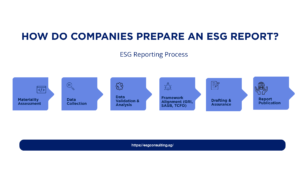
The ESG reporting process is normally initiated months before the ESG report is released. The first step is to establish the reporting scope, i.e., determine which subsidiaries, regions, and time periods are to be included in the reports, and which ESG framework or set of frameworks is to be followed. The GRI ESG reporting guide is referenced by many organisations, as it offers a structured template for disclosure of environmental policies, labour practices, human rights and governance, that can be consistent and comparable between different geographies and industry sectors. After the framework is agreed, the sustainability team collaborates with finance, HR, operations and legal teams to identify the data points required and ownership of the data.
Once the scoping is done, the emphasis then moves to data collection and consolidation. This can be one of the most time consuming steps because the ESG information is distributed across various databases, such as energy bills, payroll, supplier audits, safety incident log, and board meeting minutes. Typically, companies will use a combination of spreadsheets, ESG software tool platforms and manual surveys sent to various business units. Data then is subject to validation checks to identify inconsistencies, for example, energy use in different units over a number of years reported by the same facility. The company then can proceed to analysis, drafting and ultimately assurance, that is when an internal audit team or third party verifier checks the numbers before the report is completed and released.
How Do Companies Identify Which ESG Topics Matter Most?
Most companies engage in a materiality assessment, a structured process to identify the most salient topics in ESG and how they relate to the business and stakeholders before they start collecting data. This usually includes surveys and interviews with investors, employees, customers, suppliers and community members, which seek input on how important issues, such as carbon emissions, water usage, diversity and inclusion, data privacy and board independence, are to them. The findings are typically represented on a materiality matrix that has stakeholder importance on one axis and business impact on the other. Detailed disclosure priorities are topics that are important on both dimensions.
This is important because it helps companies avoid creating overly vague or too specific reports that don’t address the matters stakeholders care about. A manufacturing business, for instance, may have water usage and the safety of its employees as more material concerns when compared to data privacy and employee wellbeing for a software business. Adhering to ESG Reporting best practices involves an annual re-evaluation of the materiality assessment every 12 to 18 months, as the interests of the stakeholders involved and the expectations of regulators evolve, especially with new regulations such as the EU’s Corporate Sustainability Reporting Directive (CSRD) introducing new definitions for what constitutes “material.”
What Are the Core Steps Companies Follow When Preparing an ESG Report?
The process may vary from company to company depending on its size and type, but five basic steps constitute the core of most ESG reporting cycles. Companies’ first step is to establish governance and accountability, with a cross-functional ESG team or committee reported directly to the board or a sustainability officer to manage the entire process. Second, they carry out or update the materiality determination to ensure that the topics covered for detailed disclosure this cycle are appropriate. Third, they gather and synthesize information from internal systems, suppliers and third-party sources, and make sure there is a consistency of units, time frame and definitions. Fourth, they write the reporting substance in line with selected reporting frameworks (e.g GRI, SASB, TCFD) and add narrative context to targets, progress and challenges. Fifth, they should be subject to internal review and more frequently to external audit or verification by an in-house or external auditor or verification body before being published together with the company’s annual financial statements or separately.
How Does the GRI ESG Reporting Guide Shape Report Structure?
One of the most widely used reporting guides is the Global Reporting Initiative (GRI) with its modular approach: every organization is required to report on a set of universal standards, the same set of standards for each sector, and a set of standards for each topic (such as emissions, employment and anti-corruption). Companies tend to begin by setting out the universal standards as a foundation for setting out the basic disclosures on the company’s organizational profile, strategy and approach to stakeholder engagement, and then add sector and topic standards as relevant to the priorities that have been identified through their materiality assessment.
One good reason for adhering to the GRI structure is comparability: Investors and analysts who are reviewing reports for a number of companies in the same line of business can easily compare the performance of each company when all are using a similar disclosure format. For instance, a beverage company in Europe and a beverage company in Latin America, which are within different regulatory frameworks, can report water and effluents data based on GRI’s standard, allowing comparisons between companies. If you’re a junior professional, knowledge of the GRI codes (like GRI 305 for emissions, or GRI 401 for employment) is a skill that you often need to apply when applying for a job as a sustainability analyst or ESG coordinator.
What Role Do External ESG Reporting Services Play?
Many companies, including those with smaller in-house teams or smaller size, use external ESG reporting services to oversee a portion or the entirety of their ESG reporting process. The services provided include data management platforms automatically gathering and calculating data, such as carbon footprint, and full service consultancies that assist in the preparation of report, materiality assessment and conducting third-party assurance. For companies that are creating their initial ESG report, outsourcing can be a particularly useful option because they might not be well-versed in the requirements of the ESG frameworks, or skilled at accurately calculating Scope 1, 2 and 3 emissions without expert guidance.
However, using only external sources of information can create problems if internal staff do not develop sufficient awareness to sustain the report in the long term. It’s a trend we see across industries: they rely on the external services for the first 1-2 reporting cycles, and then shift to having more of the process internally within the company, using the external service for credibility. This is a trend that fuels a consistent demand for ESG consultants: businesses continue to require external advice and assistance as their knowledge and understanding in the field grows, especially when it comes to new, emerging areas such as double materiality and supply chain emissions tracking.
Example: How a Mid-Sized Manufacturer Approached Its First ESG Report
Let’s take one of the companies in the Eastern Europe mid-size industrial equipment sector, employing approximately 1,200 people in three locations. The company’s first ESG report was stimulated by a large customer’s demand for supplier ESG data, and the sustainability function was made up of one part-time coordinator. The company commissioned an external ESG reporting services provider to undertake a first round materiality assessment and identified the issues of energy consumption, occupational safety and labour practices as the most relevant issues for their stakeholders in the supply chain.
This data collection period lasted almost four months, because energy consumption was measured differently at each facility: one facility did have a metered electricity bill to track, another facility estimated energy use based on equipment run times, and the third facility had no consistent way of tracking energy use. The firm needed to add the sub-metering at the third site before they could start reporting accurate data. Even in the face of these challenges, the final report, organised loosely around both GRI’s topic and universal standards, enabled the company to maintain its key customer relationship, and also led to two new clients specifically mentioning the report in the procurement process. A common lesson being learned by businesses in similar situations is that investing in fundamental data infrastructure, such as the tracking of utilities, provides great value when it comes time for reporting.
Benefits and Challenges of ESG Reporting
| Benefits | Challenges |
| Works well with investors and customers. | Data is distributed in different departments and systems. |
| Committed to supporting access to financing for sustainability | The process of frame selection may be confusing for first-time reporters. |
| Enables internal data management and accountability improvements | In smaller companies, limited ESG expertise in-house, particularly. |
| Improves procurement competitive position | The costs and time of assuring and verifying can be high. |
| Encourages recruitment of those interested in corporate responsibility | Ensuring good compliance with emerging legislation (such as CSRD and ISSB). |
Tabel 1: Benefits and Challenges of ESG Reporting – How Do Companies Prepare an ESG Report?
ESG reporting increases in benefit with time. The first report is seldom perfect, with gaps in data and narrative elements that are perhaps generic. Later reports will likely enhance as the data systems are developed and internal teams become more experienced. The problems, on the other hand, never go away completely, but rather change their form. Simple availability issues of basic data that occur early often evolve into more advanced issues related to setting science-based targets, scenario analysis for climate risk, or Scope 3 emissions data management, with hundreds of suppliers.
What Lessons Have Companies Learned from ESG Reporting Cycles?
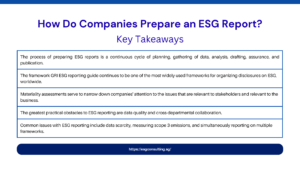
A consistent takeaway is that it is important to consider ESG reporting as a continuous process and not a race to the finish. If companies integrate the collection of ESG data into a regular part of their business, they’ll see that creating the report doesn’t involve scouring for missing numbers, but rather consolidating and analyzing the data. Companies that put together the data at the last minute are often plagued with inconsistencies, missing data from previous years for comparisons, and hasty writing of narratives.
Another lesson involves stakeholder engagement. Simple statistics – targets, trends, reasons for failures – are not as compelling to readers of the report or even as appealing to more sophisticated investors who like to know what the company is doing well as well as what it is not doing well. Reports of failure of targets to be met, in tandem with a plan to correct this, typically get a positive response from analysts rather than a negative one. This openness combined with following ESG reporting best practices including third-party assurance and consistent framework alignment has proven to be a significant differentiator as ESG reports become an important part of the investment and lending process.
Conclusion
The journey of creating an ESG report is a multi-step process, combining elements of data management, stakeholder outreach and strategic communication. Those who do well don’t see it as a compliance exercise to be completed once a year, but rather as a process that is constantly followed and regularly reviewed, with data collected on a regular basis; progress and challenges are openly communicated. For professionals pursuing careers in this field, three tips come to mind: firstly, familiarize yourself with the GRI ESG reporting guide, as it underlies a lot of the reporting in the global arena; secondly, it is important to have a strong understanding of data quality and collaboration across functions, and not just in how to build a framework; and thirdly, ESG reporting services are still very much required, and there is a need for someone who can simply communicate that information into business. With regulations becoming more stringent across the globe, now is the time for businesses to begin investing in their ESG reporting processes rather than waiting for regulations to come into effect in the years to come.