How ESG Initiatives Can Increase Business Value
Introduction to How ESG Initiatives Can Increase Business Value
Environmental, Social, and Governance (ESG) initiatives have become more than just sustainability reporting efforts; they are now mainstream in the rapidly changing corporate world. They are now key contributors to the success of the enterprise in the long-term, investor confidence, and competitive advantage. In Singapore and the Asia-Pacific region, business owners, CFOs, auditors, and corporate finance professionals simply cannot afford not to know how ESG initiatives can add value to their businesses.
There is ample evidence of the link between the integration of ESG and measurable business value, which is now gaining recognition in the capital markets, regulators, and institutional investors. Firms that take ESG into account in their daily business practices routinely outperform on risk-adjusted returns, access to capital, and stakeholder loyalty. However, there are many organisations that still view ESG as a compliance task and not as a way to create value.
It is an in-depth, evidence-based analysis of the relationship between ESG initiatives and the real monetary worth of enterprises – and how that affects the way enterprises are assessed, financed, and placed for development. ESG has become a key factor to consider whether you’re embarking on a merger, sourcing investor funding, or developing a value strategy.
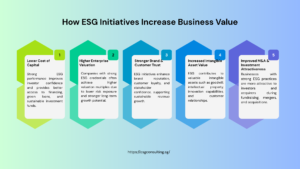
The Growing Connection Between ESG Performance and Enterprise Worth
Over the last decade, the use of ESG in financial analysis has gained momentum. It has become commonplace to use ESG as a proxy for management quality, operational resiliency, and future earnings stability in screening investment portfolios by global investors now, including sovereign wealth funds, pension funds, and private equity firms. It has a direct and measurable impact on how companies are valued, as a result of this change in investor behaviour.
Valuation-wise, ESG performance affects a number of the financial drivers of a company: cost of capital, potential revenue growth, operational efficiency, and risk exposure. Those companies that have strong ESG programmes are more likely to receive cheaper loans, have higher price-to-earnings multiples, and fewer regulatory or reputational shocks likely to impact enterprise value. In real dollar terms, a lower discount rate to cash flows in the future (due to lower perceived risk) can be a meaningful component of the business’s fair market value.
Most businesses that are in a formal business valuation services engagement are now using ESG credentials in the risk assessment and qualitative adjustment process. When forming the company’s worth appraisal, valuation professionals take into account the quality of governance, environmental liabilities, and social risk factors, as well as standard financial factors. Not taking ESG into account here can result in an undervaluation of a company’s intrinsic value or the undervaluation of the risks that could affect this.
The Singapore Exchange (SGX) and Monetary Authority of Singapore (MAS) have also emphasised the importance of ESG disclosures by mandating listed companies to disclose on climate-related risks based on the TCFD framework. This guidance by regulators is a clear indication that the evaluation and reporting of corporate value is already integrating ESG factors in the region.
How ESG Strengthens Brand Equity and Stakeholder Trust
One asset that’s priceless but often overlooked belongs to a company: its brand. ESG has direct financial impacts on brand equity and stakeholder trust valuation, with a good sustainability record being central to it. Today, more and more consumers, employees, and business partners prefer organisations that are committed to responsible action.
This isn’t just a matter of sentimentality. As a result of a strong brand position with ESG, customer acquisition costs are lowered, employee retention rates are higher, and premium pricing power is increased, which all lead to better revenue quality and earnings stability. These results can be directly translated to improve the enterprise worth analysis, especially by income-based valuation methods, from a financial point of view.
If businesses invest in brand equity, they will receive valuation professionals’ term brand equity valuation premiums. These premiums are based on the additional value that the brand brings to the company beyond its physical assets, being a strong and trusted brand. As consumer trust erodes with ease and rapidly, the ability to leverage the trust relationship that can be earned through sincere ESG engagement will be a powerful competitive advantage for any brand.
ESG commitments, especially on the environmental side, fair labour practices, and community engagement, are important elements of ESG and can play a significant role in the brand asset consulting value of a company in a strategic brand valuation. If your business is pondering a sale, merger, or investment round, it is important to clearly and adequately articulate and support this ESG brand value to ensure you get a fair and defensible transaction price.
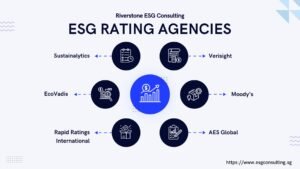
The corporate image valuation in ESG markets is also reflected in the perception of a company by institutional investors and ESG rating agencies like MSCI, Sustainalytics, and S&P Global ESG Scores. A positive ESG rating can lead to a lower cost of equity, be a factor for inclusion in indexes, and appeal to more investors, which can build on each other to drive value.
ESG and the Valuation of Intangible Assets
In today’s economies, many of the intangible assets make up most of the enterprise value of a business. Ocean Tomo has always discovered that more than 90 percent of the market value of the S&P 500 is comprised of business intangible assets. However, these assets, such as goodwill, customer relationships, proprietary processes, and organisational culture, are often difficult to value and even more challenging to argue in a transaction or dispute.
ESG initiatives directly help to develop and maintain ESG intangible assets. Organisational goodwill valuation, customer relationship valuation, and strengthening workforce capabilities are some of the intangible asset advisory areas that can be formally assessed as a result of a company’s commitment to sustainable practices. If these contributions are not quantified, businesses can end up undervaluing their most productive assets in negotiations and fundraising, and in their financial reports.
Working with a professional intangible asset valuation expert can help companies determine, measure, and support the value of intangibles related to ESG. This involves the value of environmental certification for the sustainability asset, sustainability business partnerships with suppliers, and the brand premium for ethical business standards. These evaluations are frequently necessary to make as part of a purchase price allocation after an acquisition for financial reporting under IFRS 3 and FRS 103.
ESG also influences the intellectual capital assessment dimension of intangibles. Businesses that invest in an innovative green economy, responsible deployment of technological solutions, and human capital building develop an intangible asset that can distinguish them from others and ensure higher multiples in the long term. Identifying and appreciating this ESG-related intellectual capital is a very important part of devising a credible long-term valuation strategy.
A specific focus needs to be on goodwill valuation in ESG circumstances. When goodwill is generated in a transaction, it is usually a sign of what the market expects from the transaction in terms of future synergies and excess earnings. The benefits of ESG-driven goodwill, in the form of stakeholder trust, sustainability reputation, and governance quality, can be significant, but need professional attention to be properly shown and argued.
ESG as a Driver of Intellectual Property and Innovation Value
One of the strongest drivers of enterprise value creation is through innovation and intellectual property. The correlation between innovation and the sustainability goals is especially high in ESG-aligned companies. Firms involved in the development of cleaner technologies, circular economy models, and digital sustainability tools possess commercial value IP portfolios.
ESG-related intellectual property has distinct features that require special considerations from IP valuation services. These are all areas where patent asset valuations are becoming more in demand for clean energy processes, carbon reduction technologies, and sustainable materials, as well as green manufacturing methods. These assets’ commercial value is more than just in terms of revenues generated; it’s also in regulatory benefits, first-mover advantages, and market access.
To assess the value of innovations in an ESG context, it is necessary to know the technical aspects of the IP as well as the market dynamics influencing the commercial aspects. The value of proprietary technologies is likely to be influenced by the changing regulatory framework, which includes the emergence of carbon pricing and green finance regulations, and these should be taken into consideration in the process of technology valuation services for innovations that fall under the ESG umbrella.
ESG proprietary technology valuation also includes the valuation of software platforms, data analytics, and digital reporting systems that allow companies to measure, manage, and communicate their sustainability performance. The software asset value of these systems is increasingly coming to the fore in transaction due diligence and investor analysis as the ESG data infrastructure is becoming competitive.
Other companies with creative ESG methodologies, sustainability frameworks, or environmental compliance processes should also think about how these assets are reflected in their digital asset valuation and intellectual capital valuation. When properly identified and assessed, these assets do not necessarily show up on the balance sheet, but can be substantial contributors to enterprise value.
ESG in Mergers, Acquisitions, and Purchase Price Allocation
ESG credentials are one of the most impactful areas where they impact on business value, with mergers and acquisitions being one of them. Increasingly, acquirers are performing ESG due diligence in conjunction with financial and legal due diligence on the target company, to assess the environmental liabilities, governance, and social risk profile of the target company before finalising terms of the deal.
A company with a good ESG track record is more of a desirable acquisition target. It offers reduced risk of regulation, better staff continuity, and better customer and supplier relations, which can result in a higher acquisition value justified. On the other hand, if a company’s environmental liability is not resolved, its governance is substandard, or it has major social issues, it may be undervalued, and/or deal structuring may be contingent on these issues.
One of the important financial reporting requirements after an acquisition is the allocation of the purchase price between the assets and liabilities of the acquired company. Professional PPA valuation services offer an organized analysis, which is required to allocate transaction value in a proper manner among tangible assets, identifiable intangible assets, and goodwill. Intangibles related to ESG, including sustainability certificates, customer loyalty based on ethical practices, green technology patents, etc., will need to be clearly identified and measured as part of this process to meet applicable accounting standards.
Having a seasoned valuation advisory firm on the business side of the transaction early on facilitates businesses to recognise and reflect the impact of ESG on enterprise value terms. In Singapore’s M&A landscape, certain industries like energy, real estate and consumer goods are more susceptible to ESG considerations, making this a critical aspect, especially when transactions are conducted across borders.
How ESG Affects Cost of Capital and Investor Attractiveness
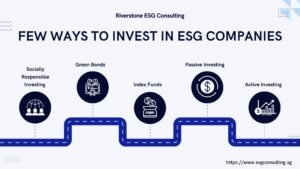
An obvious way that ESG adds value to a business is by influencing a company’s cost of capital. The volume of green bonds, sustainability-linked loans, and equity bonds with environmental, social, and governance (ESG) labels has increased considerably, and the bond pricing tends to be better for companies that satisfy certain sustainability standards.
Companies that have credible sustainability programmes are more likely to be included and have a position in their portfolios when institutional investors are screening for sustainability. It has given rise to more demand for ESG-compliant stocks, making for higher valuations and lower equity risk premiums. The net effect, on a discounted cash flow basis, is to reduce the weighted average cost of capital and to increase the value of the future earnings, in terms of net present value.
Access to capital is not just a function of cost of capital; ESG performance has an impact as well. In Singapore and the Asia-Pacific region, banks and development finance institutions are increasing the variety of their green and sustainable finance products, and are increasingly offering preferential terms to those who can demonstrate measurable green/sustainable outcomes. For businesses looking to access debt finance, a robust ESG programme can directly impact financing terms and conditions and provide greater financial flexibility.
From an ESG business valuation perspective, these effects on the capital markets need to be built into any credible company that needs to be valued. There needs to be an adjustment to take into account the ESG premium that is being increasingly accrued to companies with proven sustainability information.
Practical Steps for Businesses to Maximise ESG-Linked Value
Theoretically linking the ESG to business value is one thing. Taking it one step further to take action is another. The following practical steps can be useful for business owners, CFOs, and others in corporate finance to ensure that ESG initiatives are designed and presented as efficiently as possible to deliver their greatest value to the enterprise.
- Be clear on what ESG outcomes you’re looking at and how to measure them. A commitment that’s not specific is of little value to investors or valuation professionals. Set measurable ESG goals – e.g., emissions reduction targets, diversity targets, governance improvement targets, etc. – and monitor progress regularly against these targets. Documented outcomes are the supporting evidence for value claims related to ESG in engagements of due diligence and formal valuation.
- Make ESG a part of your financial reporting story. ESG information should not only be contained in a separate sustainability reporting document. Include ESG risk and opportunity analysis in annual reports, investor presentations, and management commentary. This integration is a clear message to the capital markets that you are not taking ESG in isolation but have it at the heart of your business.
- Get trusted valuation experts on board at an early stage. From capital raises, acquisitions, and corporate restructuring, to any other scenario when you have to communicate the value of your company, it is important that you rely on valuation advisory services to make sure that your business’s intangible assets, brand value, and intellectual property are identified, measured, and communicated. If the engagement is done early, enough time can be allotted to develop the documentation and analytical tools needed for a comprehensive valuation.
- Perform an intangible/information property audit. There are numerous assets tied to ESG that are not reflected in traditional financial metrics, such as sustainability certifications, green patents, customer relations based on ethical practices, proprietary data platforms, and more. A systematic intangible asset advisory review process can help uncover these latent values and add the necessary footing to support formal valuations.
- Ensure ESG strategy is aligned with long-term value creation goals. ESG efforts that are public relations or compliance-driven are not likely to be impactful in terms of value enhancement. The best ESG programmes are those that are embedded in the business, connected to areas of the business where the company really stands out, and backed by continuous executive leadership. This alignment is just what advanced investors and buyers seek in the evaluation of a sustainable enterprise.
Conclusion
The proof is in the pudding: ESG can be a valuable and quantifiable opportunity for businesses. The financial value of well-structured ESG programmes is significant, and is growing in recognition with markets, regulators, and transaction advisors, all the way from reduced cost of capital and brand equity, to improved intangible asset value and acquisition price.
Businesses in Singapore and across the Asia-Pacific are already in the midst of a business imperative to integrate ESG into their strategy. Businesses that pursue ESG value creation in a proactive and analytically thoughtful manner will have a competitive edge in securing investment, premium valuations, and establishing a resilient, stakeholder-trusted business that will see long-term success.
The first step in understanding and maximising the value of your business’s ESG is to engage a business valuation specialist, a brand equity valuation expert, an intangible asset valuation expert or an expert in IP valuation services. The value is there. But the issue is whether your organisation has the equipment and know-how to capture it.