ESG Strategy for the Healthcare Industry
Introduction to Developing ESG Strategies in Healthcare
Once considered the health sector, the healthcare industry is currently being reshaped by the environmental, social, and governance (ESG) expectations. Healthcare organizations, including hospitals and pharmaceutical companies, medical devices manufacturers and insurers, are increasingly being pressured to show accountability, sustainability, and ethics.
The balancing of patient care, public health, and profitability make the ESG integration necessary and complicated in the sector, as it is unique. With the increasing vulnerabilities of supply chains, heightened exposure of the company to a range of climate change and increasing governance scrutiny, a clear ESG strategy has become an essential element of operational resilience and corporate reputation. The article discusses the implementation of the ESG principles in the healthcare industry strategic framework and its compliance, reporting, and performance measurement.
1. Learning about ESG in Healthcare.
1.1 Why ESG is important to health care organizations.
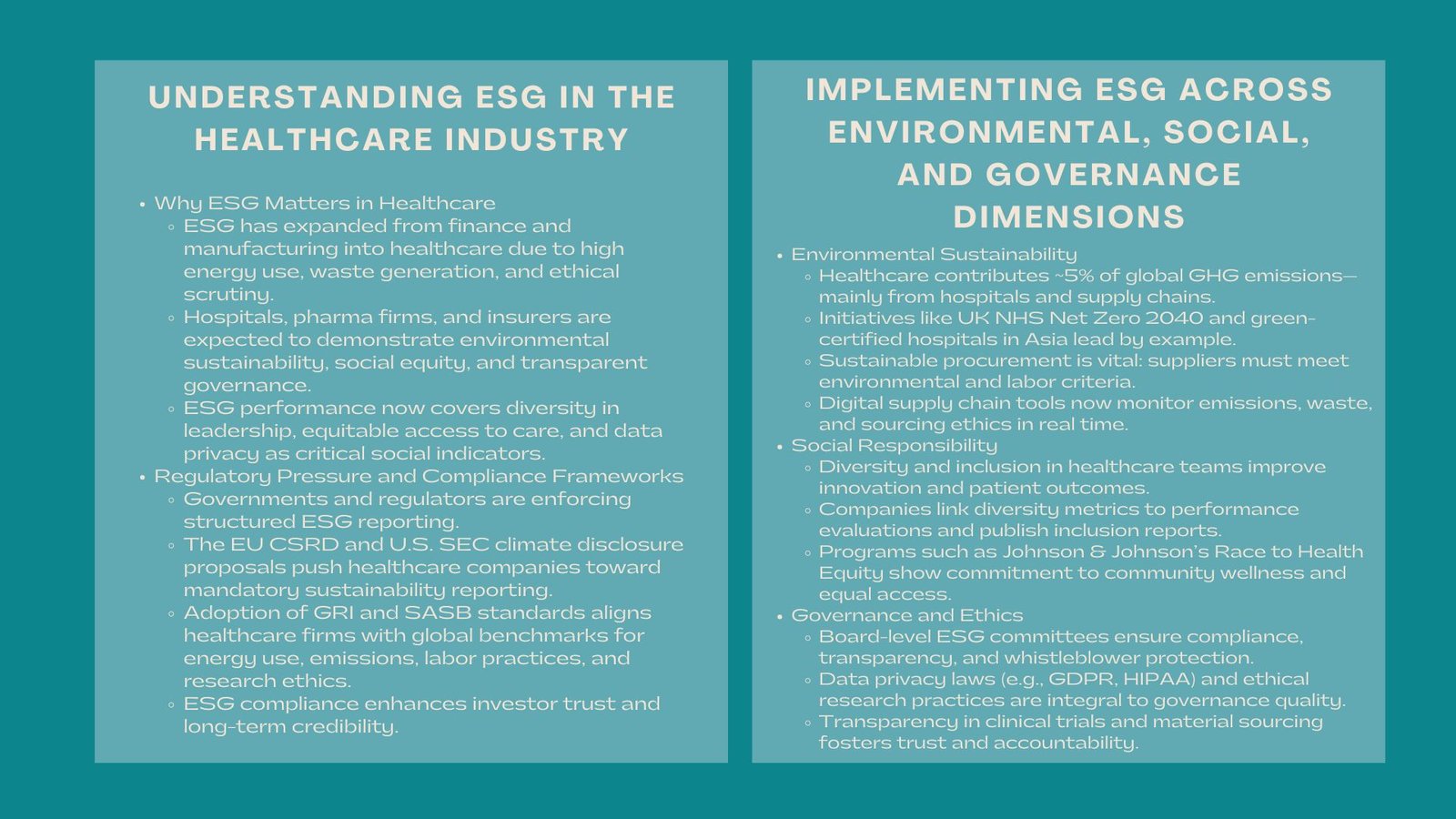
ESG is no longer a manufacturing or finance phenomenon, it is transforming the world of healthcare. Some of the greatest energy consumers are hospitals, pharmaceuticals generate a lot of waste, and life sciences companies have been ethically questioned on price fixing and transparency in trials. The investor, regulators and patients now demand that the industry record quantifiable improvements in terms of sustainability and governance.
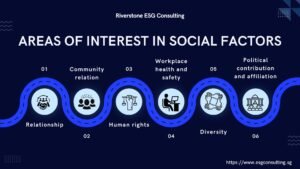
The social aspect of healthcare is particularly problematic. The evaluation of ESG performance includes diversity in leadership, equal access to medical services, and privacy of patient data among other aspects. With the spread and digitization of healthcare systems, governance and ethics should change with the aim of maintaining accountability and equity in medical innovation and delivery.
1.2 The Regulatory Push
The regulatory authorities are increasing regulation on ESG reporting. In other systems such as the European Union, the Corporate Sustainability Reporting Directive (CSRD) mandate healthcare firms to disclose homogenized sustainability information. Meanwhile, in the US, the Securities and Exchange Commission (SEC) has suggested climate disclosure regulations that cover healthcare organizations.
These requirements drive the organizations towards structured ESG reporting standards- either the Global Reporting Initiative (GRI) or the Sustainability Accounting Standards Board (SASB) that define industry-specific indicators such as energy use, emissions, labor practices and clinical trial ethics. As a result, Healthcare ESG reporting guidelines have become an essential reference for corporate governance and investor relations teams seeking to meet international best practices.
2. The Environmental Dimension: Building Sustainable Healthcare Systems
2.1 Managing Carbon Emissions and Waste.
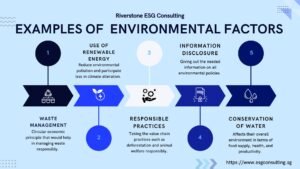
Healthcare sector contributes to the total global greenhouse gas emissions by almost 5 percent, with the major contributor being the operations of the hospitals and their supply chains, and the manufacture of pharmaceuticals. To solve this, healthcare providers are embracing energy saving technologies, sustainable energy sources, and intelligent systems of managing facilities.
An example is the National Health Service (NHS) of the UK, which introduced its Net Zero by 2040 program, i.e., the complete shift to renewable energy and significant decrease in the volume of medical waste. Likewise, to reduce their negative impact on the environment and to reduce operation expenses, the hospitals groups in Singapore and Malaysia are investing in green building certifications.
2.2 Sustainable Supplies and Procurement Chains.
Much of the healthcare emissions is produced in the supply chain pharmaceutical ingredients, medical devices and logistics. Hospitals and pharmaceutical industries are adding sustainability requirements to procurement policies where suppliers have to comply with environmental and labour requirements.
The digital supply chain management tools have enabled organizations to analyze the supplier emissions, ethical sourcing and waste management instantaneously. This visibility is useful in minimizing the risk exposure as well as improving healthcare delivery networks integrity.
3. The Social Dimension: Equity, Safety and Employee Well-being.
3.1 Diversity and Inclusion within the Workforce
The mission of healthcare cannot be separated in social sustainability. Ethical leadership is not only seen through diversity and inclusion of the workforce, but also enhances patient outcomes. Multidisciplinary healthcare teams are more qualified to take into consideration the cultural differences, customize care delivery, and be inventive in their interactions with patients.
Health care institutions are establishing specific diversity goals and connecting them with performance reviews. Numerous worldwide pharmaceutical organizations today release reports of annual diversity and inclusion, which point out achievements in leadership quality and equal compensation.
3.2 Patient and Community Engagement.
In addition to internal policies, social responsibility is also on the health of communities. There is a growing convergence between hospitals and biotech companies efforts with the social health objectives – including access to care, specifically disparities, and preventative health programs.
One such program is the Our Race to Health Equity by Johnson and Johnson that has the aim of eradicating racial and social barriers to health care in the U.S. Incorporating these programs as part of their ESG plan, healthcare firms will show that the idea of social value creation is not a side effect of success in the future.
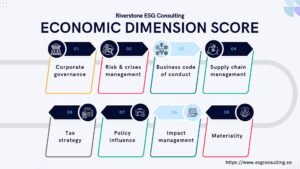
4. The Governance Dimension: Compliance and Ethical Oversight.
4.1 Building on the Governance Structures.
A believable ESG strategy is based on governance. In the case of healthcare, it would involve putting in place regulating measures that would provide transparency, ethical conduct of research, and sound financial service delivery. ESG committees at the board of directors level are now a common occurrence in big hospital systems and pharmaceutical firms.
These committees are charged with ensuring adherence to sustainability objectives, managing whistle blowers and aligning management incentive with ESG objectives. The inclusion of the ESG in board governance is an indication of a long-term value creation instead of short-term profit orientation.
4.2 Data and Ethical Research.
As digital health technologies are on the increase, the patient data privacy and research ethics are questioned. Healthcare agencies have the responsibility of handling sensitive data in a responsible manner, and they should follow such laws as the General Data Protection Regulation (GDPR) of the EU and the HIPAA Act of the United States.
Open disclosure of clinical trials, sourcing of medical materials in an ethical manner and patient consent processes has become a part of corporate ESG assessment. Such governance practices do not only instill the confidence of people, but also ensure that institutions are held by the neck against reputational and regulatory risks.
5. The introduction of ESG in Healthcare: Strategy to Measurement.
5.1 ESG as part of the Core Strategy.
Healthcare ESG cannot be an isolated program. Top organisations comprise sustainability goals in their mission statements, strategic planning and risk management systems. This involves the mapping of ESG material issues E.g. patient safety, climate resilience, workforce well-being, etc. against business priorities.
In an effort to institutionalize the ESG practices, healthcare companies are turning to the cross-functional governance, whereby the sustainability responsibilities are integrated into procurement, finance, and operations departments. This guarantees that there is compatibility between ESG performance and organizational objectives.
5.2 Evaluating and Communicating Performance.
One of the most significant problems of healthcare ESG implementation is measurement. Organizations should measure carbon footprints, energy consumption, patient satisfaction and diversity outcomes on standardized scales. More sophisticated analytics platforms are now capable of continually tracking these indicators, and ESG has ceased being a fixed position of reporting and is becoming an active management process.
Healthcare leaders have been gaining knowledge that effective disclosure needs to be credible, as well as transparent and consistent. Third party assurance and standardized audit practices can be used to make sure that the data is reliable- essential to regulatory compliance and investor confidence.
By aligning operations with ESG compliance healthcare sector frameworks, organizations gain a competitive edge in securing sustainable financing and public support. Economic value of ethical business practices is further improved by the fact that financial institutions would be more willing to fund projects that are verifiable to ESG standards.
6. The Future Perspective: ESG, A Healthcare Innovation driver.
6.1 The Drift In Preventive and Green Health Systems.
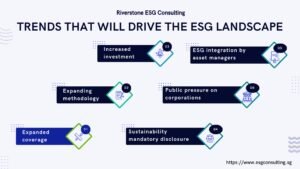
The ESG strategies in healthcare in the future will focus on preventive care, circular economy, and low-carbon infrastructure. Future hospitals are expected to include renewable micro grids, well-crafted materials, and zero waste programs to reduce the ecological footprint and increase recovery conditions for patients.
Moreover, investors and regulators will keep pegging ESG performance on financial rewards -rewarding those organizations that can provide both medical and environmental results. Such change makes healthcare a world leader in sustainable innovation.
6.2 Teamwork and International Direction.
The following decade will be characterized by more correspondence between the ESG reporting frameworks and healthcare standards. The cooperation between hospitals, research organizations, and suppliers on the international level will provide uniformity and transparency in terms of reporting. The healthcare industry can provide a faster way to achieve a sustainable and equitable global health ecosystem through the sharing of data and best practices.
Conclusion
ESG strategy in healthcare is not a peripheral aspect any more–it is a business central aspect, which is resilience, reputation, and responsibility-making. ESG performance defines the contemporary healthcare institution, ranging from energy-efficient hospitals to the inclusive workplaces and the ethical governing systems.
The ones that correspond to the Healthcare ESG reporting guidelines and show an excellent ESG compliance healthcare sector practice will not just comply with all regulatory requirements, but will also become a leader in the global transformation that considers sustainable healthcare, ethical healthcare and patient centered healthcare.