Mastering global esg compliance in the Evolving esg compliance market: Rules, Services, Regulations, and Strategic Challenges
Introduction to Certified Global ESG Compliance Training
The acceleration of sustainability-driven regulation has elevated global esg compliance from a voluntary corporate initiative into a mandatory operational discipline. In the financial markets, supply chains, and investment ecosystems, organizations have become liable to the sophisticated esg compliance regulations, augmented esg compliance rules, and stakeholder scrutiny.
Simultaneously, the dynamically growing esg compliance market has catalyzed the explosive growth of esg compliance services, and corporate leaders are confronted with esg compliance challenges never seen before due to the threat of data integrity, regulatory fragmentation, and enforcement. The article is a thorough, expert examination of the functioning of global ESG compliance, its regulation, organization of services and how organisations can deal with its ever-increasing complexity.
1. Defining Global ESG Compliance in the Modern Regulatory Economy
1.1 The Meaning and Scope of Global ESG Compliance
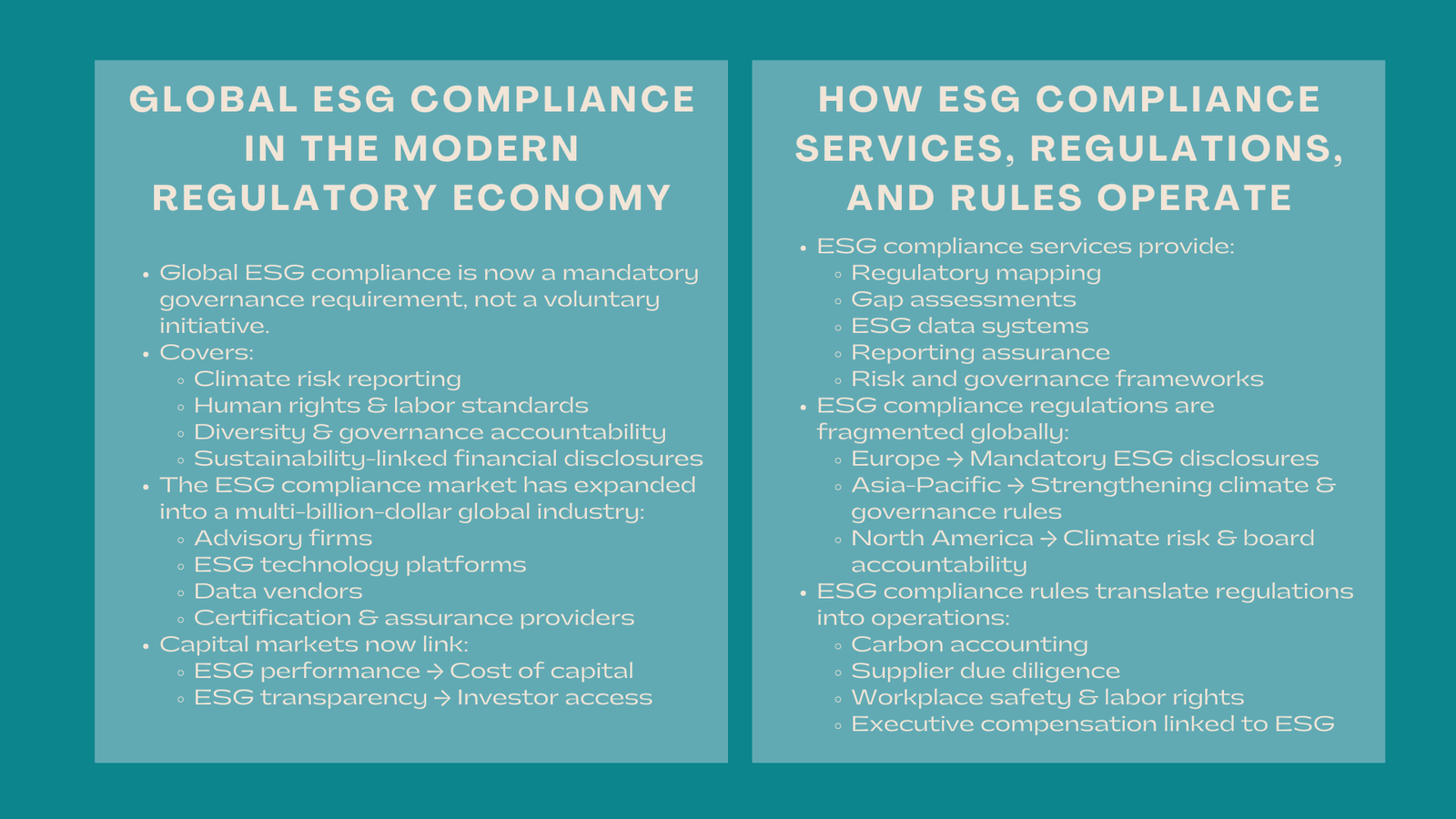
The term global esg compliance means the capacity of companies to meet internationally accepted environmental, social, and governance standards in various jurisdictions. In contrast to conventional financial compliance, ESG compliance also extends to climate risk reporting, human rights, modern slavery prevention, diversity measurements, board accountability, carbon disclosure, and sustainability-related financial performance.
As a matter of fact, there is no one global authority on global esg compliance. Rather, it is a product of a stratified mechanism of national rules, supranational systems, set of investor requirements and voluntary international standards. It is the multi-layered structure that makes ESG compliance especially challenging to multinational enterprises.
1.2 Why Global ESG Compliance Is No Longer Optional
The expectations of ESG have changed in the last ten years, which is no longer reputational branding but direct enforcement of regulations. Verified ESG disclosures have now become a prerequisite to accessing capital by financial regulators, stock exchanges, development banks, and institutional investors. The lack of strong global esg compliance will limit the funding of companies, impose legal fines, brand devaluation, and loss of investment.
2. The Rapid Expansion of the ESG Compliance Market
2.1 Structural Growth of the ESG Compliance Market
ESG compliance market place has become a multi-billion dollar international sector which involves advisory companies, technology solutions, assurance companies, data companies, and certification companies. The factors that lead to this increase include regulatory escalation, investor pressure and accountability structures of the supply chain that demand continuous ESG checks.
Currently, corporations invest substantial budgetary resources to the ESG infrastructure such as ESG management software, third-party verification, combined reporting platforms, and regulatory advisory support. The long-term expansion of the ESG compliance market is more of a structural change than a shift in the status of regulation.
2.2 Capital Markets and the ESG Compliance Market
The standardized ESG metrics are being utilized by institutional investors in increasing dependence on asset allocation strategies. With the expansion of a sustainability-linked financing, the esg compliance market is viewed as a gatekeeper to access to capital. Firms that have a weak ESG reporting framework have increased cost of capital, they are not listed in ESG indices, and their issuance of sustainability-linked bonds are limited.
Such a capital market connection has turned the compliance with ESG into a governance undertaking into a fundamental financial strategy.
3. The Strategic Role of ESG Compliance Services
3.1 What ESG Compliance Services Deliver to Organizations
Esg compliance services offer systematic arrangements in the risk recognition, regulatory mapping, gap evaluation, data gathering, system design, reporting assurance and regulatory interpretation. These services are translated into operational activities in finance, supply chain, human resources, operations, and corporate governance based on legal requirements.
The growth of esg compliance services is an indication of the technical complexity of environmental regulations, which is currently demanding interdisciplinary skills in law, finance, climate science, engineering, and data analytics.
3.2 Why Companies Outsource ESG Compliance Services
Although certain companies develop in-house ESG departments, a majority of them depend extensively on ESG compliance solutions as a way of coping with the multi-jurisdictional complexity of regulation. Jurisdiction regulatory expertise, live tracking of emerging ESG laws, and the credibility of independent assurance required by investors and regulators, are provided by external advisors.
In the case of multinational organizations, it can be very expensive to amass the same internal expertise as it is to outsource to dedicated ESG compliance vendors
4. ESG Compliance Regulations and Their Global Impact
4.1 The Fragmented Nature of ESG Compliance Regulations
Esg compliance regulations differ significantly across regions. Europe has established one of the most comprehensive regulatory landscapes, with mandatory ESG disclosures tied to financial reporting obligations. Asia-Pacific jurisdictions are rapidly strengthening climate and governance reporting rules, while North America focuses on climate risk disclosures and board governance accountability.
The rules of ESG compliance vary enormously in various regions. Europe has created one of the most extensive regulatory environments, whereby there are compulsory ESG disclosures that are connected with the financial reporting requirements. The jurisdictions of Asia-Pacific are fast advancing the climate and governance reporting regulations, whereas North America concentrates on climate risk reporting and board governance responsibility.
The dispersion of the esg compliance regulations poses a significant compliance burden to international companies that are involved in different regulatory jurisdictions. One sustainability measure can be mandatory in one jurisdiction but be optional in the other.
4.2 Enforcement and Legal Liability Under ESG Compliance Regulations
ESG compliance regulation in the enforcement aspect is growing at a quick pace. Financial fines are now imposed by regulators on greenwashing, misrepresentation of ESG metrics and non-compliance with required disclosure standards. There is a growing personal liability of directors and senior executives to flawed ESG disclosure.
Since ESG is now part of financial regulation, breach of esg compliance regulation exposes to civil and criminal liability in some jurisdictions.
5. ESG Compliance Rules and Corporate Operating Models
5.1 Translating ESG Compliance Rules into Business Processes
Esg compliance rules serve as operational implementation of ESG regulations into corporate policy/procedure. These regulations regulate the procedures of carbon accounting, vendor due diligence requirements, whistleblower procedures, occupational safety measures, incentive schemes of the executive in line with sustainability performance, and board-level ESG auditing.
In order to have a sustained global esg compliance, the organizations need to be in a position to entrench the rules of esg compliance in the procurement systems, internal audit system, human resource policy, risk management model, and the enterprise resource planning system.
5.2 The Operational Burden of ESG Compliance Rules
The net load of the esg compliance regulations applies to almost all business operations. Emissions and waste management have to be documented in operations. Diversity and safety as well as labor rights have to be monitored by human resources. The teams of supply chains need to certify environmental and social standards with tier-two and tier-three suppliers. Finance departments should establish the connection between ESG measurements and the integrated reports and external assurance.
The ESG compliance rules perimeter justifies why ESG compliance ceased to be a departmental responsibility but rather a cross enterprise governance practice.
6. Core ESG Compliance Challenges in Global Organizations
6.1 Data Integrity and Measurement Risk
One of the most important esg compliance challenges is ESG data reliability. In contrast to financial accounting, most of the ESG measures do not have standardized approaches to measurement. The areas of carbon emission, exposure to human rights, working conditions of suppliers, and biodiversity impact are estimated, sampled, and audited by third parties.
Lax integrity of data puts the organization at the risk of regulatory action, lawsuits by investors and brand crises. This has made data governance one of the most pressing esg compliance issues in the international market.
6.2 Regulatory Fragmentation and Jurisdictional Conflict
The other key compliance issue of ESG is having conflicting ESG regulations across borders. What can be termed sustainable finance in a given jurisdiction might not be included in another jurisdiction. Unpredictable carbon pricing policies, human rights documentation guidelines, and environmental permitting policies make global compliance strategy difficult.
Such fragmentation adds considerably to compliance expenses and requires an ongoing regulatory surveillance system in a global ESG program.
6.3 Cost, Talent, and Technology Constraints
The growing speed of the ESG regulation exerts financial and organizational stress on the business, especially SMEs. The hiring of skilled ESG executives, the implementation of ESG software packages, and the externality of assurance procedures add to the increase in compliance costs. These organizational structures are entrenched esg compliance challenges that every organization irrespective of its maturity faces.
7. Integration of ESG Compliance into Enterprise Risk Management
7.1 ESG as a Core Category of Enterprise Risk
Global esg compliance has become one of the main risk types in the scope of enterprise risk management at the leading organizations. ESG risk is classified in terms of climate transition risk, supply chain disruption, labor violations, governance failure and social license to operate.
Organizations enhance their scenario planning, efficiency in the use of capital, as well as alignment of insurance coverage by integrating global esg compliance with enterprise risk registers.
7.2 Financial Institutions and ESG Risk Governance
The asset managers and banks are further pressured by the regulators to incorporate the ESG risk in the credit evaluation, investment approval, and management in the portfolio. Lack of showing global compliance of esg at portfolio level subjects financial institutions to regulatory fines, capital sufficiency fines, and damaged reputation.
8. The Role of ESG Compliance Services in Regulatory Assurance
8.1 ESG Assurance and Verification Functions
Along with advisory, esg compliance services now comprise formal assurance and verification services. They are independent ESG audits that confirm greenhouse gas inventories, human rights due diligence systems, governance structures and sustainability disclosures.
These verification services play a comparable role to financial audits whereby they help to promote market trust when it comes to integrity of ESG reporting and they contribute towards regulatory compliance with regulations on esg compliance.
8.2 ESG Compliance Services as Strategic Business Partners
Elegant esg compliance services are currently running as long term change agents. They are not just responsive to regulations but are dynamic in setting ESG strategy road maps, digital reporting framework, governance structures and assurance pipelines in accordance with the future regulatory trends.
This strategic position makes the market of esg compliance solidly grow in the world.
9. Digital Transformation of ESG Compliance Infrastructure
9.1 ESG Technology Platforms and Automation
More sophisticated digital solutions are used to report on the ESG end-to-end, track emissions in real-time, conduct due diligence of suppliers automatically, and map regulations. Such systems save the errors in manual reporting and enhance effectiveness in the compliance across boundaries.
The digital ESG platforms play the role of technical support of the global ESG compliance, as it provides the possibility of continuous monitoring instead of annual snapshot reporting.
10. The Future Trajectory of Global ESG Compliance
The future of international esg compliance will be determined by stricter climate policies, obligatory biodiversity reporting policies, the broadening of the social accountability regulations, and the direct links to financial reporting policies. The esg compliance market will further accelerate its growth as convergence of the regulatory regimes and enforcement of the same increases.
Meanwhile, ESG compliance regulations will become increasingly more finer-grained in terms of data validation, internal control, and sophisticated digital compliance technology. Companies that do not invest early will not be able to grow compliance at tolerable cost and risk levels.
Conclusion
In the modern regulatory economy, global esg compliance has become a defining requirement for corporate legitimacy, capital access, and long-term survival. The current growth of the ESG compliance market is an indication of the entrenched nature of the ESG requirements within financial regimes, supply chains, and governance frameworks. With the tightening of esg compliance regulations and the further operationally challenging nature of esg compliance rules, organizations are turning to the help of increasingly complex esg compliance services to avoid compounding complexity.
However, ongoing ESG compliance challenges of data integrity, regulatory fragmentation and corporate capacity still test the corporate resilience. Those companies that can consider ESG compliance as a strategic system of governance and not an obligation to report will be in the best position to succeed in this new era of regulation.