ESG Valuation Methods for Financial Services: A Deep Dive Into Measuring Sustainability-Driven Financial Performance
introduction to Certified ESG Financial Valuation Methods
The financial services sector is undergoing one of the most drastic changes ever as the concept of environmental, social and governance (ESG) factors takes over when evaluating the credit worthiness, investment quality and enterprise value over the long run of the enterprise. Fintech companies, asset managers, insurers, and banks have become anticipated to estimate ESG risks and opportunities in an equivalent way as they apply to the financial analysis.
The current market environment is requiring regulators, investors as well as the clients that require valuation approaches that reflect the translation of the sustainability performance into the financial results. This article (among many potential angles) concentrates on one of them: the way financial institutions use ESG valuation models in its application to client portfolios, to direct capital allocation, and to enhance risk management in general. Learning these valuation tools, financial institutions will be able to incorporate more sustainability in the decisions they make when lending and investing, enhancing transparency, and extending market credibility.
1. ESG Valuation and its role in the contemporary financial services.
1.1. Broadening of Regulatory and Market Expectations.
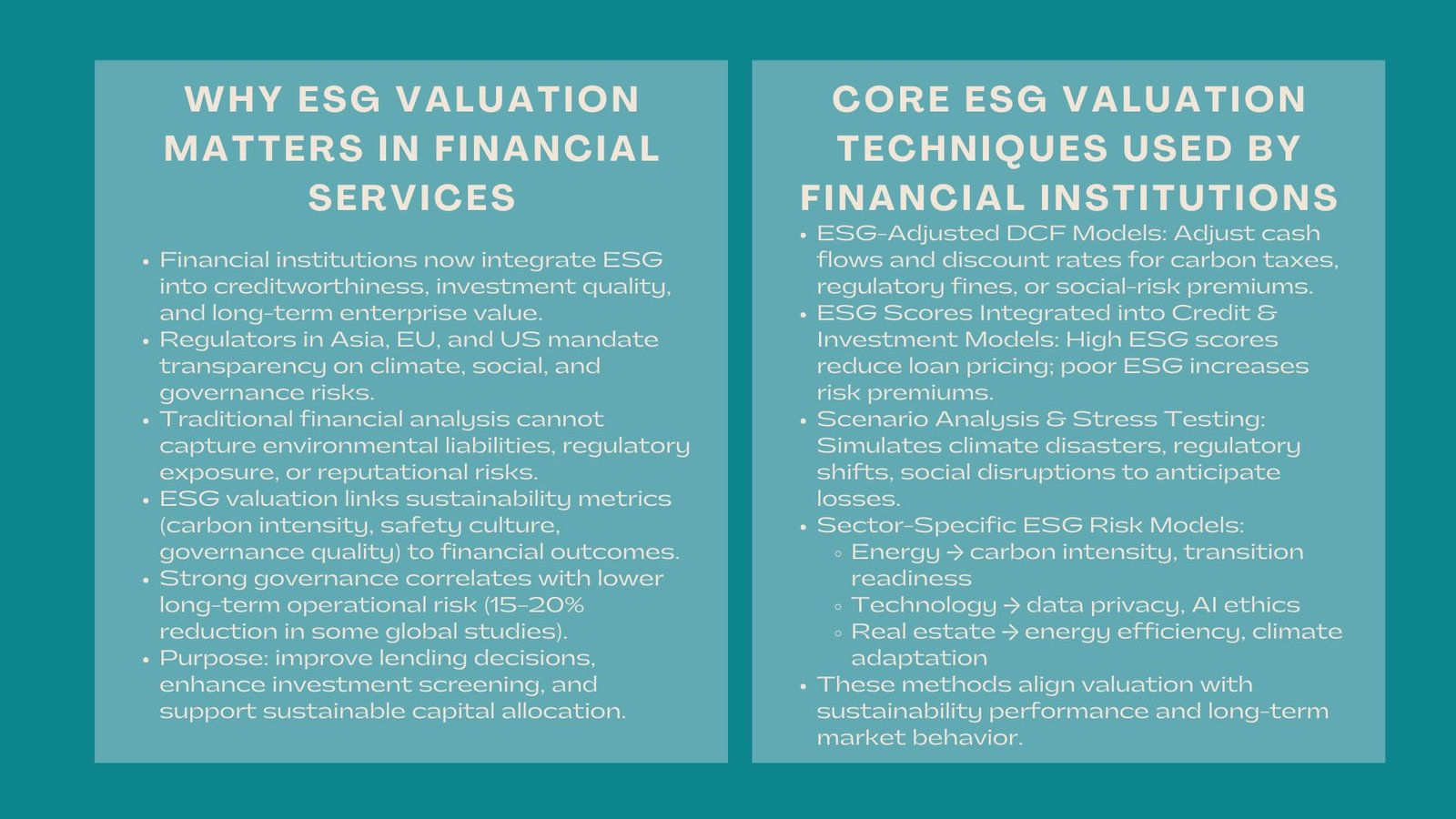
Governments in Asia, Europe and the U.S. are getting stricter on reporting of climate, social risks disclosure and transparency in their governance. Consequently, financial institutions have to consider the impact of ESG performance on credit risk, stability and investment value. This is causing a rapid switch to ESG valuation systems to measure long term factors of sustainability, such as carbon exposure, to labor practices.
Banks and asset managers increasingly apply Financial services ESG valuation techniques to quantify environmental liabilities, measure transition risks, and price sustainability-linked financial products. As an example, to model the possible effect of increased carbon taxes on the cash flow of a borrower, lenders can apply scenario analysis; and insurers can estimate the exposure to climate-related risks before they underwrite large assets.
1.2 The Reason Traditional Financial Analysis is not Enough Anymore.
Traditional valuation methods are usually very blind to any externalities like environmental, regulatory, and reputational risk. These variables can have a substantial impact on the profitability in the long run and the corporate stability. ESG valuation techniques present a better idea because they incorporate non-financial metrics in investment and credit decisions.
One international asset manager discovered that the more firms had good governance controls, the lower its operational risk over the long term by 15-20 percent. These results support the necessity to have valuation models that consider the use of ESG measures as indicators of financial stability.
2. Basic ESG Valuation Techniques Employed by financial institutions.
2.1 Adjusted ESG Discounted Cash Flow (DCF) Models.
The ESG-adjusted DCF model makes adjustments to the cash flow projections, depending on the effects of sustainability risks or opportunities. An example is when a bank will lower revenue estimates of a high-emitting firm that is being pressurized by the authorities, or raise cost implications on clients who have poor health-and-safety records.
On the other hand, a company that embraces renewable technologies, enhances the welfare of its employees, or the firm that enforces well-established compliance programmes can have an upward adjustment in its cash flows. Adjusted discount rates including ESG are also emerging, which is risk premium in relation to poor ESG performance.
A real case scenario is that of a manufacturing client with high carbon exposure whose value is being gauged. In case, the country implements carbon pricing policies, future compliance expenses can decrease the free cash flows and decrease the valuation of the borrower and loan pricing.
2.2 Incorporation of ESG Score into Credit/Investment Model.
Scores on ESG are now established in credit rating systems by many banks and asset managers. Such scores test the environmental impacts, labor practices, community relations, board diversity, anti-corruption policies and others.
These ESG scores determine the price of a loan, changes on the interest rate, and whether to allocate the portfolio or not. An example is that a bank can lower the interest rate of loans to customers who score high in ESG due to lower credit risk and adherence to the sustainability goals.
2.3 Scenario Analysis and Stress Testing.
Financial regulators have made climate stress testing more significant. Institutions simulate various conditions like climate disasters, changes in regulations, and social disturbances to know the possible financial losses.
An example of this is a European insurer using climate stress testing to make long-term projections of liabilities in terms of rising frequency of natural calamities. These estimates have an impact on underwriting as well as the capital allocation approach.
2.4 Sector-Specific ESG risk assessment model.
The various industries have various risks of ESG. Sector-specific valuation techniques are applied by the financial institutions to reflect material problems that are unique to each industry. For example:
- Carbon intensity, readiness to transition, and impact on the community is measured in energy companies.
- The assessment conducted on technology clients is based on privacy of data, cybersecurity and the ethical use of AI.
- Energy efficiency, climate adaptation and green-building standards are analyzed on real estate borrowers.
Industry specific models allow better valuations and adherence to new rules of sustainability.
3. The Strengths of ESG Reporting to Valuation Accuracy.
3.1 The relevance of Quality ESG Data.
All valuation models are based on reliable data. Banks rely on proper data concerning emissions, governance procedures, labor regulation, and supply-chain threat. The incompleteness or low quality of ESG data may skew the valuation and place institutions under regulatory risk.
To address this challenge, many financial firms now require detailed ESG reporting finance sector disclosures from borrowers and investee companies. This information helps validate assumptions used in valuation models, supports loan monitoring, and improves portfolio-level risk assessment.
3.2 Technology-Driven ESG Data Collection and Analytics
Mature tools like AI-powered analytics, satellite tracking, and blockchain-based supply-chain tracking assist institutions to gather precise data on ESG. For instance:
- Satellite images are used to detect deforestation in agricultural borrowers.
- Emission monitoring at industries is conducted by IoT sensors.
- Blockchain authenticates the origin of raw materials employed by the clients.
The technologies increase the accuracy of valuation and adequacy to the global standards of sustainability reporting.
3.3 Verification and Assurance by the Third Parties.
ESG metrics are more credible when independent-assured and minimize the chances of greenwashing. Huge lending institutions make it mandatory to have large loans or investment transactions audited by external auditors of the sustainability reports.
As an example, a financial institution in Southeast Asia requires a third party verification of the high-risk sector in the region like mining and building. The verified ESG metrics are fed into the valuation models and enhance the accuracy of financial decisions.
4. Practical Uses: The Practical Uses of ESG Valuation by financial institutions.
4.1 Sustainable Lending and Green Finance
Banks are turning to ESG valuation more and more in order to detect companies that qualify to take sustainability-related loans or green financing. Borrowers who have high ESG performance are likely to be charged favourable loan conditions.
One of the banks in Singapore, in their case, introduced a green financing program to companies with certified low-carbon strategies. The valuation framework evaluates the intensity of emissions, transition planning and a system of governance oversight which enables the bank to capitalize more responsibly.
4.2 Portfolio Risk Management and Optimization.
Asset managers use ESG valuation to reallocate portfolios, limit the risk response of portfolios, and find long-term developments. The funds that are well integrated in ESG tend to perform better than the traditional portfolios because they are less volatile and better governed.
In the case of a European pension fund, a 20 percent portfolio reallocation was realised following ESG valuation analysis that determined that the fund had high exposure to climate transition risks in heavy industries. The relocation minimized the long-term risks and enhanced the resilience of the portfolio.
4.3 Mergers, Acquisitions and Due Diligence.
M&A transactions and financial institutions that engage in them are increasingly using ESG valuation to determine reputational risk and sustainability performance in the long-term. Governance, environmental and social risks are some of the aspects that acquirers are assessing during pre-deal analysis.
One international investment organization has given up a possible acquisition because of the ESG valuation, there were numerous environmental exploitations and governance flaws in the target company.
Conclusion
ESG valuation has emerged as a critical part of the financial decision-making process amid the increase in the sustainability pressures and regulatory demands on the institutions. Through the use of advanced valuation models, enhancement of data quality in ESG, and incorporation of sector-related risk measurement, financial institutions are able to improve the quality of credit assessments, enhance the resiliency of a particular portfolio, and direct capital towards sustainable growth. With the financial industry shifting to low-carbon global economy, the financial institutions that adopt strict ESG valuation will be in a better position to address the risks as well as opportunities and retain their competitiveness in the long term.