Case Study: Comprehensive ESG Portfolio Analysis Supporting Investment Decision-Making in Singapore
Background on Case Study Comprehensive ESG Portfolio Analysis
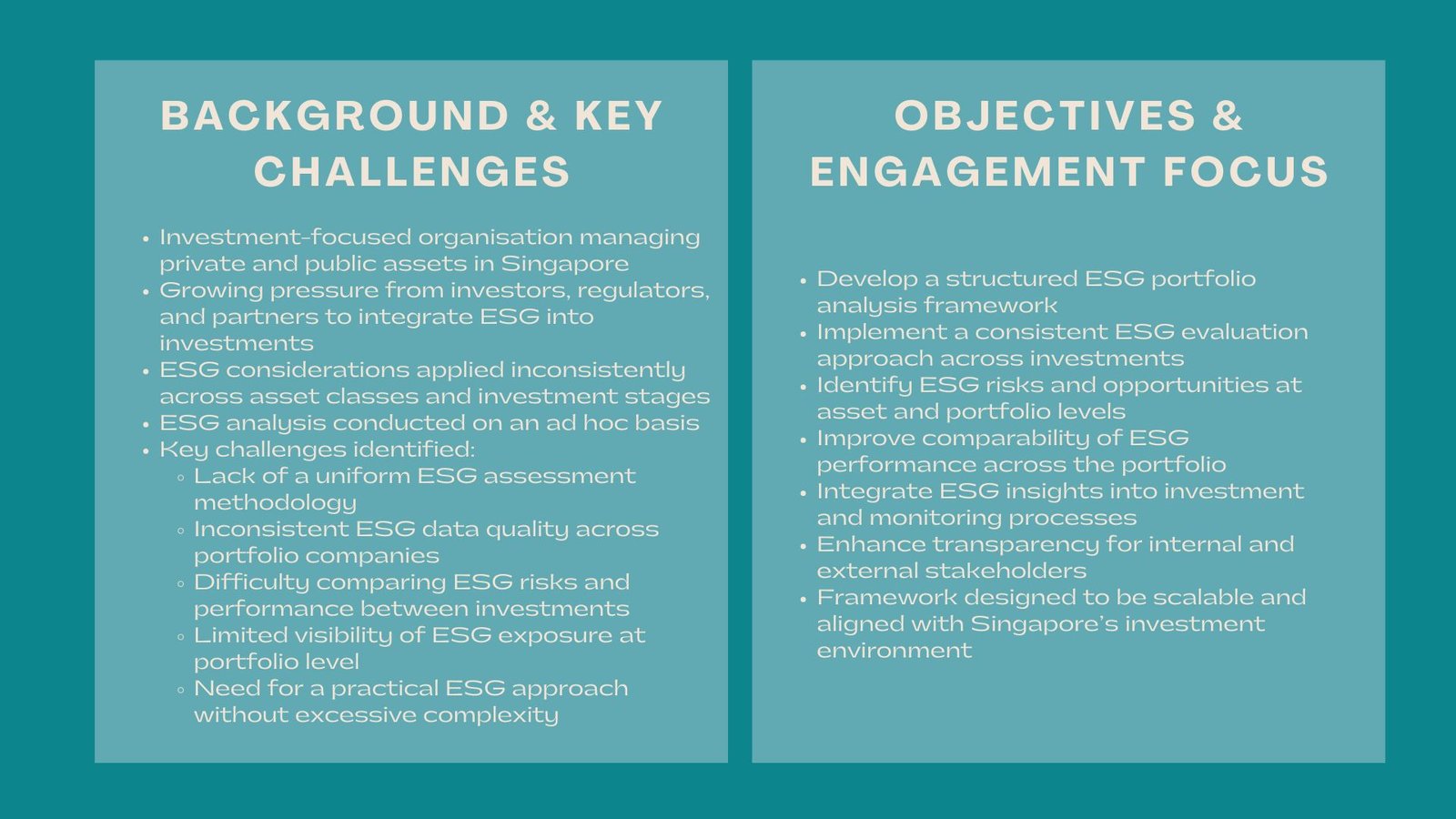
A private and publicly held assets, investment-orientated organisation was becoming increasingly pressurised to incorporate environmental, social, and governance (ESG) factors in its investment decision-making and portfolio management. Investors, regulators, and business associates wanted more light shedding on how ESG risk and opportunities were determined, evaluated and integrated across the portfolio.
Although the investment team was highly aware of financial performance, ESG considerations were not realized across asset classes and investment stages. Many ESG analyses were typically done ad hoc and it was challenging to compare ESG exposure to investments or describe a portfolio level profile of ESG.
In order to solve these issues, the organisation contracted our Comprehensive ESG Portfolio Analysis Services in Singapore to assist Investors in formulating a comprehensive, coherent, and decision-supportive ESG portfolio analysis framework.
Issues and Challenges
The organisation was facing some of the obstacles that are common to investors that incorporate ESG in the portfolio management.
One of the issues was the absence of the uniform ESG assessment methodology among the portfolio companies. ESG risks and data availability were disproportioned because different investments were undertaken in different sectors, geographies and at different stages of development. In absence of a standardised approach, ESG insights could not be easily aggregated or compared.
There was another challenge with data quality and availability. The level and quality of ESG information in portfolio companies differed greatly. Other assets were documented in a formal way; ESG policies and reporting whereas others had minimal documentation which added the chances of incomplete analysis.
Another challenge that the organisation experienced was the translation of ESG analysis into action insights. Whereas single ESG problems were determined at the asset level, portfolio-wide exposure to the ESG, risk concentration, or alignment with investment purpose was usually less visible.
Lastly, it was necessary to make ESG portfolio analysis moderate and realistic. The investment team desired a solution that would increase the decision making without introducing the needless complexity and administration workload.
Objectives
The main aim of the engagement was to give the investment organisation a broad and structured ESG portfolio analysis which would enable the organisation to make sound investment decisions and manage the portfolio.
Particularly, the organisation intended to:
- Implement a uniform ESG evaluation tool on investments.
- Detect ESG risks and opportunities on either asset or portfolio level.
- Enhance comparability of ESG performances in the portfolio.
- Encourage ESG to be incorporated in the investment and monitoring procedures.
- Increase internal and external stakeholder transparency.
The ESG portfolio analysis was to be scalable, versatile and compatible with the Singapore investment environment.
How We Helped
In our analysis of the ESG portfolio, we were particularly structured and investor-oriented, which would help us to obtain meaningful information but be feasible at the same time.
We have started our interaction with the analysis of the investment policy, asset portfolio and current ESG practices of the organisation. This assisted us to learn the role of ESG considerations that could be incorporated by various steps of the investor lifecycle that includes due diligence to post-investment monitoring.
Then we came up with a similar ESG evaluation system that is applicable to the portfolio. This framework included major environmental, social and governance dimensions but provided flexibility to be able to incorporate sector specific risks and material differences.
In the case of every investment, we have checked the existing ESG information and performed systematic evaluations to understand the areas of major ESG risks, opportunities, and exposures. In those areas where we lacked data, we concentrated on qualitative measures and analysis of risk to remain consistent without exaggerating accuracy.
On the portfolio level, we summarized ESG information to give a summarized picture of ESG exposure. This involved the detection of patterns, concentrations, and themed risks in the investment to allow the investment team to have a better picture of how ESG dynamics are playing out in a portfolio.
We also collaborated with the investment team to incorporate the ESG analysis in the current investment and monitoring practices. This meant that ESG insights could be applied together with financial analysis to inform decision-making as opposed to being an independent activity.
During the interaction, we stressed on clarity and usability. The ESG results were displayed in a decision-oriented form that was well structured to allow discussion at investment committees and stakeholders.
Value Delivered
This interaction shows that thorough ESG portfolio analysis can help to make better and more robust investment decisions.
Through the creation of a regular ESG evaluation system and concentration of ESG knowledge at the portfolio scale, the organisation became more visible to ESG risks and opportunities across its investments. The concept of ESG was no longer as challenging to talk about, compare, and incorporate into investment management and policy.
The ESG portfolio analysis framework presented a pragmatic base that the organisation would proceed to use as the portfolio progressed as part of better governance, transparency, and investment resiliency in the Singaporean environment that was gradually becoming ESG oriented.