ESG Reporting for the Utilities Sector: Building Transparency, Accountability, and Long-Term Resilience
Introduction to Advanced ESG Reporting Utilities Certification
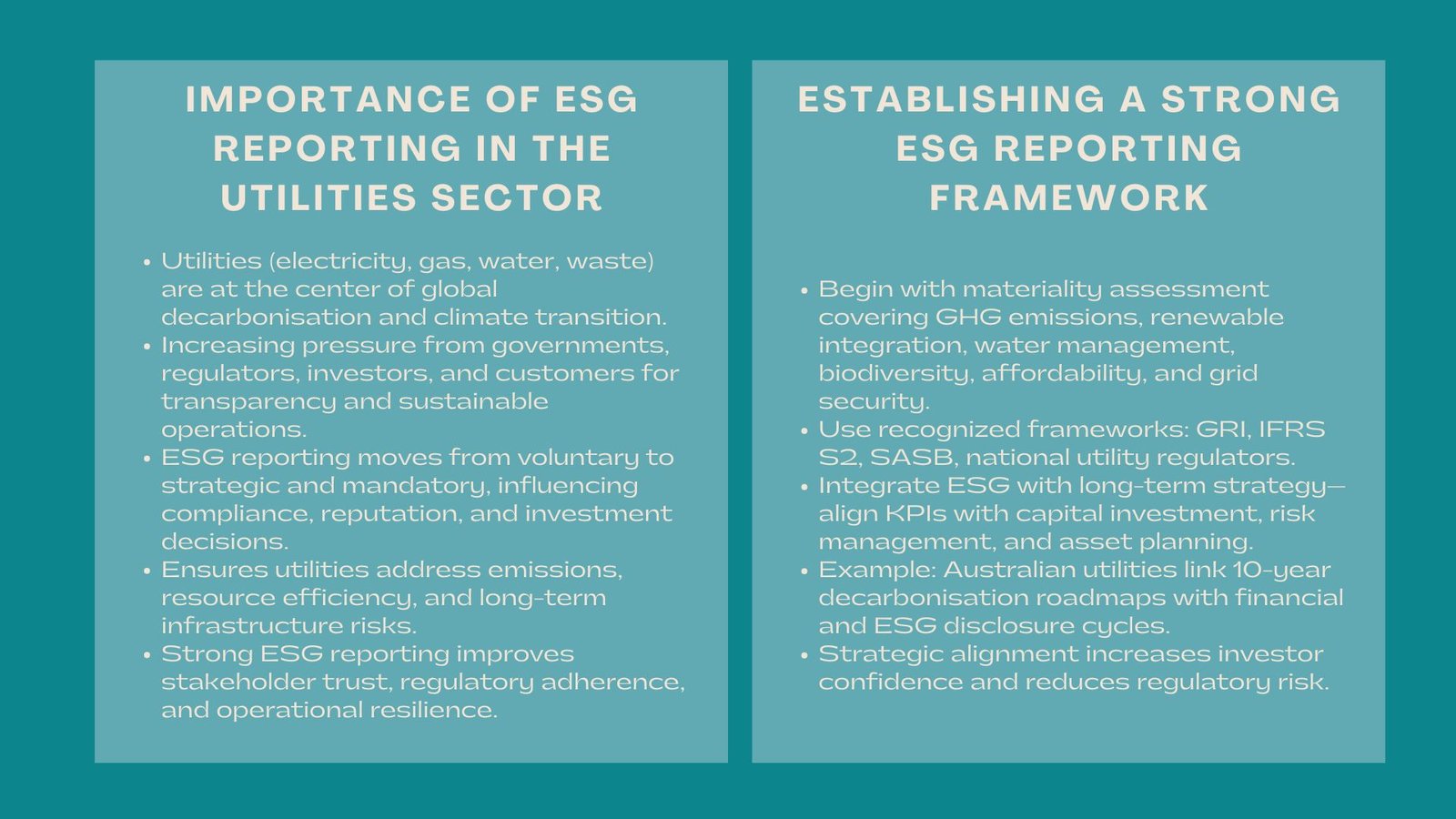
The utilities industry, such as electricity, gas, water and waste management, has found itself in the centre of the global sustainability and climate-transition process. With governments hastening decarbonisation policy and demand by investors that companies produce more evidence of environmental performance, utilities themselves are increasingly under pressure over the way they deal with both emission and resource management and long-term infrastructure risks. Simultaneously, customers and regulators demand availability of services, low prices, and responsible leadership. Strong ESG reporting has also emerged as a strategic requirement in this environment as opposed to a discretionary activity.
The article is specifically dedicated to the manner in which utilities companies can enhance ESG reporting in order to enhance compliance, stakeholder trust, and operational excellence. It analyzes the systems, standards, and governance structures that are required to realize the credible ESG transparency through elaborate sections and real world examples.
1. Setting up a Strong Platform of ESG Reporting.
1.1 Conceptualizing Material Problems in a High-Impact industry.
The utilities sector is regarded as a high-impact in practically all the global ESG frameworks as the actions of this sector directly determine the climate consequences, environmental well-being, and social well-being. As such, the establishment of material sustainability issues is the initial stage of establishing a plausible reporting framework.
The utilities should undertake organized materiality tests which take into account the greenhouse gas emissions, integration of renewable energy, water management, biodiversity, customer affordability and security of the grid. These priorities are understood in a clear way and that is why reporting will be relevant, clear and consistent to what the stakeholders expect.
In this context, many companies reference Utilities ESG compliance standards such as GRI, IFRS S2, SASB, or national energy regulators to determine which indicators should be disclosed and how performance should be measured.
1.2 Integrating ESG into Corporate Strategy
ESG reporting is enhanced when it is combined with the long-term strategic planning. Instead of coming up with sustainability as an annual report, utilities must integrate environmental and social KPIs into the capital investment choices, the asset management, and the risk planning.
Indicatively, an example of this type of alignment in the case of electric utilities in Australia is that the decarbonisation plans are now being tied to 10-year roadmaps of investment, so that renewable integration, coal retirement schedule and grid resilience upgrade programs reflect both in financial and ESG reporting cycles. This is alignment which enhances investor confidence and lowers regulatory risk.
2. Making Environmental Reporting Stronger by providing Verifiable and Accurate Data.
2.1 Monitoring the Progress of Emissions and Climate Transition.
The most controversial part of ESG reporting about utilities is environmental reporting, especially given that the reinforcement of climate-related reporting is becoming significantly more popular. The companies have to gather in-depth emissions information in Scopes 1, 2, and 3, such as power generation emissions, transmission and distribution losses, fuel combustion, purchased electricity.
Current utilities are embracing an emissions-monitoring software and real-time data systems, which is installed within the power plant and within pipeline systems. Through these tools, the carbon intensity is measured properly thus reducing the chances of non-compliance with the expectations of investors and climate regulations.
2.2 Reporting on Deployment of Renewable Energy and Decarbonisation Projects.
The utilities are significant in enhancing the speed at which energy transition is taking place globally. As such, ESG reporting should contain clear reports on renewable energy capacity addition, grid modernisation, energy-storage installation, and investments in low-carbon technologies.
A good example is the way the European utilities are reporting gigawatts of renewable energy ordered each year and outlining their future plans in investment in offshore wind, green hydrogen, and smart-grid systems. The revelations assist the investors to assess prospective growth in the long run and the credibility of climate-alignment.
2.3 Multi-Utility Company Resource and Water management.
In the case of companies that deal with water supply or wastewater services, ESG reporting should also include information about water efficiency, the minimization of leakages, the effectiveness of the treatment process, and the resiliency of the infrastructure. The Water utilities in Singapore and Japan, as an example, publicly report on measures of water quality, desalination efficacy and recycling rates to indicate that they are operating in a responsible manner.
3. Improving Social Reporting to show Customer and Community Impact.
3.1 Reliability, Affordability, and Consumer Protection.
The utilities have necessities and therefore affordability, accessibility, and reliability are key elements of the social performance. The measures of customer satisfaction, the frequency of outage, the speed of complaints resolution, and low income households affordability programs should be included in the ESG reporting.
In America, a number of utilities currently report in-depth information on billing-support initiatives and energy-saving rebates as a way of showing their dedication to social justice. This kind of transparency will enhance the public confidence and would be in line with the regulatory expectations.
3.2 Safety, Training and Diversity of the Workforce.
As utility operations are dangerous, safety of workforce is a crucial ESG concern. Firms are required to disclose lost times injuries, fatality rates, safety measures by contractors, and emergency preparedness measures.
Middle East and North American utilities have now begun issuing annual safety dashboards and third party audits to provide transparency in reporting. Moreover, the information on the workforce skill development begins to be disclosed more actively as the sector becomes more technologically advanced.
3.3 Impact on Community and Stakeholder involvement.
Major infrastructural activities may have a serious effect on the communities around them. It is critical to have transparent reporting on the community engagement and land-use planning as well as mitigation of the environmental impacts.
As an illustration, hydropower developers in Southeast Asia are now putting the outcomes of the public consultations, compensation programs and biodiversity strategies in their yearly ESG reports, a show of responsible development practices.
4. Enhancing Governance, Transparency and Compliance Controls.
4.1 Fitting Internal Controls to ESG Reporting Requirements.
There is credible ESG reporting which is anchored on governance. The utilities should have stringent internal control mechanisms, audit systems and supervision structures to enable the information reported to be authentic and verifiable.
The creation of cross-functional ESG committees and sustainability reporting boards by various utilities has not only provided assurance to adherence to significant reporting standards but also has also coordinated the diverse environmental, social, and data-management teams.
4.2 Managing Regulatory risks and emerging disclosure requirements.
Reporting requirements are rising across the globe on utilities, particularly on climate transition and infrastructure resilience. Violation of compliance may lead to either fines, bad publicity, or operating license suspension.
Organizations working in Europe, such as, have to adhere to the Corporate Sustainability Reporting Directive (CSRD) that requires extensive disclosures to be made on climate risks, supply chain impacts and corporate governance processes. In the same manner, in Asia, some regulators are currently imposing the publication of climate-transition plans on the utilities to match the 2030 and 2050 goals.
4.3 Personally Accountable Procurement and Supply Chain Transparency.
With supply chains thriving as major causes of indirect emissions and operational risks, utilities are required to report on supplier evaluation, ethical procurement and contractor performance.
The utilities that are at the forefront in this regard have ESG audits on equipment manufacturers, fuel suppliers and engineering contractors to ensure that they are in line with the expectation of sustainability. The practices increase accountability throughout the value chain, and build investor trust.
5. Using ESG Reporting as a Strategic Competency.
5.1 Specializing and drawing in Capital and satisfying the expectations of the investors.
ESG data is also increasingly being used by investors to determine risk, direct capital, and determine long-term value creation. It is common to find that utilities with plausible ESG results have enhanced access to sustainability-related financing, as well as green bonds.
European and South American utilities have been effective at raising billions in green financing through effective renewable energy plans and an open framework of ESG reporting.
5.2.1 Enhancing Operational Effectiveness and Risk Management.
It is not only transparency, but also improves the decision-making in ESG reporting. Emission details, water use, and condition of assets assist utilities to detect their operation inefficiencies and avoid expensive downtimes or fines.
This data-driven approach aligns closely with ESG accounting utilities industry practices, where financial, environmental, and operational metrics converge to support long-term planning.
Conclusion
ESG reporting has taken on the form of a hallmark of utilities aiming to earn trust, enhance regulatory adherence, investor attraction, and the global energy transition. With the increase in climate issues and stakeholder demands, utilities need to leave the past models of reporting and adopt a more transparent, more data-driven, and strategic ESG reporting. Companies that base their operations on sustainability and report their performance clearly, credibly and accountably will determine the future of the sector. With strict reporting and sound governance practices utilities can establish themselves as the pioneers in achieving a strong, sustainable and energy secure future.