Case Study: ESG Risk Management and Due Diligence Supporting Informed Business Decisions
Background on Case Study ESG Risk Management and Due Diligence
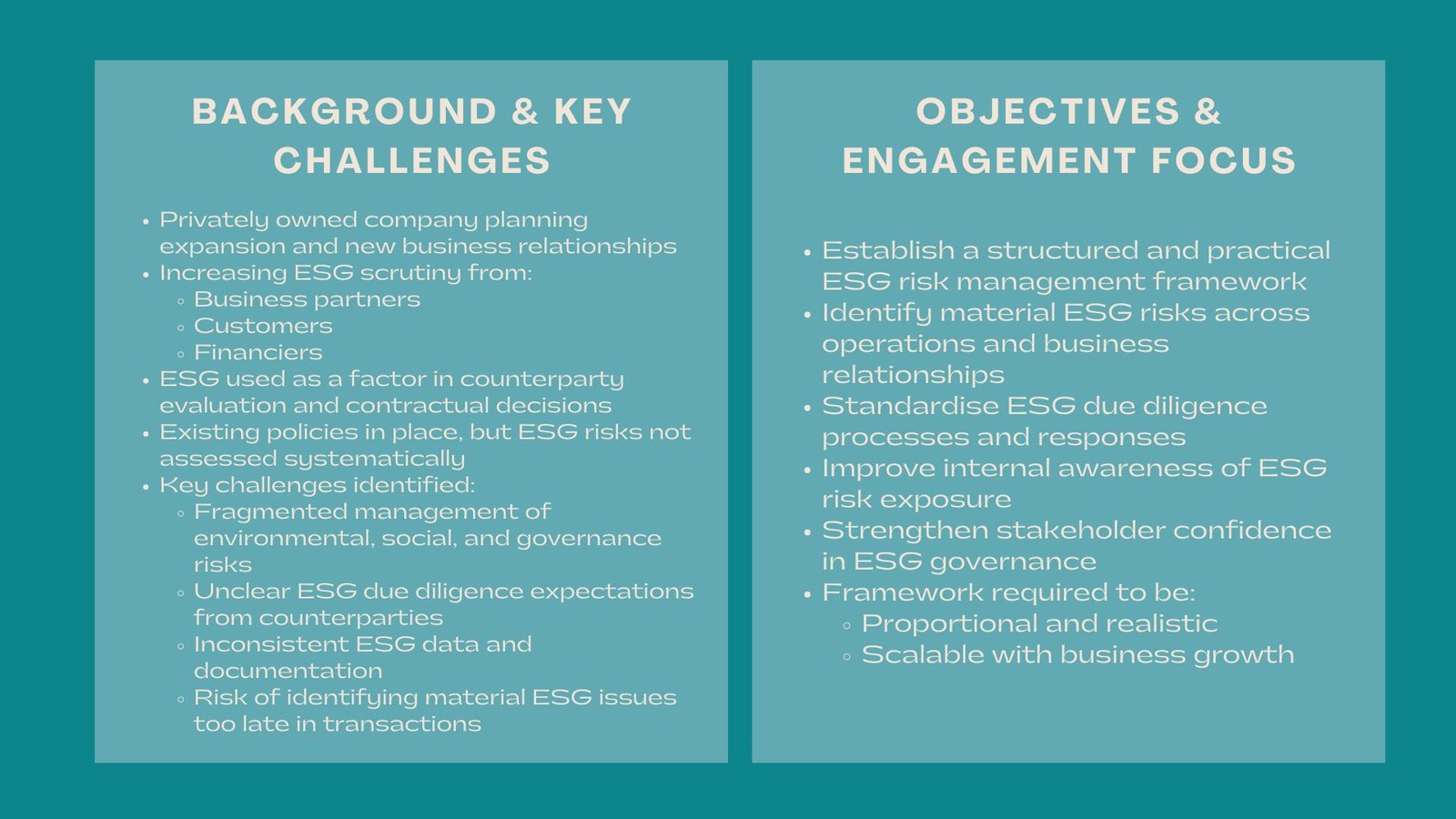
One of the privately owned firms was planning a major strategic move that included the establishment of new business relations and the growth in operation. In this exercise, the company was subjected to mounting pressure on the part of its business partners, customers, and financiers to learn more about its vulnerability to the environmental, social, and governance (ESG) risks. ESG was no longer viewed through the perspective of reputation alone, but it was now being used as a significant component of counterparty evaluation, contractual terms and conditions, and business resilience in the long run.
As much as the company already had in place policies and operational controls, the ESG risks were not evaluated in a systematic or integrated way. The management realised that the visibility of the risk exposure to ESG and the due diligence expectations were imperative so that the decisions could be made and the stakeholders could be confident.
In response to this requirement, the company contracted our Professional ESG Risk Management and Due Diligence Consulting Services to formulate a well devised ESG risk assessment and due diligence framework in line with the business purposes.
Issues and Challenges
Some of the ESG-related challenges that the company experienced have been associated with the time of growth or strategic transitions.
Lack of a coherent perspective of ESG risks was one of the leading challenges. The environment, social and governance concerns were handled in various functions hence the lack of cohesion and visibility of such concerns, at the management level.
The other problem was the uncertainty regarding ESG due diligence expectations. The counterparties were sending questionnaires and requests related to ESG to the company and internal units did not know how to systematically evaluate ESG risks or consistently respond.
There were also issues of data availability and documentation. Information on ESG sensitive issues was not always captured in writing and the likelihood of mixed disclosures and possible lapses in responses to due diligence enquiries was higher.
Lastly, the management feared that the risks related to ESG would be detected at an opportune time to prevent downstream problems. Lack of proactive ESG risk management approach saw to it that material ESG issues would be detected too late during commercial negotiations or transactions.
Objectives
The main aim of the engagement was to enable the company in the identification, evaluation and management of ESG risks in a systematic and proportional form.
In particular, the company set out to:
- Create an effective ESG risk management framework.
- Determine material ESG risks in its area of operation and relationships.
- Enhance uniformity in the due diligence of ESG.
- Enhance internal awareness of risk exposure on ESG.
- Increase the level of trust in stakeholder engagement on ESG issues.
The concept of ESG risk management and due diligence should have been realistic, scalable, and in line with the reality of operations of the company.
How We Helped
Our practice of risk-based and systematic ESG risk management and due diligence consulting was adopted.
We started by carrying out an ESG risk diagnosis to learn more about the business operations, the environment, and expectations of the stakeholders of the company. This analysis helped determine the major categories of ESG risks that are applicable to the company such as environmental impact, workforce practices, supply chain considerations and governance controls.
Then, we assisted the company in building an ESG risk assessment framework that facilitated the regular identification and assessment of ESG risks. The framework used took into account both the inherent risk as well as the controls in place and offered a balanced perspective of exposure.
As one of the elements of due diligence, we assisted in organizing ESG information and documentation to be consistent with the typical expectations of due diligence. These involved mapping of the current policies, procedures and practices to ESG risk areas and gaps that were to be addressed.
Another thing that we did in collaboration with the management is to apply ESG risk consideration in the decision-making processes. This made sure that the ESG risks were taken into account along with the financial and operational risks when considering the new relationships or strategic initiatives.
During the engagement, we focused on the clarity and feasibility. The factors of ESG risks and due diligence were discussed in terms of business relevancy, which allowed management and teams to participate in the ESG-related discussion and analysis.
Value Delivered
This participation shows that the professional ESG risk management and due diligence consulting can help make informed and more resilient business decisions.
Still, having a systematic risk management framework of ESG risks and enhancing the due diligence processes, the company became more visible to the ESG risks and better capable of responding to the expectations of stakeholders. The ESG factors were more incorporated into the management control, minimizing doubt and increasing business preparedness.
The ESG risk and due diligence framework offered a pragmatic basis that the business could further utilise as it grew its operations and got into new business deals to enhance greater governance and sustainability.