Case Study: ESG Rating and Benchmarking Consulting Enhancing Market Positioning in Singapore

Background on Case Study ESG Rating and Benchmarking Consulting 

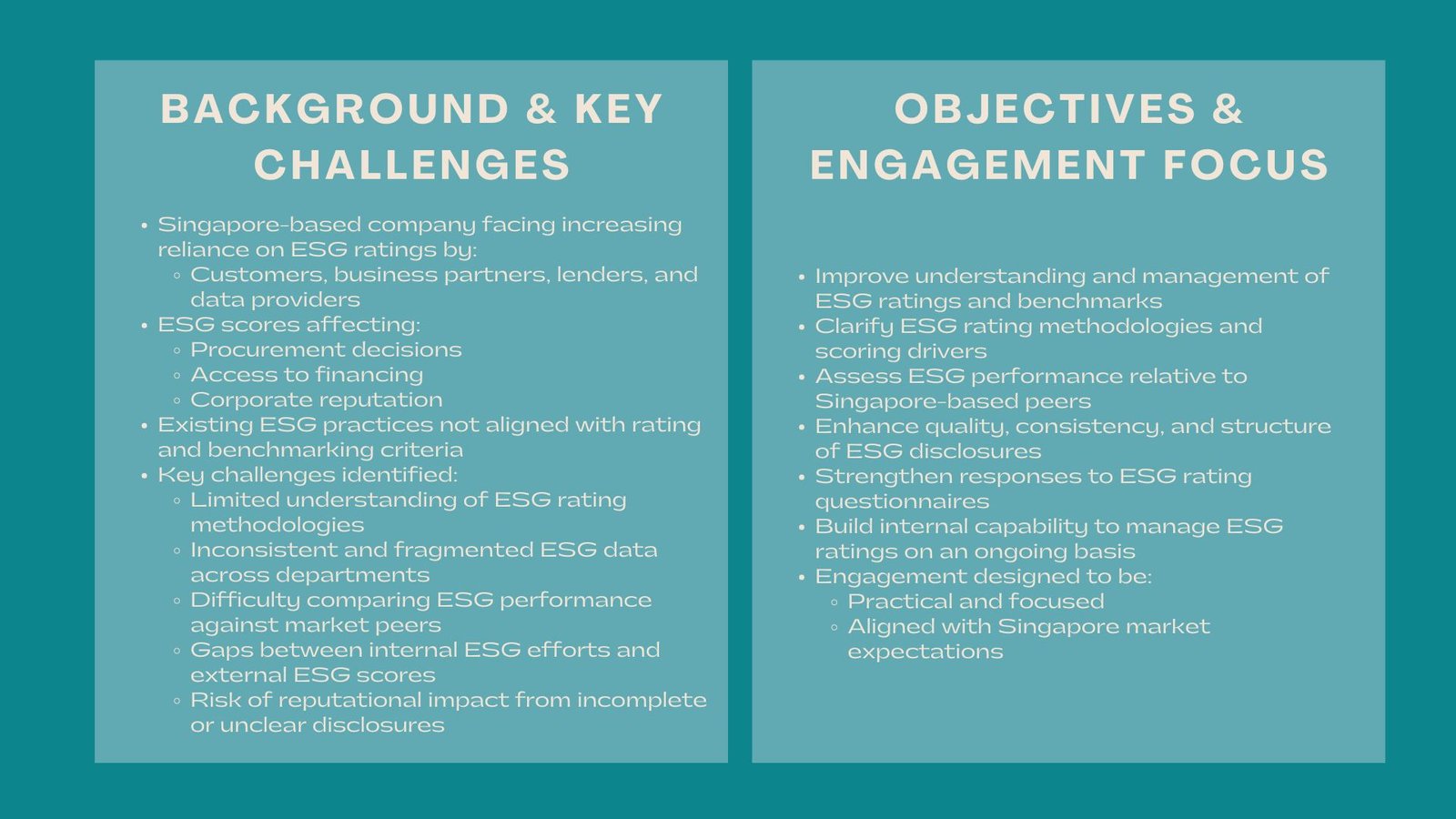
A Singapore based business was being more pressurized to answer to ESG ratings, assessment, and benchmarking activities by customers, business partners, lenders, and third-party data providers. ESG scores were starting to impact procurement decisions, access to funding and reputation. Nonetheless, the management could not see much of what was happening regarding external ESG ratings and the performance of the company relative to others.

Though the company had over the years been practicing several practices concerning ESG, they were not systematically mapped to the criteria that is usually done in ESG rating and benchmarking practices. Consequently, discrepancies in the internal ESG activities and external ESG rating were experienced at the company.

In an effort to enhance transparency, comparability and credibility, the company sought the services of our Experts ESG Rating and Benchmarking Consulting in Singapore in an effort to learn more about the approaches to the ESG rating and improve its benchmarking ratio.
Case Study ESG Rating and Benchmarking Consulting

Issues and Challenges

The company had a number of challenges that are usually related to the ESG ratings and benchmarking.

Unclearness in ESG rating methodologies was one of the issues. Various rating providers employed quite different criteria, weightings, and data sources and it was hard to compare scores and indicate the particular areas of improvement by the management.

The other difficulty was the data availability and consistency. The information concerning ESG was not always recorded in a format, which was easy to analyze as a part of rating questionnaires or benchmarking frameworks, and was distributed across the departments. This restricted the company in its response to the ESG assessment with precision and effectiveness.

The company, too, did not have a clear picture of its performance, compared to its counterparts in the Singapore market. The management might not have been able to assess whether the existence of ESG gaps was an actual performance concern or disclosure variations without sound benchmarking.

Lastly, reputational risk was a cause of concern. Incomplete or uneven disclosure of ESG made the possibility of misrepresentation or poor scoring more likely, and it might also influence stakeholder confidence.

Objectives

The main task of the engagement process was to help the company to know about, control, and make improvements in their ESG ratings and benchmarking source.

In particular, the company was to:

  • Become clear about ESG rating and benchmarking techniques.
  • Evaluate existing ESG rating compared to the peers.
  • Enhance regularity and quality of ESG reporting.
  • Enhance reactions to ESG rating survey.
  • Establish internal competences to handle ESG ratings on a continuous basis.
The involvement must have been viable, centered and directed towards the Singapore business environment.

How We Helped

Our primary ESG rating and benchmarking model was based on the business description and stakeholder environment of the company.

Our interaction has started with the evaluation of the current ESG practices and disclosures and the available data in the company. This supplied a backdrop insight about the alignment of the current information in the company and the typical ESG rating benchmarks.

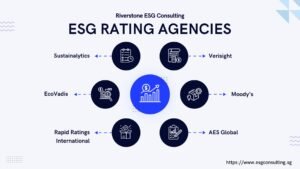
We then checked on the selected ESG rating and benchmarking structures to the stakeholders of the company. We have not centred on any individual rating agency but identified the general themes, indicators, and expectations across the methodologies. This enabled us to convert complicated ESG rating needs into precise and actable suggestions.

Then, we performed benchmarking analysis to find out how the company can be positioned in regards to ESG with respect to peer organisations that work in the similar environment. This benchmarking was based on the indicators of performance as well as disclosure practices underlining the relative strength and aspects in which the company was in bad shape compared to its peers.

We encouraged the management to format the ESG information in a more fashionable approach that matched the rating methodologies. This involved enhancing the organisation of the data, explaining policies and processes positively and reinforcing the narratives in the place where quantitative data was scarce.

During the interaction, we collaborated with the management to clarify the logic behind the ESG rating, clarify the scoring drivers, and develop internal comprehension. This was aimed at helping the company to be active and comfortable when it comes to taking part in the process of ESG rating and benchmarking as opposed to responding defensively to the scores.

Value Delivered

This interaction demonstrates how professional ESG rating and benchmarking consulting may assist companies in Singapore to overcome the ever-progressing ESG evaluation environment.

Through enhanced transparency, comparability and alignment with rating methodologies, the company was now in a better position to present its ESG endeavors in a credible and consistent manner. The ability to understand the effectiveness of ESG performance and disclosure related to compelling external perceptions provided the management with a better understanding of how to make informed decisions.

The systematic benchmarking practice also offered a viable basis of continuous ESG enhancement and stakeholder involvement to the competitiveness and resiliency of the company in a market whereby ESG is increasingly becoming a significant factor.

Related Posts

Transform Data Into Impact With Expert ESG Reporting

Ensure transparency, meet compliance, and build stakeholder trust-connect with us today.