Case Study: Building a Sustainable ESG Strategy to Support Long-Term Business Value in Singapore
Background on Case Study Building a Sustainable ESG Strategy
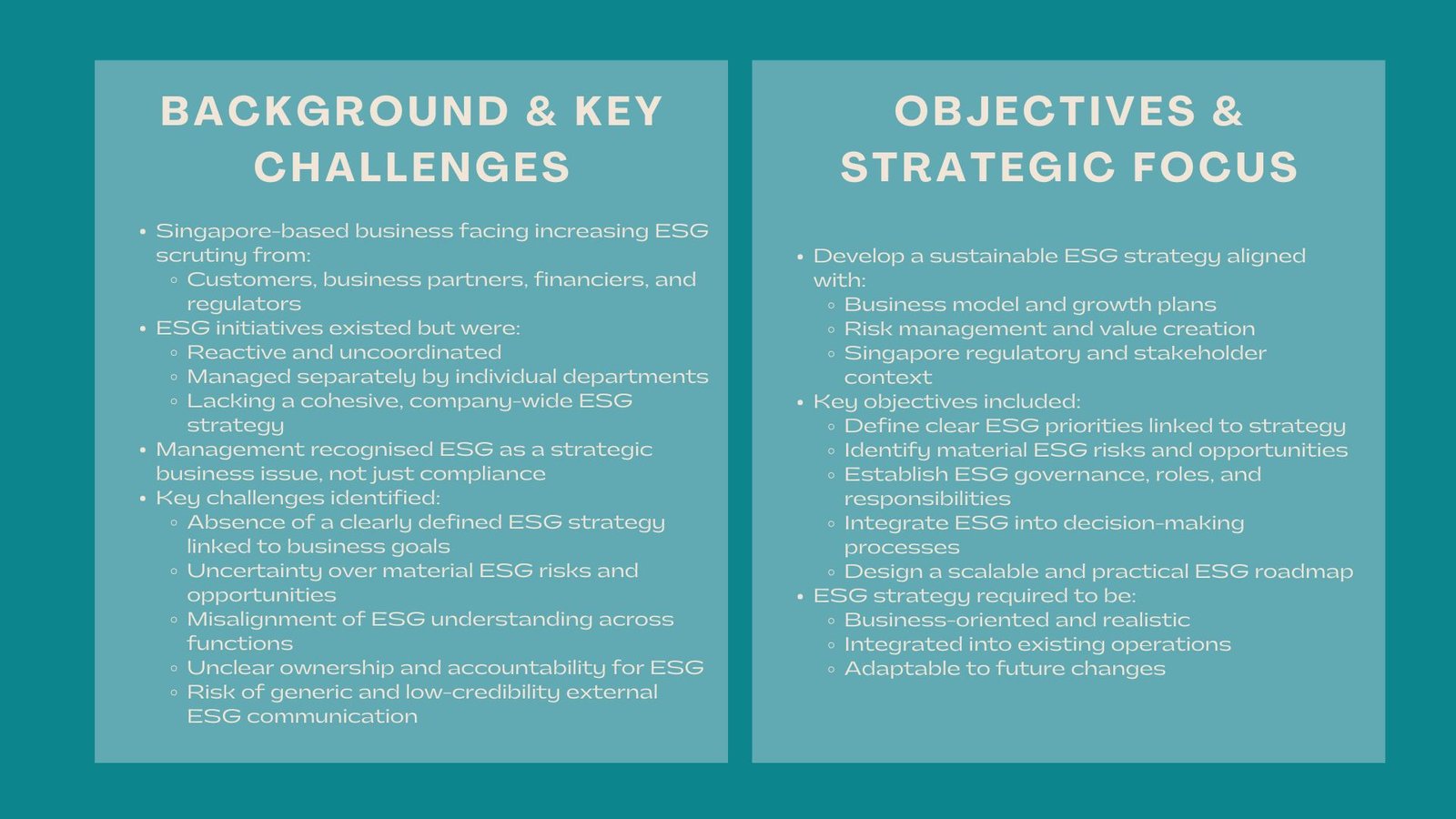
One of the Singapore-based businesses was under growing pressure to show commendable and systematic response to environmental, social and governance issues (ESG). Stakeholders such as customers, business partners, financiers and regulators were increasingly focusing on the extent of integrating ESG considerations into strategy as opposed to considering them as independent initiatives.
Although over the years, the company has been executing different actions associated with sustainability, much of this was in the form of reaction and without a cohesive strategy of ESG. Individual departments had ESG initiatives that lacked strategic direction of direction, and thus, it was challenging to communicate progress, risk management, and effect impact uniformly.
Understanding that ESG was no longer a compliance activity, but a strategic business matter, the management took on board our How to Build a Sustainable ESG Strategy for Businesses in Singapore Services to design a systematic, feasible and scalable ESG strategy in line with the long run goals and environment it operated.
Issues and Challenges
The company had a number of problems that are prevalent in businesses with an early to intermediate level of ESG maturity.
Lack of clearly defined ESG strategy was one of the challenges. Although the management noted the significance of ESG, there was no common framework to connect ESG priorities with both business objectives and risk management, and value creation. This led to piece meal initiatives with low strategic value.
The other challenge was uncertainty on materiality. The issue is that the company did not know which ESG issues are the most appropriate to its business and stakeholders in the Singapore context. Given the lack of a definite materiality lens, the company would run the risk of over-investing in low-impact projects at the expense of attending to more important ESG risks and opportunities.
Another problem that the company experienced was alignment problems. The interpretation of ESG differed among different functions and their degree of commitment was also different. There were no clear definitions of the ESG responsibilities and this created an issue of gaps in ownership and accountability.
Lastly, there was the concern of credibility and consistency by the management. The absence of an organized ESG policy meant that external messages would be viewed as being overly generic or unfounded to inspire trust in the stakeholders.
Objectives
The main goal of the engagement was to assist the company in developing and executing a sustainable ESG strategy that would be aligned to its business model, growth strategies and the Singapore regulatory environment.
In particular, the company strived to:
- establish explicit ESG priorities related to business strategy.
- Name material ESG threats and opportunities.
- Introduce rules and responsibility of ESG.
- Consider the ESG when making decisions.
- Design a scalable ESG strategy which might change over time.
The ESG strategy should have been realistic, balanced and integrated in the current business processes instead of being a stand-alone point.
How We Helped
We were systematic and business-oriented in our approach to ESG strategy development, which aims at implementing ESG concepts into viable and sustainable practices.
We started by carrying out an ESG diagnostic to get the business model, the business environment, and the current practices that the company has regarding ESG. The evaluation aided in the determination of existing strengths, weaknesses, and weaknesses of exposure pertinent to the Singapore market.
Then we assisted the company in streamlining material ESG issues. It entailed conducting environmental, social and governance assessment with respect to business operations, stakeholder expectations and regulatory considerations. The result was a set of ESG priorities that were narrow and specific to the strategy of the company and its risk profile.
It is on these priorities that we collaborated with the management to shape clear objectives and themes of ESG. They were in line with the overall business objectives of the company as ESG initiatives were to be used to add value in the long run and not compliance in the short run.
We also helped in the creation of the ESG governance structures such as the roles and duties within the organisation. This contributed to instilling responsibility and making sure that ESG factors were factored in the management control and decision-making.
We helped the company to create realistic plans of action and performance indicators of ESR, with the aim of implementation. The focus was placed on the initiatives that could be implemented, realistic schedules, and the opportunity to monitor the progress along the way.
During the engagement, we had been working on internal processes of understanding and alignment. This was done through workshops and discussions which helped the leadership and the key stakeholders to have the same understanding of the ESG priorities and how these were converted into daily operations.
Value Delivered
This interaction evidences that a systematic method of developing a sustainable ESG strategy could assist the Singaporean business to outgrow disjointed initiatives to more organized and reputable ESG framework.
Aligning ESG priorities to business strategy and governance helped the company to enjoy more clarity, consistency and confidence in dealing with ESG issues. The ESG strategy offered a viable basis on the way to the further actions, communication with the stakeholders, and the changing regulation demands.
This engagement formed the structured ESG framework, which enabled more efficient risk management, better internal communication, and resilience of business in the context of an ESG-oriented business environment.