Case Study: Comprehensive ESG Training and Capacity Building Supporting Organisational Readiness in Singapore
Background on Case Study Comprehensive ESG Training
An organisation based in Singapore was undergoing a rising number of ESG-related demands on the part of regulators, business partners, investors and customers. Although the senior management recognised the strategic relevance of environmental, social, and governance (ESG) considerations, the level of ESG understanding was not balanced throughout the organisation. The different functions understood the issues differently and the ESG responsibilities were not well entrenched in the day-to-day decision-making. Prior to that, the organisation was using inconsistent briefings and informal learning, which were not adequate when ESG considerations started to affect procurement decisions, customer due diligence and long-term strategy. The management realised that to implement the ESG effectively, the policies are not enough; it should have people with the appropriate skills, knowledge, and responsibility in every hierarchy. To address this gap, the organisation used our Comprehensive ESG Training and Capacity Building Programs in Singapore in order to develop internal ESG capacity in a systematic, realistic and scalable process.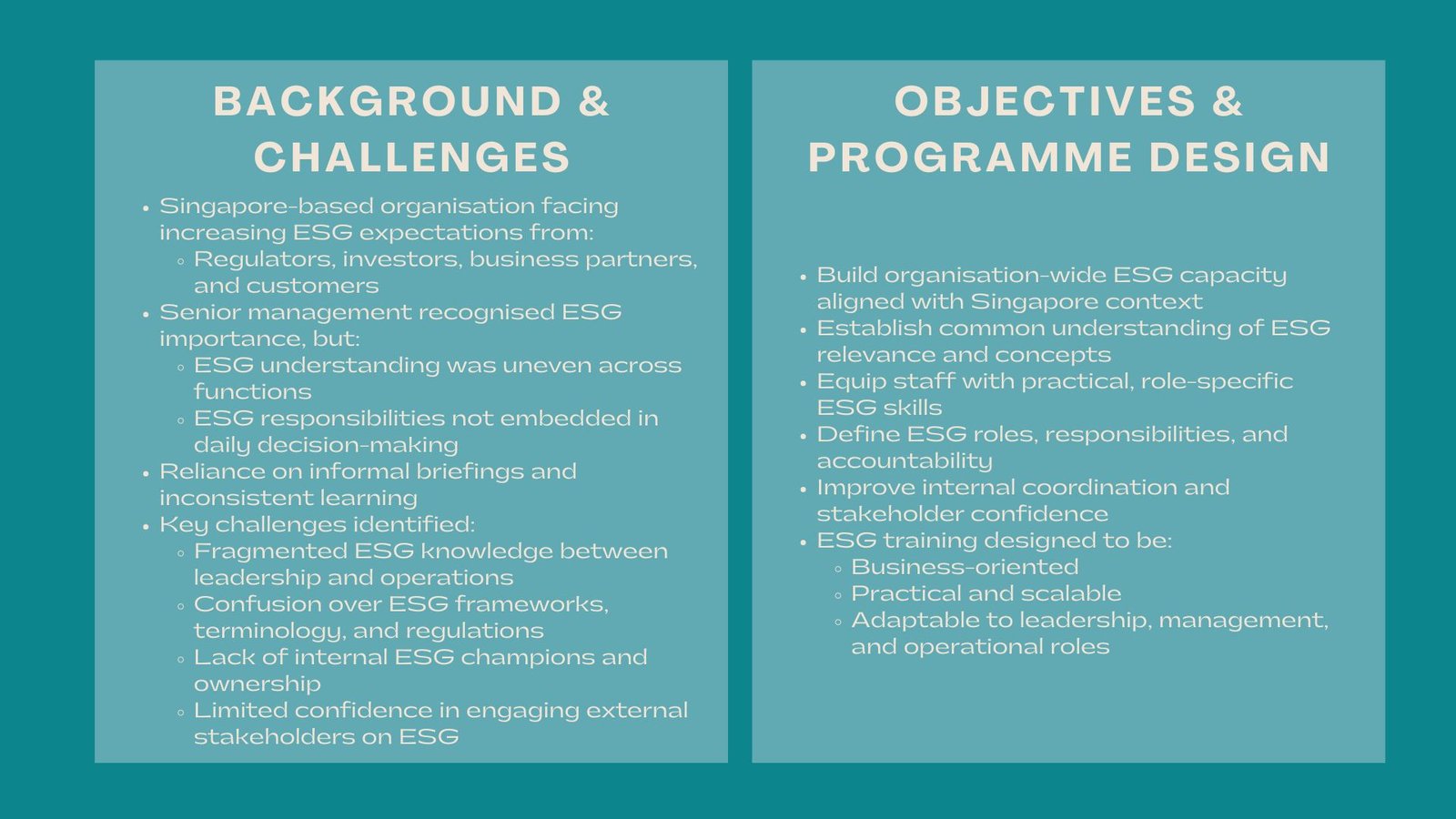
Issues and Challenges
The organisation has a number of challenges that are typical of businesses at an early to middle level of ESG maturity. Lack of coherent ESG knowledge within teams was one of the major difficulties. The senior leadership was strategic in its outlook on ESG and the operational and support functions were not clear of how ESG was relevant to them. This brought the discrepancy of top-level promises and implementation. The other issue was that there was confusion concerning the ESG frameworks, terminology, and regulatory expectations. The employees did not know how the ESG concepts were to be translated into actual business activities and it was feared that it might be misunderstood or there was the risk of over-committing without much knowledge. Internal ESG champions were also absent in the organisation. Unless the ESG initiatives were handed over to trained professionals, the sustainability initiatives would be treated as a one-off compliance rather than a business process. Lastly, there was a low trust of involving external stakeholders on ESG issues. Management desired the teams to be enabled to answer questions raised by the customers, partners and regulators in a consistent and credible manner in relation to the ESG, but due to the gaps in knowledge available, the same was not achievable.Objectives
The main aim of the engagement was to build the capacity to have better ESG throughout the organisation by providing a systematic training and capacity-building programme based on the Singapore business environment. Precisely, the organisation was interested in:- Establish a common perception of ESG concepts and relevance.
- Provide staff with relevant ESG skills that they can use in practice.
- Define ESG roles, responsibilities and accountability.
- Enhance in-house coordination in regard to ESG activities.
- Increase trust in stakeholder engagement with regard to ESG.