ESG Reporting for E-commerce Sector
Introduction to Professional ESG Reporting Certification
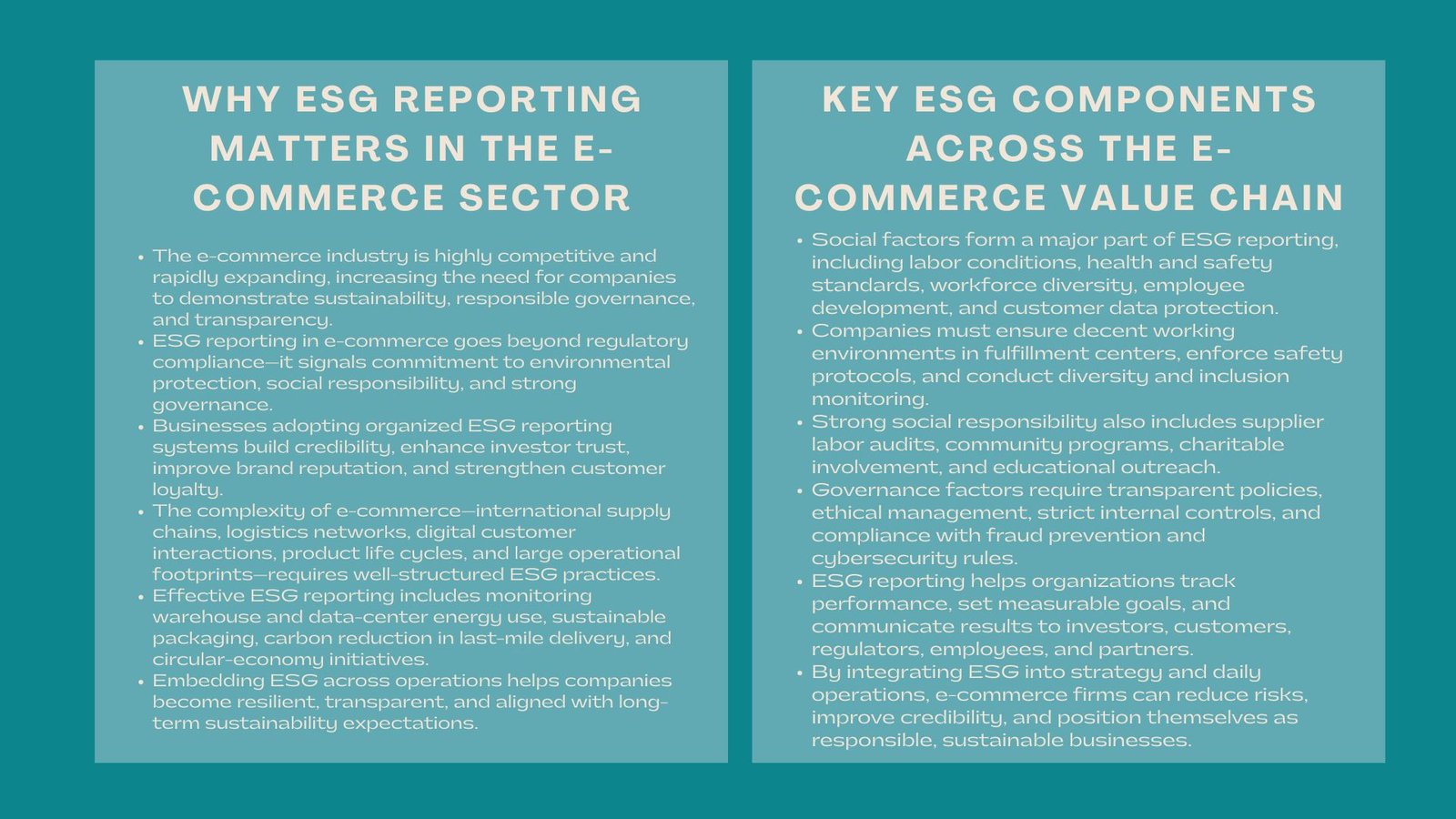
The business environment is very competitive and fast expanding especially in the e-commerce industry, where business establishments are called upon to portray sustainable practices and responsible governance, as well as transparency in their operations. ESG reporting in e-commerce is much more than compulsory, it is the continued desire by any company to keep the environment sustainably, socially responsible and with a sense of good governance. Organisations that embrace organised ESG reporting systems, not only do not need to prove to the regulatory authorities but also gain credibility, investor confidence, brand reputation, and customer loyalty.
The contemporary e-commerce system is unbelievably complex as it covers international supply chains, massive logistics, online interaction with customers, e-marketing, e-paying, product life-cycle, and a multi-product line. It is mandatory that the ESG report in this industry involves a thorough embedment and coordination of the environmental, social and governance concerns of all business functions. It will involve tracking of warehouse and data center energy use, sustainable packaging, lessening carbon footprint in last-mile delivery, effective use of returns management, and the need to implement the circular economy.
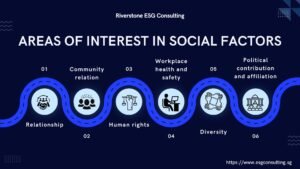
Social factors are also the same component of the e-commerce ESG reporting. The companies have to provide decent labor conditions, impose occupational health and safety standards in fulfillment centers, address workforce diversity and inclusion, develop professionals, and maintain the high level of data privacy and cybersecurity. Another important pillar is governance and this implies open policies, supply chain management, and ethical management, strong internal controls, anti-fraud rules, and corporate governance arrangements.
The systematic ESG reporting allows members of the organization to monitor the performance, E-commerce ESG compliance guide establish measurable goals, as well as convey success to stakeholders, such as investors, regulators, customers, employees, and business partners. Inculcating ESG into operation and strategy planning, e-commerce companies will enjoy a competitive edge, reduce the risk factor, and introduce themselves into responsible and sustainable businesses.
Designing a Comprehensive ESG Reporting Framework for E-commerce
Establishing ESG Policies and Operational Guidelines
The initial and important step towards successful ESG reporting is to have clean defined policies that clearly state the sustainability goals that the organization is geared towards and the governance practices used. Environmental commitments including energy efficiency, carbon footprint, reduction and waste minimization should be defined as social commitments including labor standards, diversity in the workplace, and protection of customers. The governance policies must define the roles, responsibility, accountability structure and compliance requirements among the departments.
The formulation of working guidelines would mean a uniformity in the ESG practices across the organization. To illustrate, standardized energy-saving measures could be adopted in warehouses, sustainable sourcing could be implemented by procurement teams, and the digital marketing teams could also encourage ethical relationships with customers. These guidelines are the basis of systematic data collection, monitoring, and reporting of e-commerce business, which facilitated the alignment of everyday e-business with strategic ESG objectives.
Aligning ESG Reporting With Global Standards and Regulatory Requirements
E-commerce firms tend to have a presence in the various jurisdictions and each jurisdiction has its own laws of ESG disclosures. A credible and comparative reporting by aligning with international frameworks, including Global Reporting Initiative (GRI), Sustainability Accounting Standards Board (SASB) and Task Force on Climate-related Financial Disclosures (TCFD) is possible. At the same time, corporations should comply with local policies concerning sustainability reporting, environmental laws and regulations, labor laws and regulations and consumer protection.
The internal workshops and training programs serve to make the employees understand these frameworks and get acquainted with materiality assessments and incorporate ESG considerations into the operations and financial reporting. Companies may also initiate ESG software applications that will automatically assemble compliance data of international business, which will provide the correct reporting of real time and minimize the error of manual reporting.
Measuring ESG Performance Across the E-commerce Value Chain
Environmental Metrics and Impact Monitoring
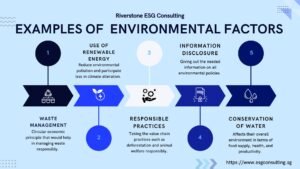
The major aspect of ESG reporting is environmental sustainability. The issues in e-commerce business include high energy consumption of warehouses and data centers, transportation emissions, waste packaging, and returns on products. ESG reporting entails the need to monitor the performance of the environment throughout the value chain.
Measures such as energy per unit consumed by a given warehouse, greenhouse gas generated per order, recyclable and bio-degradable packaging rate, product returns and consumption of water in production or distribution plants are measured. Optimizing routes, electric vehicles, and environmentally friendly packaging solutions are some of the green logistics measures that companies can incorporate to minimize the environmental impact. Regular monitoring will also allow tracking of the progress built against set targets that can be reported on the annual ESG reports.
Social Responsibility and Workforce Management
Ecosystem Scope Social considerations on ESG reporting entail work ethics, human welfare, diversity and inclusion, and customer relationship. The companies are to monitor the rate of employee satisfaction, employee turnover, variations in diversity, incidents of on-job crashes, training and development of staff, and customer satisfaction feedback.
Indicatively, introducing systematic employee development initiatives and lifelong professional training do not only enhance the productivity of the workforce as well but also as a social responsibility initiative. To enhance responsible sourcing companies can incorporate supplier labor audits as a way of guaranteeing that the working conditions are fair across the supply chain. The social measures also include community involvement programs, charity donations, and education outreach programs, proving the desire of the company to have more influence on the higher society.
Governance Metrics and Ethical Oversight
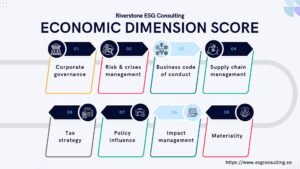
Accountability, risk management, and ethical behavior are few of the sustainabilities of governance. The metrics of ESG governance can comprise what the board of directors does with equity diversity, sustainability initiatives, the effectiveness of internal audit, the anti-fraud and anti-corruption policies, and adherence to data privacy.
Corporate governance frameworks have to be documented, internal governance committees should be established, reporting lines should be defined, and audit trails should be enforced so as to maintain transparency. Good governance is a good way of making sure that ESG initiatives have become part of the corporate strategy and are reviewed on a regular basis and also reported in a credible way to both internal and external stakeholders.
Leveraging Technology for ESG Data Collection and Reporting
Digital Tools and ESG Dashboards
ESG reporting of e-commerce is dependent on technology. Companies can monitor the energy use, waste management, carbon emissions, labor practices, supplier compliance, among other essential indicators in real-time using digital tools, automated platforms, and analytics dashboard.
With the ESG dashboards, the professionals will be able to gather data across the departments and geographies, visualize, find areas of concern and produce reports to the regulators, investors and customers. Automation provides less manual errors, consistency, and enables organizations to act timely to the changes in the ESG requirements.
Advanced Analytics for ESG Insights
In addition to data collection, advanced analytics are also applied to help companies evaluate the level of ESG performance, compare it with the performance of other companies in the industry, and to predict the results in the future. The prediction models are able to model the effects of the sustainability plans, streamline the supply chain, and assess the risk exposure. Analytics also assists companies to find out material ESG factors that are most applicable to the stakeholders, allocate resources that provide a high priority and arrive at strategic decisions made wisely.
Integrating ESG into Strategic Planning and Business Decisions
Embedding ESG Principles Across Business Functions
The e-commerce companies should incorporate sustainability concerns in all their business operations, which include procurement, logistics, marketing, customer service, and product development, in order to create an effective effect of sustainability. The integration of ESG entails assessing supplier sustainability processes, applying to the development of the circular economy, the ESG valuation online retail development of products that are environmentally friendly, incorporating ethical promotion of the marketing approach, and improving interaction with the customers with sustainable programs.
Linking ESG Performance to Financial and Operational Outcomes
ESG reporting does not just work as a compliance activity, but it directly impacts the performance of the business. One such case is energy efficient logistics, which can lower operating costs, ethical sourcing which enhances supplier relations and strong governance which limits regulatory and reputational risks. Those companies, which can adequately connect ESG performance with financial indicators, will be in a position to show a quantifiable value to the investors, set themselves apart on the market, and become more competent in the long run.
Advancing ESG Reporting Practices for E-commerce Leadership
Staying Ahead of Emerging ESG Trends
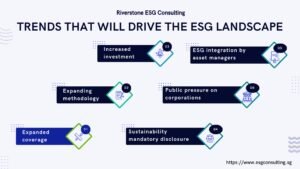
The ESG environment keeps on changing. There are constantly changing rules, investor requirements and customer tastes and tastes so that e-commerce companies must preempt and respond to this. To be aligned with the changes in regulations, as well as market demands and requirements, companies can conduct ESG training and workshops in the industry, and engage in international sustainability efforts.
Driving Innovation and Market Differentiation
Innovation in the product development, packaging, supply chain management and customer engagement can also be a result of the ESG reporting. The way e-commerce firms can create a competitive advantage is through factors such as the implementation of sustainable logistics, provision of products that are sustainable, and transparency of sustainability in ESG activities. Through the application of ESG principles to strategic planning, businesses are likely to increase their brand reputation, attract responsible investors and develop long-term value in their customers, employees, and the society in general.
Conclusion
Formal e-commerce reporting of the ESG is not merely a compliance procedure, but an essential business strategy that supports the long-term business sustainability, its efficiency, and competitiveness. Through the systematic application of ESG practices, it is possible to express corporate responsibility to the environment, social responsibility, and sound governance systems that would reinforce the trust in a stakeholder among the customers, investors, employees, regulators, and business partners.
Using the E-commerce ESG compliance guide and ESG valuation principles embedded in operational, financial and strategic decision-making, the professionals can monitor, evaluate and report the performance in a transparent, reliable and actionable way. Such a systematic approach makes ESG initiatives measurable, evidence-based, and corporate objective and world sustainability based.
An effective ESG reporting initiative does not only involve implementing a simple disclosure program. It allows organizations to make the idea of sustainability work on a variety of levels of the e-commerce processes, including the optimal energy use in the fulfillment centers, warehouses, and data centers, eco-responsible packaging, decreasing the carbon-related emissions of the logistics, and impacts of the products life cycle.
At the social level, organized ESG reporting encourages workers with fair labor relations, social solicitude, variety and inclusion, data security, data rate security and equitable treatment of customers so that human resource and relationships amongst stakeholders are administered with decency and duty. The presence of governance, such as open policies, risk management procedures, internal controls, and ethical decision-making procedures, keeps a close check that all environmental, social, and governance activities get coordinated and tracked according to the available strategy of the organization.
Using ESG principles is a move that equips with tangible operational benefits. Sustainable supply chain management has the capability to help the companies attain crucial cost efficiencies, reduce waste as well as optimize energy consumption. Meanwhile, there is improved engagement and satisfaction of employees as well as their retention due to apparent organizational concern with social responsibility resulting in a motivated and productive workforce.
When the organizations are perceived as being transparent as well as accountable in their operations, the customer trust and loyalty get strengthened resulting in repeat business and long-term cooperations. There is growing interest among investors in ESG-compliant companies because it has been identified that a high sustainability performance is associated with reduced risk exposure, financial strength and high long-term value generation.
Incorporating the values of ESG in the main business practices makes e-commerce companies leaders in sustainable business. This stance can help the organization to acquire responsible investment, achieve strategic relationships, and innovate in spheres like practices of the circular economy, green logistics, sustainable design of products, and ethical digital marketing. Companies that maximally incorporate the ESG in the decision-making and operating processes receive a competitive green card as they are distinguished in the market, develop their brand reputation, and exercise thought leadership as to sustainability.
ESG reporting for e-commerce sustainability and compliance processes should be continually refined to maintain such benefits. Using technology like ESG dashboards, predictive analytics, data integration platforms, organizations are able to bring together the Information of various functions of operation, create real time insights and detect areas where performance is failing, and also predict the outcome of future ESG.
When ESG initiatives are aligned with the global standards in reporting, domestic regulations, and stakeholder expectations, further credibility is created, as well as regulatory compliance and accountability is enhanced as the organizational culture of responsibility.
Conclusively, ESG reporting framework is the key to developing the e-commerce businesses into sustainable, resilient, and responsible market leaders. Operation excellence, trusted by stakeholders, innovative growth, improved financial performance, and measurable positive influence on social and environmental conditions can be considered tangible long-term gain of the companies, which place sufficient emphasis on ESG integration.
With the integration of ESG across all business strategy levels, and business practice, e-commerce organizations stand to enjoy a long term competitive edge, improve transparency, and generate lasting value to their customers, employees, investors and the global market at large therefore remaining dynamic, accountable, and progressive in an ever dynamic, and environmentally conscience industry.