ESG Compliance in Agriculture Sector
Introduction to Professional ESG Agricultural Standards Course
In the modern business environment that is becoming more and more sustainable, agricultural organisations are under increasing pressure by regulators, investors, consumers and the immediate societies to implement sound environmental, social, and governance (ESG) business practices.
The agribusinesses and farms are no longer judged merely on the output and profitability in the production business; they are now judged on the level of responsibility and sustainability of their business. Operational excellence, market positioning and sound governance practices are embracing the environment stewardship practices, social responsibility practices and effective governance practices as critical elements.
The structured ESG compliance programs will give agricultural entities an outline of the steps on the way to the systematic implementation, measurement, monitoring, and reporting of ESG performance. By following an Agriculture ESG compliance checklist and implementation of ESG accounting principles into the day-to-day routine, farms and agribusinesses are likely to find the risks, enhance transparency, and build trust between the stakeholders.
Such frameworks are not only beneficial in assisting organizations to adhere to both local and global requirements but also keep the strategic benefits, which include enhancement in the operational efficiency, availability to sustainable finance, enhanced brand reputation, and resiliency in the long term.
The ecosystems that agriculture organizations work in are elaborate in relation to which the influence the environment has, the way of work including labor practices, interactions with the community, and governance supervision are mutually dependent.
Through a comprehensive ESG strategy, all the operational decisions made by the company are based on its sustainability, social impacts are handled with responsibility, and governance measures render accountability, transparency, and satisfaction of compliance. Besides that, structured ESG programs enable organizations to present their sustainability promises in a believable way showing regulatory agencies as well as investors and the wider population that they are taking the initiative in dealing with the ESG issues.
Enhancing Environmental Sustainability Across Farming Operations
Implementing Sustainable Practices for Agriculture
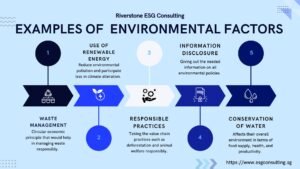
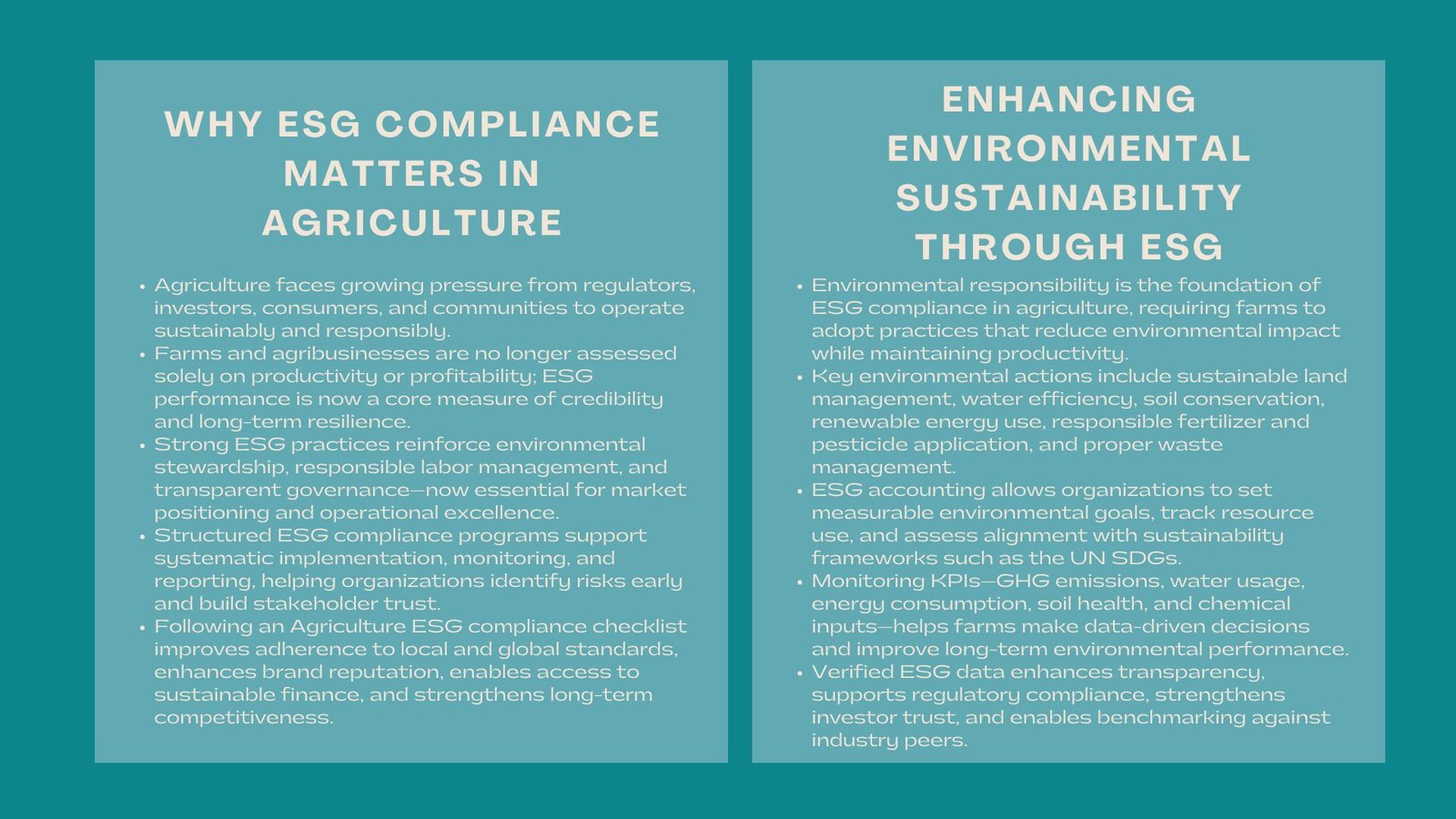
The agricultural ESG compliance is based on environmental responsibility. Farms should consider using methods which have less effects on the environment as long as they are productive and profitable. These measures such as sustainable land management, accurate use of water, preservation of soil, incorporation of renewable power, management of fertilizers and pesticides, and two responsible waste management mechanisms are applied. Through the integration of environmental issues in the process of operations, the agricultural organizations can reduce the consumption of resources, decrease the carbon emission, and enhance biodiversity conservation.
Organized ESG accounting for farming industry enables farms to monitor and assess the success of such programmes in the long run. This includes the establishment of quantifiable environmental goals, tracking consumption of resources and also controlling conformity to best practices. These programs are also useful in assisting organizations to foresee and act on regulatory adaptations as described by the tighter demands of environmental compliance, carbon disclosure and world-sustainability schemes including the UN Sustainable Development Goals (SDGs).
Monitoring Environmental Performance Through ESG Accounting
ESG accounting has the means to measure environmental impacts on a system scale. The greenhouse gas emissions, water efficiency of use, energy, soil health, and chemical use are some of these KPIs that are crucial in the management and understanding of environmental performance. Through the incorporation of the principles of ESG accounting in operational decision-making, organizations will be able to gauge the results of sustainability, determine the areas in which the company can improve, and make evidence-based decisions based on information, which will result in better long-term operational and environmental performance.
The transparency and credibility are also guaranteed with the proper ESG accounting. Verifiable ESG data is becoming a requirement by the investors, the lenders, and other stakeholders who continue to deal with agricultural organizations. Proper accounting and reporting of the environment initiatives will enable organizations to prove that they are in compliance with the National laws and regulation, International standards and also sustainability framework, though will also allow organizations to draw parallels with the industry counterparts.
Advancing Social Responsibility and Governance Practices
Promoting Social Responsibility Across Farming Communities
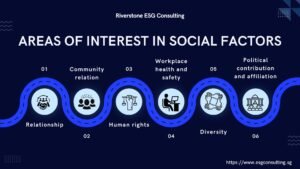
The ESG social aspect of agriculture is also very urgent. Farms are expected to deal with the welfare of its workforce, equal treatment of labor, health and safety, community involvement, and the broader social consideration of agricultural activities. Organized ESG programs assist in enabling organizations to assess the social risks, adopt mitigation strategies and generate beneficial social impacts among the employees, their suppliers, and other communities in and around the organizations.
Placing a socially responsible place of work can be achieved by educating employees through training, establishing a decent labor, and developing systems that effectively solve grievances. Social responsibility also ensures community participation like educational support, development of their localities and even providing activities of farming without impacting negatively on the local communities. Such initiatives enhance the stakeholder trust besides an aura of shared value that drives loyalty among the employees and increases the social license to operate the organization.
Strengthening Governance and Risk Management
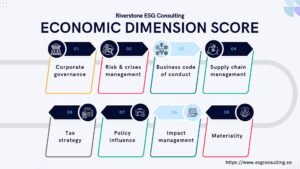
The pillar of ESG compliance of agriculture is governance. Effective governance will help in ensuring the implementation of ESG projects is underway and also ethical business conduct is practiced and legal and regulatory obligations are complied with. Good governance involves the development of clarity in policy, level of decision making, channel of reporting as well as accountability.
Along with the operational control, the governing systems of agriculture are concerned with risk management. Farms are prone to various risks, which include environmental risks, non-compliances with regulations, and supply chain risks as well as reputational risks. When herded into governance, ESG enables organizations with proactive control to these risks, strategic orientation towards sustainability, and making sure that long-term value creation is taken into consideration during decision-making. Good governance helps in ensuring accountability, instill confidence among the stakeholders and help in giving confidence that the ESG initiatives are being well executed throughout the organization.
Measuring, Reporting, and Optimizing ESG Performance
Leveraging ESG Metrics and Data Analytics
Data analytics is one of the key ESG compliance areas. In order to track and assess the level of ESG performance in agriculture, the organizations in the field should employ quantifiable measures. Using the information about environmental impact and social outcomes and effectiveness of governance, the organizations will be able to track trends, evaluate progress and ensure the ESG initiatives have the best effect.
Combined with accounting practices, ESG reporting systems present uniform structures to capture and report performance in a variety of dimensions. Through such systems, the management of these companies is able to record KPIs on a regular basis, report to its stakeholders in a transparent manner and to show continuous improvements. With the help of analytics, farms will be able to detect inefficiencies in their operation, anticipate ESG risks, and apply specific interventions to achieve sustainability.
Developing an Agriculture ESG Compliance Checklist
Agriculture ESG compliance checklist is an instrument that can be used by organizations in ensuring that ESG standards are adhered to. Examples of items displayed in the checklist are the environmental performance objectives, compliance to establish labor practices, the processes of governance and the processes of engagement of the stakeholders, and the reporting requirements. The frequent use of the checklist enables the farms to track the progress, seal the areas of non-compliance, and maintain the internal control systems.
The checklist is also intended to facilitate audit, ESG certification, and benchmarking activities and the sustainability activities are therefore systematic, measurable, and in resource to local legislation and international ESG standards. Organizations integrate the checklist into the day-to-day activities to form the culture of accountability, continuous improvement, and ESG excellence.
The Strategic Benefits of ESG Integration in Agriculture
Driving Operational Efficiency and Sustainable Growth
By incorporating the ESG principles in agriculture operation, it influences the efficiency of operations while minimizing waste, the use of resources and downplaying the environmental and social risks. By employing sustainable practices, costs will decrease over the long-run, crop yields will amplify, and flexibility to change in weather conditions will intensify. The integration of ESG also allows organizations to tap into the possibilities of green financing, impact investing, and sustainability-based financing, which can promote the growth of the organization strategically and allow it to remain viable in the long run.
Enhancing Stakeholder Confidence and Market Position
Open ESG reporting enhances trust to stakeholders among the investors, regulators, customers, and local communities. By showing the dedication to the ESG practices, the agricultural organizations will have an advantage over the competitors as responsible leaders in the industry, which, in turn, will bring additional benefits in terms of brand recognition. The confidence of the stakeholders will convert into customer retention, involvement of investors, and extended market inclusion, which will contribute to the competitive edge of the organization further.
Conclusion
The creation of an effective ESG compliance program is indeed a necessity of agriculture organizations that strive to become a long-lasting organization, increase the resilience of its operations and build the trust of a vast number of stakeholders, i.e., investors, regulatory bodies, employees, local populations and customers.
Organizations can monitor, measure, and report on the ESG performance in a structured and consistent fashion by adopting a detailed Agriculture ESG compliance checklist and by implementing a systematic way of integrating the ESG accounting principles in daily farming operations. The given approach enables the agricultural enterprises not only to efficiently respond to the environmental, social, and governance risks but also actively identify the spheres of enhancement, reduce the possible risks of operations or regulation, and be accountable on all organizational levels.
An effective ESG compliance program is not just a regulatory compliance one. It also contributes to the implementation of green practices related to environmentally friendly land use, water saving, land soil management, chemical input decrease, energy use, and minimum carbon footprint. Simultaneously, it enhances social responsibility as it focuses on welfare of the workforce, equitable labor practices, involvement in the communities and equal distribution of resources.
Besides that, ESG compliance enhances the governance systems by creating transparency in making decisions, clear reporting systems, and moral controls on company matters, and internal controls on accountability that are aligned to the local standards and international standards. Altogether, such initiatives decrease the risks of operation and increase the efficiency of resources utilizing, productivity, and also allow organizations to be completely compliant with the changing regulatory environment.
Integrating the ESG principles into the process of strategic planning, operational management, and reporting makes agricultural organizations the accepted leaders in the sphere of sustainable agriculture. Such leadership is translated into real-life gains such as enhanced investor confidence, enhanced relationship with the community stakeholders, enhanced publicity and industry credibility, and enhanced position in the local and global marketplace.
Clear ESG commitment can better enable organizations to tap green sources of funds, to attract impact-oriented investors, as well as to highlight in competitive agricultural markets with sustainability coming to represent a crucial requirement in partnerships and consumer retention.
Moreover, implementing sophisticated ESG reporting processes, capitalising on the power of data analytics, and aligning the initiatives of the organisations with the global frameworks and their local policies, the organisations dealing with agriculture can attain sustainable growth, increase operational efficiency, and gain a competitive edge over the long-term perspective.
Evidence-based choices empower farms and agricultural enterprises to make timely decisions, resource distribution, performance measurement against significant performance indicators, and the factual advancement of ESG performance over the course of time. An excellent ESG implementation also promotes innovation, stimulates the creation of sustainable farming technologies, builds better relations with stakeholders, and does not leave positive social and environmental outcomes unnoticed and measurable.
By ensuring a sustainable and organization-wide approach to ESG principles, the agricultural organizations not only fulfill their compliance needs and requirements but also participate directly in the work to spread sustainability even on a global scale (entailing the reduction of climate change, safeguarding of biodiversity, welfare of rural populations, and creation of ethical business practices).
This holistic ESG strategy will make agriculture businesses strong enough to withstand in economic, environmental, and social negligence as well as make them competitive enough to succeed in a global market that is becoming more attentive to the importance of sustainability. Aggressing all these Agriculture ESG compliance checklist for sustainable farming operations towards making the agricultural organizations an industry of the future and responsible and highly sustainable would provide long term value to their workers, investors, customers, communities and even the environment.