ESG Valuation in the Oil & Gas Sector
Introduction to Advanced ESG Oil Gas Analysis
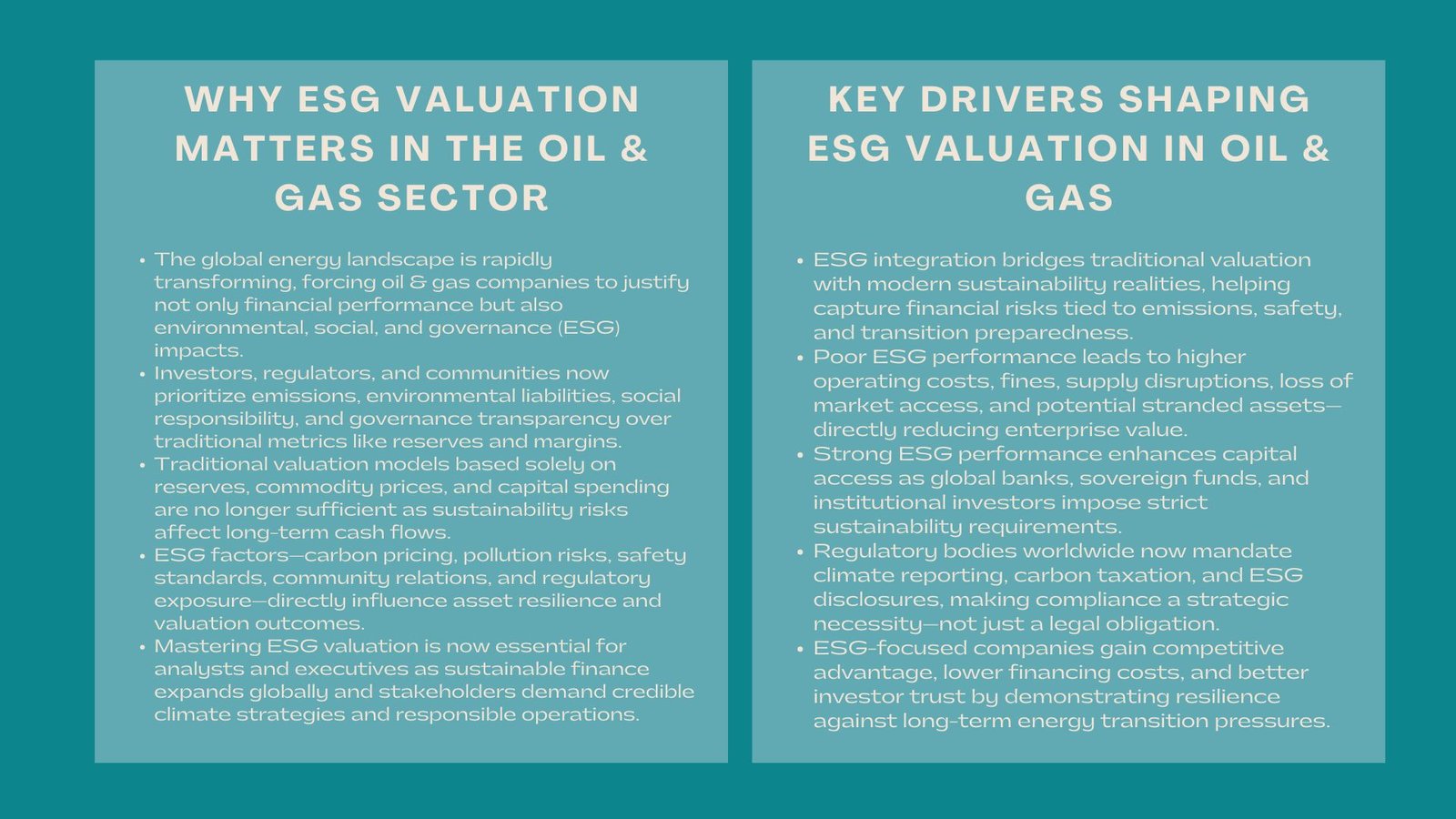
The energy environment of the world is evolving at a very fast rate and the oil and gas industry is subjected to the worst form of questioning where all other industries are also under pressure to conform to environmental changes and regulations.
The companies that have operated in exploration, production, refining and distribution must argue not only about their performance in terms of financial aspects, but also in terms of environmental, their impacts on the society as well as the clarity of their governance systems. Investors, regulators and societies are no longer appraising the oil and gas companies based on their reserves, their margin or their productivity. They are becoming more and more ESG-sensitive when making oil and gas ESG valuation.
Since the concept of sustainable finance is proliferating across the globe the capacity to incorporate the ESG indicators into the enterprise valuation becomes necessary. The energy companies cannot afford to deploy the traditional modeling tools which are based on the volume of the reserve alone, which is based on the assumption of the commodity prices, and capital spending.
In place of that they need to know how environmental liabilities, carbon pricing mechanisms, social risks, and governance structures have an impact on the resilience of financial structures on a long-term basis. To both the analysts and the executives, mastering is a skill.
The Growing Relevance of ESG Valuation in Oil & Gas
Bridging Traditional Valuation with Sustainability Realities
Traditionally the models of valuation of oil and gas were developed based on the geological information, cost of production, and the price fluctuations of commodities. Be as it may, long-term asset value has changed in the perception of analysts due to the sustainability-led revolution of the global energy systems. A company whose emission rate is high, safety practices are weak or which has limited transition planning, is at a high risk in finances. This risk may occur in the form of higher operating expenses, damaged reserves, governmental fines, shutting out of the market, or even stalled assets.
Incorporation of the ESG into valuation helps to bridge an interval between short-term success of operations and long-term strategic sustainability. It makes businesses count the impact of climate change policies, renewable energy innovations, and changing expectations of society. ESG integration is not instead of financial fundamentals, but an addition that seeks to address closer ties between operational projections and realities of sustainability that sensitivity impact cash flows in a future context, material. Due to this, the current appreciation of the oil and gas business must take a two-fold prism that will be able to visualize the economic power and stability of its performance.
ESG as a Driver of Capital Access and Compliance
The financial opportunity of an oil and gas company has been related to its ESG performance in the past years. The barring criteria or inflexible sustainability measures are being embraced by global banks, sovereign wealth funds and institutional investors prior to capital allocation. Those companies that do not believe and show plausible climate strategies or fulfill the expectations of their stakeholders tend to pay more in terms of financing or they are simply disposed of.
This is further enhanced by regulatory compliance. Asian, European, and United States governments have either enacted compulsory sustainability reporting, climate reporting and taxation on carbon. These requirements make ESG compliance energy sector companies not only a regulatory requirement but a main strategic cause of operation. When this is properly done, oil and gas companies that consider the ESG aspect of their valuation models can be more competitive and reduce the risks that are likely to disorient the financial results in the long term.
Basic Areas of ESG Valuation in Oil & Gas
Environmental Impact and Carbon Exposure Modeling
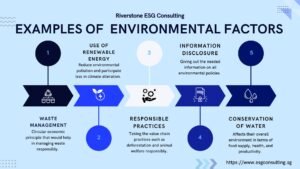
In oil and gas, environmental factors prevail in ESG valuation as the environmental liabilities are found to have direct influence on cash flow and life of an asset. Carbon emittance, the risk of pollution, the use of water, waste disposal, effects on biodiversity, and remediation strategic plans are the areas that have to be analyzed by analysts. The data on emissions in Scopes 1, 2, and 3 impact on the exposure to future regulations, particularly due to the globalized carbon pricing measures.
Governments have become stricter on carbon policies which will ensure that carbon-intensive companies operate at higher operating costs and lower profitability. The danger of having the stranded assets, especially when the company has the hold on the high-cost or highly carbonated holdings of resources, turns to be a paramount consideration of the process of valuation. Therefore the environmental impact modeling determines not only the present footprint but the capacity of the company to minimise the emissions, switch to cleaner technologies and operate through tougher and tougher regulations. These environmental variables affect discount rates, assumptions on costs and impairment test of any asset in determining in the long-term the appeal of any business.
Social Impact and Workforce Responsibility
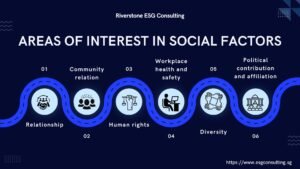
These issues are also social considerations that are vital when evaluating ESG. Oil and gas businesses are greatly interconnected with the local people, workforce, and health and safety protocols. Unsafe conduct or low protection of workers, environmental incidents, or interpersonal strife with the communities could seriously fault the operations and impact on reputation. Such disruptions may result in stalling of production, legal suits and expenditure losses in the long run.
The social performance of a company is manifested in the capacity of the company to safeguard its workers, maintain good relationships with communities, defend human rights, and responsible development of its projects. In analytical terms, social risks affect continuity in operating and trust by the stakeholders. Well-managed social governance is a frequent occurrence in the companies, and this results in a reduction in disruption, higher retention rates, and easier regulatory authorizations, which enhance financial performance and valuation metrics.
Implementation of ESG Valuation in the Energy Sector
Integrating ESG Metrics Into Financial Modeling
Incorporating ESG measures in valuation involves having analysts incorporate sustainability aspects in basic financial premises and not as single-quarter analysis. It includes changing cost of capital to indicate the risk associated with ESG and changing future revenues to capture the fluctuation in demand and factoring in the environmental liabilities in the cash flow statements.
An example of this is an oil and gas company that has a lot of carbon exposure where the future taxes and operating costs could be increased and analysts will capture this on the changed EBITDA margins or by increasing the risk premiums. On the other hand, the companies that invest in decarbonization technologies, as well as low-carbon energy projects, might increase their long-term resiliency, thus the discount rates should be reduced or the terminal value should be elevated. This needs the ESG measures to be put directly into the financial model to have a complete economic bearing of the sustainability performance.
Governance and Risk Management Integration
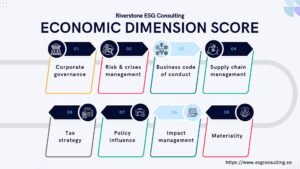
Governance is very crucial in the ESG valuation. Firms, which show transparent reporting, well functioning internal controls, ethical leadership, and board level information on sustainability related matters, would be more likely to attract investor confidence and remain stable in the long term. Weak structures of governance on the contrary raise the risks of misreporting, violation of regulations, and inefficiency of operation.
In the oil and gas sector, good governance is the key to early identification of the environmental and social risks, proper implementation of the mitigating strategies, and pre-timely compliance with the air, soil, and water quality standards. The aspect of governance also impacts valuation by not only influencing the perception of the investors but also by determining how the company can cope with the intricate regulatory conditions, environmental, and operational environment.
Improving Strategic and Analytical Thinking
Developing a Mindset for Long-Term Decarbonization
The mindset of approaching the valuation by the energy companies should be strategic in how it acknowledges the fact that global decarbonization is inevitable. The measurement of the long-term risks is carried out by determining the possibility of the company to change to lower-carbon business models, implement new technologies, and reposition the assets.
The executives will need to examine how the current trends, including the development of hydrogen, carbon capture technologies, or integration of renewable energy, can affect the profitability in the future. This attitude demands thinking systems that would look beyond the present financials to the capacity of the firm to meet the long term environment objectives. Due to the increased pace of decarbonization in the world, businesses that are not able to envisage the consequences will lose customers and investor trust.
Enhancing Transparency and Stakeholder Communication
Effective ESG valuation includes a precondition that communication with the stakeholders is clear and transparent. Investors require plausible sustainability reports, periodic performance measures and expansive reports on the environmental and social impacts. Oil and gas corporations are required to state not only their current performance in terms of ESG but also their future intentions to become more sustainable and reduce the level of emissions.
Open communication fosters trust, lowers the uncertainty level and also exhibits competent leadership. The effective communication plan allows to make the expectations of the stakeholders more consistent with the long-term vision of the company and increase the degree of trust in the investors towards its capacity to address the ESG risks.
Integrating Technology and Automation
Digital Tools for ESG Monitoring and Reporting
Measure, track and report of sustainability data are some of the techniques that are increasingly being used by oil and gas companies through advanced technology. The accurate emission values, enhanced safety controls, and regulations can be ensured thanks to real-time monitoring systems, including the IoT-enabled sensors and satellite analytics, digital reporting platforms, etc.
Digital transformation will improve the valuation because it will increase the precision of the ESG information, and the management can make informed decisions. Automation eliminates human errors, and it saves time in reporting schedules and also enables investors to have confidence in verified and consistent sustainability information. These technological systems consequently appear in the center stage of forming ESG performance and long term enterprise value.
Using Data for Scenario Planning and Strategic Adaptation
The scenario analysis based on data helps companies to model possible regulatory dynamics, a shift in energy demand, a carbon pricing scenario, and technological advancements. Through these simulations in strategic planning, companies are able to get better insights into risk and opportunity that are up-shifting their financial performance in the future.
Advanced scenario analysis empowers valuation by indicating the assets that will stand firm in various situations within the market, the operations that have increased risk and the way strategic adjustment can impact long-term sustainability.
Advantages of ESG Valuation in Oil & Gas
Strengthening Investment Appeal
Independent oil and gas companies that are highly performing in terms of ECS are able to avert such a problem because of adequate capital access, reduced cost of financing and also higher loyalty of investors. With the trend of focusing on sustainability by the world capital markets, firms that are able to show their conformity to the expectations of environmental and governance boost their competitive advantage and increase their valuation potential.
With the introduction of ESG into the financial evaluations, organizations communicate their desire to be stable over the long term and develop in a responsible way, which will make them more appealing to institutions that are interested in sustainable investment projects.
Enhancing Compliance and Operational Performance
ESG valuation motivates companies to perform efficient operations, lessen the ecological obligations, raise safety and quality, and enhance the relations to the community. Such improvements lead to a more stable production, fewer disruption, and higher compliance with the regulations. The high ESG performances eventually result in more predictable cash flows, less risk exposures, and better enterprise value in the long run.
Conclusion
The adoption of the ESG concept in the valuation of the oil and gas firms is transforming the way analysts, investors, and managers evaluate the financial performance of companies in the long-term. The ESG valuation strategies for oil and gas companies in a decarbonizing global energy market relates the sustainability performance to the enterprise value, because it quantifies environmental risks, social responsibility and governance effectiveness in financial models.
Firms which are able to adjust to regulatory changes, embrace new technologies as well as make communication with the stakeholders transparent will be better placed to succeed in the ever-changing energy environment in the world today. With the increasing interest in ESG valuation processes, it is not a strategic strength but a modern necessity of a long-term competitive environment in the oil and gas industry.