ESG Strategy for Non-Profit Organizations: Strengthening Accountability Through Measurable Impact
Introduction to Certified ESG Strategy Nonprofits Training
Non-profit organizations are in an environment that is characterized by trust, impact, and accountability to the people. With the increase in the demands of donors, regulators and beneficiaries to obtain more convincing evidence of responsible management, environmental stewardship, and ethical conducts, ESG strategy has become a long-term credibility requirement. Through the broad set of issues surrounding sustainability, there is one area that is proving to be the most pressing among non-profits, and that is the development of the structured, measurable, and transparent ESG strategy that would improve the delivery of the mission and increase the governance. This paper will discuss the ways NGOs and foundations can create such system, and the main focus will be on the reporting practices, alignment in operations, and measurement of impact.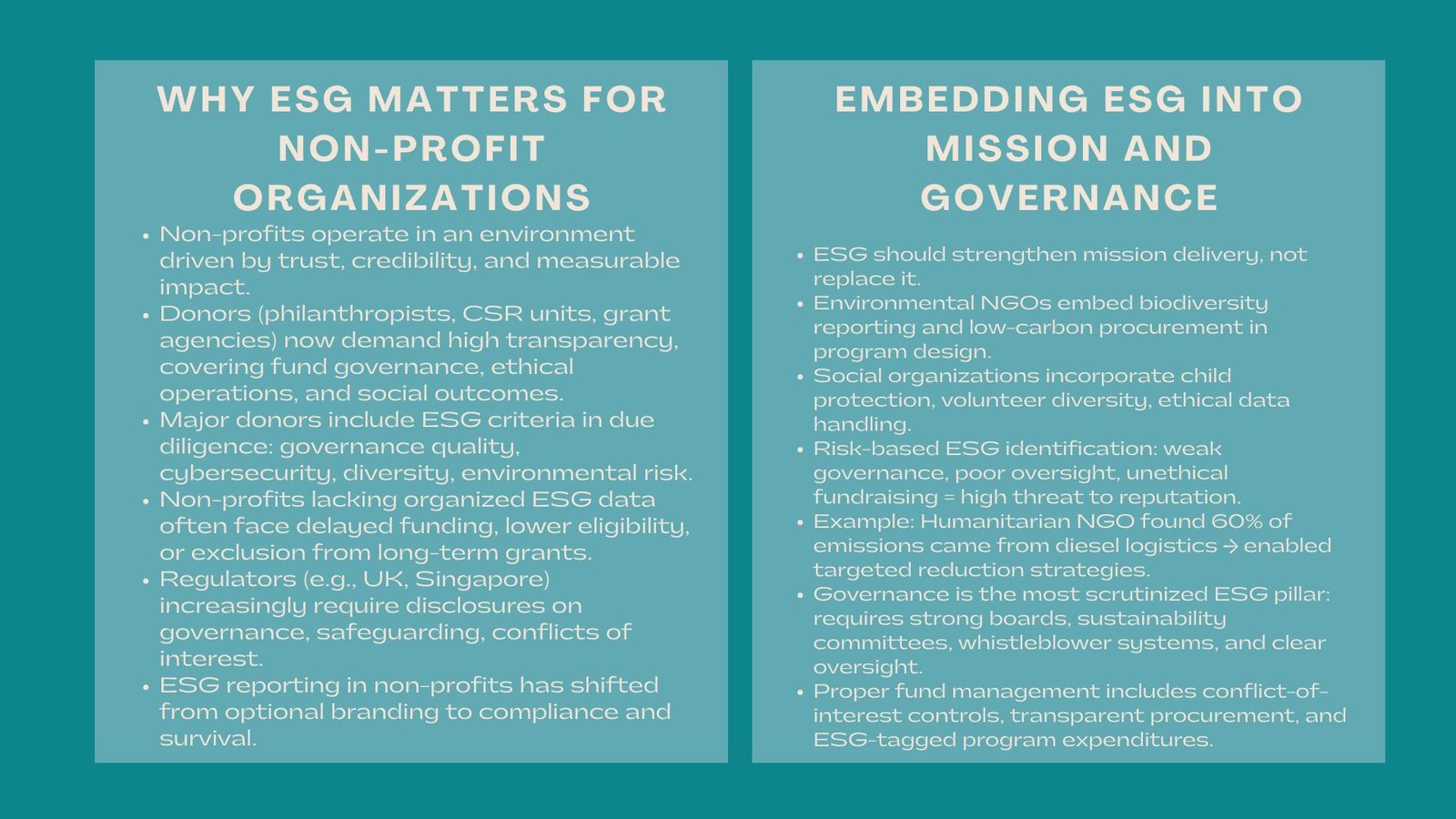
1. The importance of ESG Strategy to Non-Profit organizations.
1.1 Donor Requirements on Transparency and Governance.
Donors, such as individual philanthropic individuals, corporate CSR units, or grantmaking agencies, now demand a lot of transparency in the way the funds are managed, as well as how the programs correspond to responsible practices. Most large grantors look at non-financial measures like environmental risk control, employee welfare, participation in the community and governance procedures prior to giving multi year funds. A major international foundation has recently changed its due-diligence framework to comprise governance performance metrics, cybersecurity practices and diversity metrics. The non-profits that could not offer organized information were either left behind during funding or held up. This trend explains the reason why most organizations are establishing an NGO ESG compliance strategy to stay eligible and enhance partnership credibility.1.2 Increasing Regulatory and Reporting Pressure.
Even though non-profits are not necessarily subject to the same requirements of mandatory disclosure as listed companies, regulators are increasing their control. As an illustration, Singapore and UK charities are required to disclose their governance standards, related-party transactions, safeguarding and conflict-of-interest procedures. With the inclusion of grants by governments which relate to responsible practices, ESG reporting is encompassed in the compliance and not a simple exercise of image building.2. Creating an ESG Foundation: Strategic Performance and Mission.
2.1 Incorporating ESG in the Mission Delivery.
In the case of non-profits, the mission should be strengthened by ESG, rather than be overtaken by it. This involves having a clear idea of the role played by environmental, social, and governance in program impact, allocation of resources, and stakeholder outcome. Developing low-carbon procurement policies and biodiversity reporting may also be directly embedded within the design of a project, as an environmental conservation NGO. A social welfare group can incorporate child protection, volunteer diversity, and ethical information practices in its system. The point is at making sure that the ESG strategy in question facilitates quantifiable mission returns.2.2 ESG Areas of priority with regard to organizational risk.
A successful approach to ESG would involve a risk-based approach. Weak governance due to low oversight, misleading reporting, or unethical ways of fundraising can be very dangerous to a non-profit, because their survival depends on the trust of the public. In the case of international NGOs, transportation footprint, field operations, and procurement environmental footprint might have to be structured. A humanitarian agency based in the world had recently measured its logistics carbon footprint and found that transportation conducted on diesel made up more than 60 percent of the overall footprint. This understanding made the organization to develop focused reduction strategies and enhance cost effectiveness.3. Governance as the Core of Non-Profit ESG Strategy.
3.1 Building Board Accountability and Structure.
The most examined ESG pillar of non-profits is governance. The boards should be competent, independent, and transparent. This involves the formation of sustainability committees, development of whistleblower networks, and diversity of the board. Role ambiguity between boards and executive teams is a challenge to many organizations. Poor monitoring may result in violation of compliance or misappropriation of money. To prevent such risks, a well-organized system of governance with frequent reporting of ESG is beneficial to organizations.3.2 Reporting and Fund Management of Ethical Funds.
Non-profits are usually limited to funds associated with certain programs. The key to donor trust is to manage them responsibly. Making the controls ESG-compliant, such as conflict-of-interest statements, procurement transparency, and grant tracking systems will enhance accountability. An education charity implemented a digital system of fund-allocation which labels expenditures with ESG results. Donors are now able to monitor how their donation is assisting particular program indicators to enhance transparency as well as increase donor retention.4. Social responsibility in non-profit operations.
4.1 Supervising Operational Environmental Imprints.
Even though most non-profits work in an office setting, their environmental impact may be enormous regarding fieldwork, transportation, community events, training programs, and procurement. Emission mapping and resource use mapping enables the organizations to find areas of reduction. An NGO in a region that used community clinics cut its energy expenditure by 18 percent when it changed the lights to LED and had an equipment-use schedule. Its annual sustainability report showed these results in terms of cost and carbon savings realized.4.2 Sustainable Procurement and Supplier Screening.
Medical equipment, uniforms, food, and event materials are some of the common goods that are procured by non-profits. The adoption of suppliers screening procedures with an emphasis on environmental and ethical requirements helps to avoid the risk of a bad image and enhance the sustainability of operations. As an example, a humanitarian aid organization revised its purchasing policy to focus on suppliers that are environmentally certified and have fair-labor practices. This enhanced compliance as it developed a stronger supply chain.5. Social Impact Measurement and Standardized Reporting.
5.1 Social Impact Quantification Updating the challenge.
The core of NGO activity is social impact, but it is the most difficult one to measure. Numerous companies are based on qualitative narrative instead of quantitative metrics. ESG models have to have quantifiable metrics like beneficiary coverage, program success, employee health, and community involvement. This is where the long-tail keyword ESG valuation for non-profits becomes relevant. This valuation is aimed at assessing the non-financial value that an organization produces- be it in educational outcome, health gains or alleviation of poverty. Supporting effectiveness is done more and more with the help of standardized impact scoring, outcome mapping and valuation models.5.2 Data Management and Reporting Systems.
Non-profits usually keep data in numerous tools, namely spreadsheets, third-party databases, donor systems, and paper files. This fragmentation complicates proper ESG reporting. Other organizations are currently adopting integrated impact-measurement platforms that bring program data, financial reporting and sustainability metrics together. An NGO with health concerns took to such a system and cut its reporting by 40 percent, allowing it to apply the grant faster and have stronger audit trails.6. ESG Transformation Implementation Roadmap.
6.1 Establishing quantifiable ESG Goals.
Specific objectives that have time limits enable organizations to monitor progress. Examples include:- cutting of electricity consumption by 10 percent in two years,
- diversifying boards to 40 percent gender,
- making training 90 percent compliant,
- implementing the responsible procurement policy throughout the organization.