ESG Compliance Challenges in Food & Beverage

Introduction to Certified ESG Compliance Food Beverage

The food and beverage (F&B) industry is a complex and highly important field of the global economy that is related to the environment. The agricultural sourcing and packaging to production and distribution that consumes a lot of energy, and all these stages offer a challenge in sustainability. Due to the increasing pressure on consumers, investors, and regulators to seek higher levels of transparency, food and beverage companies can no longer afford to operate in the conventional way of doing business as this would be a faulty step towards meeting the Environmental, Social and Governance (ESG) requirements.

ESG compliance has turned into a part and parcel of corporate governance and financial performance within the F&B industry. However, compliance is not that easy to achieve. Businesses are confronted with complex reporting systems, varying stakeholder demands, and increasing demands of measuring environmental and social impacts in an exact manner. ESG accounting is thus very much involved in making sure that the data about sustainability is measurable, comparable and verifiable.
Certified ESG Compliance Food Beverage

1. The Increasing Relevance of ESG in the F&B Industry.

1.1 A Change of voluntary to Mandatory Reporting.

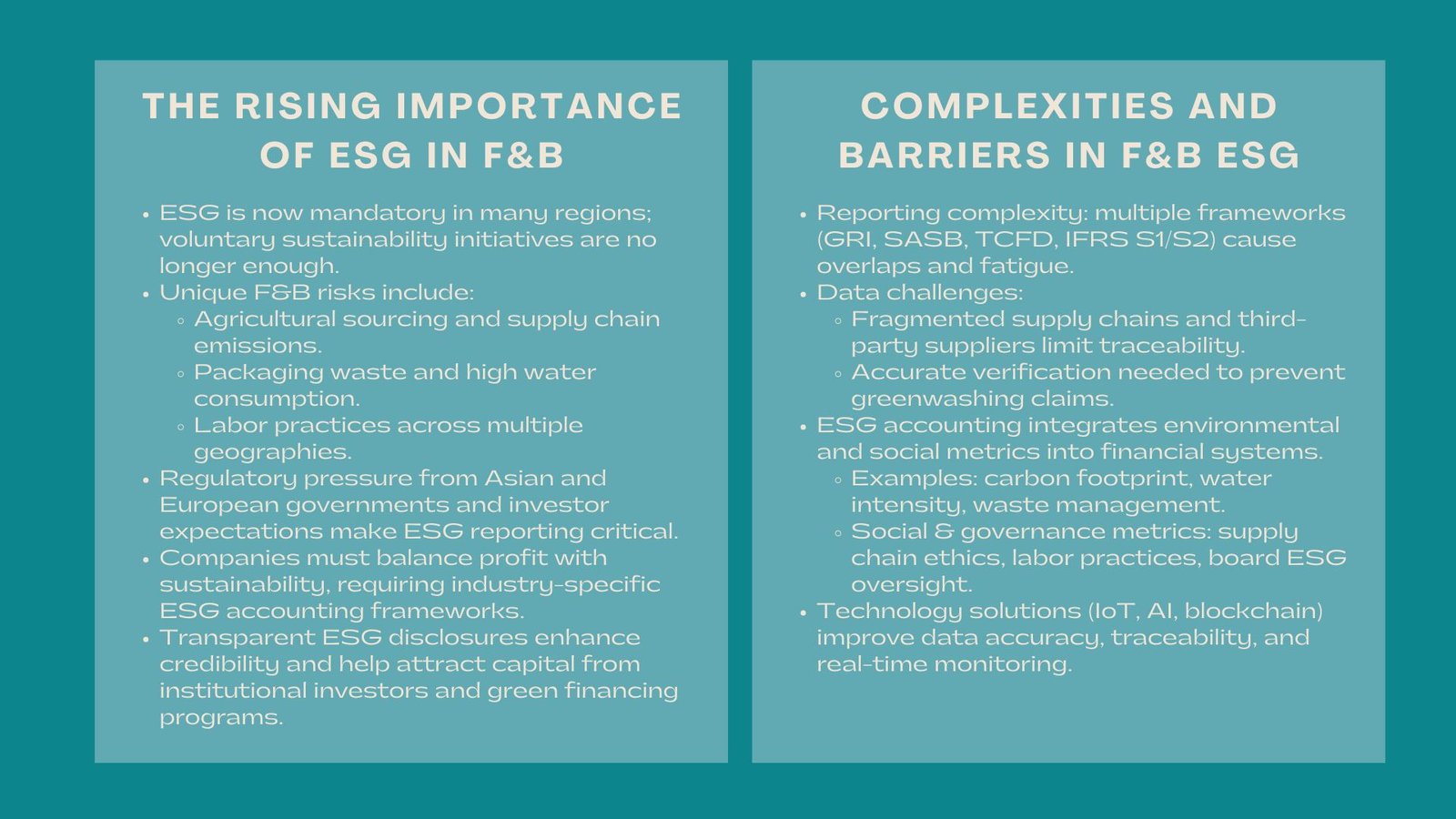
Within the last ten years, sustainability in the F&B industry has ceased being a corporate responsibility move adopted voluntarily to become a regulatory and financial compulsory measure. Asian and European governments have started to enforce ESG reporting, and institutional investors are now demanding data on sustainability issues in order to dedicate capital.

The trend represents an emergent awareness of the fact that environmental and social risks- including supply chain emissions, labor practices, etc- can have a financially significant impact. Consequently, firms are being compelled to develop strong internal mechanisms of gathering and reporting information on carbon intensity, amount of waste, energy consumption and human right activities.

1.2 The Reason why the Food Industry has unique ESG risks.

This is unlike many other industries where F&B companies have the battle of sustainability that is far beyond their scope of operation. Millions of smallholders take part in agricultural sourcing, packaging produces huge amounts of waste and water consumption impacts local ecosystems. All these factors are interdependent and therefore, ESG compliance is not only challenging but extremely important as well.

Companies have to juggle profit, sourcing responsibility, fair labor, and logistics sustainable in carbon footprint- conscious mode, more than once, in more than one geography with more than one level of regulation. It is on this basis that industry-specific ESG accounting frameworks are required to help measure the environmental and social footprint of food production, which is unique to each industry.

2. Learning about the Complexities of ESG Compliance.

2.1 Diversity in Reporting and Fatigue in Regulatory Reporting.

The F&B industry is governed by the maze of international reporting standards of GRI, SASB, TCFD, and IFRS S1/S2 that all have their disclosure requirements. In case of multinational companies, there are usually overlapping structures that managers are faced with hence leading to reporting fatigue. Smaller businesses, in their turn, might not be capable of internal capacity to read and use these changing guidelines.

An operational food sector ESG compliance map can be used to fill this gap providing step-by-step approach to align operations, supply chains, and reporting system with regulatory expectations. These frameworks do not only elucidate compliance requirements but also assist companies to determine material risks in ESG that are unique to the agriculture, packaging, and waste management.

2.2 Data Accuracy and Verification Problems.

Proper data gathering regarding ESG is one of the largest challenges that F&B companies have. Most of them depend on piece meal supply chain and third party suppliers where consistency and traceability of data are low. To illustrate, it may be challenging to get authenticated data about carbon emission or water consumption by agricultural groups.

Reliability is becoming a top priority, and this is why the third-party audits, satellite monitoring, and blockchain-based traceability systems are necessary. In the absence of authenticated information, even the most ambitious ESG plans will be destroyed by claims of greenwashing or partial disclosures.

3. The F&B Industry ESG Accounting.

3.1. Making Financial Systems Sustainable.

Modern ESG accounting is not limited to sustainability reporting, but it involves the inclusion of environmental and social metrics in the routine financial decision making. In the case of F&B companies, it implies the quantification of the relationship between sustainability initiatives and profitability, cost structures, and the creation of long-term value.

Adopting ESG accounting for F&B industry operations allows companies to translate carbon emissions, water consumption, and waste generation into financial terms.As an example, the financial cost of cutting packaging waste or switching energy to renewable forms may prove useful in ensuring that the executives make better decisions when it comes to capital allocation investment decisions.

Integrating ESG considerations into financial planning will help companies to see where sustainability initiatives save them money, add value to their brands, or reduce regulatory risks.

3.2 Measuring Environmental impacts

The carbon footprint, water intensity and waste management are the major areas of environmental accounting in the F&B industry. The examples include beverage companies which are quantifying the lifecycle impact of packaging material and the food producers can quantify the agricultural input emissions as well as food transport emissions.

By measuring such impacts, companies can be able to establish quantifiable sustainability goals, like, becoming carbon neutral, or consuming less water per unit of production. It further provides the accountability to investors and regulators, who seek more and more evidence-based sustainability disclosures.

3.3 Social and Governance Aspects.

In addition to environmental effects, ESG also records social and governance measures in accounting. Ethics in supply chain, labor and community involvement are very important in preserving brand integrity. In places where forced or child labor is still a threat, open reporting and supplier audits can be used to develop confidence among the stakeholders.

Governance metrics, in their turn, are anti-corruption policies, executive accountability, and an ESG oversight of the board. Good governance will be used to make sure that sustainability is not a side project but as a corporate strategy.

4. Breaking down ESG Compliance Barriers.

4.1 Enterprise Transparency through Technology.

The digital transformation is a significant facilitator of ESG compliance. State-of-the-art data services, IoT-based tracking and AI analytics can assist F&B enterprises to keep track of the sustainability metrics in real-time. As an illustration, the sensors that are powered by AI could monitor water consumption or identify that there is an inefficiency in a manufacturing line, and convert environmental data into a usable format.

Blockchain technology similarly increases supply chain visibility through tracking all its transactions, including sourcing of raw materials and distribution of the products, on an unchangeable registry. This enhances traceability, lowers fraud, and increases the efficacy of the ESG reports.

4.2 Developing in-house Capabilities and Training.

Successful compliance requires personnel with the necessary skills in regards to sustainability and finance. To close this divide in the market, many companies are investing in finance team and supply chain managers, as well as sustainability officer, training programs. Internal ESG committees with the assistance of external consultants may be used to monitor the implementation and to maintain the regularity in adherence to the reporting structures.

The ability of ESG compliance to become a relevant operational practice instead of a PR effort can be facilitated by a company-wide culture of accountability, which must be fostered through regular training, leadership involvement, and sustainability KPIs (which are based on performance).

5. Strategic Value of ESG Compliance.

5.1 Sourcing Investors and Business Partners.

ESG performance is being considered more by investors as a measure of long-term stability and management by ethics. Companies in the F&B sector that exemplify a good sustainability accounting and reporting receive more easily access to green financing and sustainability-related loans. In addition, international retailers and distributors tend to give preference to suppliers that have good ESG rating, which provides a direct business benefit.

A well-designed food sector ESG compliance guide doesn’t just help firms meet regulations—it positions them as leaders in responsible production, attracting partnerships and customers who value sustainable brands.

5.2 Enhancing Brand Trust and Consumer Loyalty

In the modern world, consumers expect brands to be responsible in terms of their social and environmental impact. Open ESG reporting builds confidence, distinguish products in competitive markets and equity in a long term brand. Firms that provide transparent updates on their efforts on such matters as waste management, fair trade supplier and carbon emission goals have higher chances of consumer loyalty.

As an illustration, the global beverage brands have registered great success in the market by converting to recyclable materials and releasing comprehensive sustainability reports that have been verified by third party auditors.

Conclusion

The road to the ESG compliance of the food and beverage industry is not simple and easy to follow. Businesses are forced to operate in a fragmented regulatory environment, data issues, and stakeholder demands and be profitable. The F&B industry operations can turn sustainability into a competitive advantage by investing in ESG accounting and using the frameworks suggested under a food sector ESG compliance guide.

With the international customer and investor demanding more accountability, ESG compliance will become a more pronounced factor in determining the future success of F&B brands in the market- and whose brands may be abandoned by them.

Related Posts

Transform Data Into Impact With Expert ESG Reporting

Ensure transparency, meet compliance, and build stakeholder trust-connect with us today.