ESG Reporting and Strategy for the Technology Sector
Introduction to Certified ESG Reporting Technology Sector
Technology is a dynamic system that is always evolving, disruption is the order of the day, and expansion is astronomical. But running behind this development is a new challenge which is accountability. With the increased influence of digital infrastructure, artificial intelligence, and data-driven systems on society, the intensity of requests among key stakeholders to understand how technology companies handle their environmental, social, and governance (ESG) obligations grows.
In both energy-intensive data centers and data privacy and labor ethics concerns in global supply chains, ESG is now part of how tech companies are run and what they are worth. The pressure from investors, regulators, and customers alike has turned Technology ESG reporting standards into a strategic necessity rather than a compliance formality.
The paper discusses the intersection of the ESG strategy and reporting in the technology industry, including some of the prevalent frameworks, challenges, and best practices that influence the direction of the segment in terms of sustainable innovation.
1. The Problem of ESG Reporting in Technology.
1.1 The Growing Area of ESG in Tech.
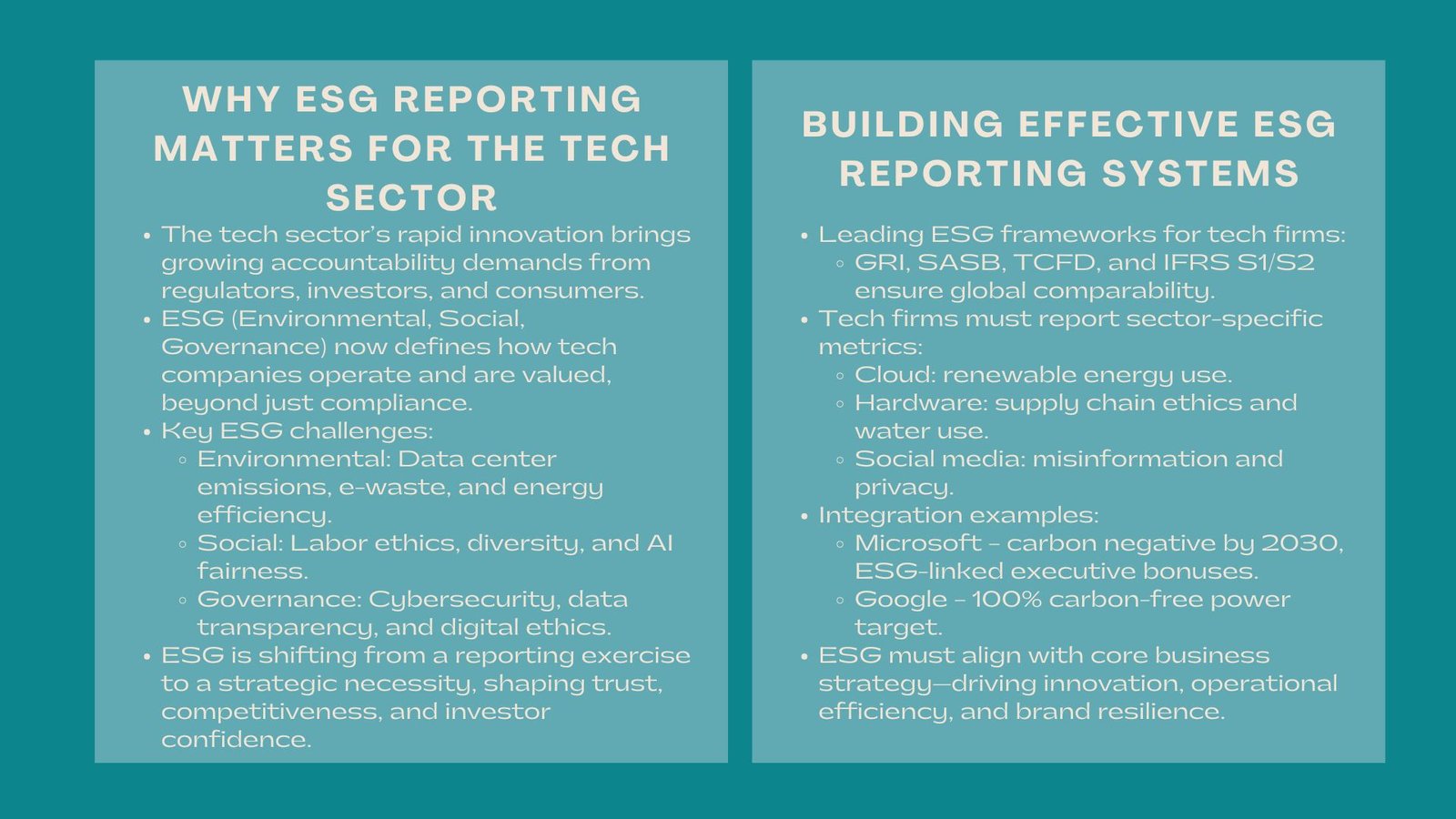
The ESG footprint of the tech industry is not merely a question of emission or waste as it is in the case of traditional industries but the influence of technology on the people or governance systems worldwide. The problems in the environment are due to data center energy consumption, hardware production, and electronic wastes. Such social issues are diversity, inclusion, and ethical development of AI. Governance is associated with cybersecurity, transparency, and responsible use of data.
As technology firms scale, their influence on both society and the environment magnifies — making robust ESG compliance in tech sector frameworks essential for sustainable growth.
1.2 Market and Investor Expectations
Investors are currently associating long-term valuation and ESG performance. Large institutional investors – such as BlackRock and Temasek – are becoming more inclined to evaluate tech companies using ESG reports and risk management. Companies that show active approaches to sustainability get more capital and reputational benefits, and laggards may be divested.
2. Critical Tech Company ESG Reporting Frameworks.
2.1 Global Reporting Standards
Technology companies are increasingly adopting international ESG frameworks in order to be consistent and credible. Among the most relevant are:
- Global Reporting Initiative (GRI)- to report on all aspects of sustainability in environmental, social and governance levels.
- Sustainability Accounting Standards Board (SASB) – offering industry-specific advice, especially of software and hardware companies.
- Task Force on Climate-related Financial Disclosures (TCFD) – focusing on risk reporting of climate and climate resilience.
- IFRS S1 and S2 – the new international standard of sustainability and climate-related reporting, which is increasingly being adopted by listed technological companies.
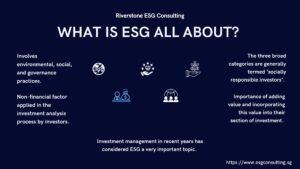
By uniting these standards, corporate accountability is enhanced and data on ESG is unified with financial reporting – filling the gap between purpose and profit.
2.2 Sector-Specific Concentration.
The technology industry may need to disclose industry-specific information when doing ESG reporting. Cloud computing companies, in their turn, need to take care of their energy efficiency and the use of renewable sources of power. The manufacturers of semiconductors should monitor the number of water used and supply chain labor standards. There is increased criticism of social media regarding misinformation, digital rights and data ethics.
3. Harnessing an efficient ESG Strategy in Tech.
3.1 The connection between ESG and Core Business Objectives.
The most effective tech-related ESG initiatives cannot be seen as peripheral undertakings, they are integrated into the business strategy. An example that could have been used is Microsoft, which targets to become carbon negative by 2030 and pegs executive bonuses on sustainability achievements. Likewise, the environmental responsibility is incorporated into the innovation agenda of Google since the company is determined to use carbon-free power by 2030.
This solution transforms ESG into a value-create center over the long-term – a motivator of efficiency, innovation, and trust.
3.2 Mechanisms of Governance and Accountability.
The strong governance is vital in ensuring that the ESG objectives are met. The top tech firms are now placing board-level committees to manage ESG strategy, to align with risk management and corporate ethics. Such a high degree of control promotes transparency and demonstrates to investors that the issue of sustainability is important.
4. Technological Industry ESG Reporting Problems.
4.1 The data is available and of quality.
Although most tech firms are technical, they are faced with the challenge of gathering and standardizing ESG data at the global level. The supply chains are complicated, and the monitoring of emissions (particularly Scope 3) is one of the significant issues. Companies are also resorting more to AI-based ESG analytics solutions to automate the process of data collection and reporting which are more accurate and comparable.
4.2 Striking a balance between Innovation and Responsibility.
Technological advancements are usually ahead of regulation. New ethical and sustainability issues are emerging around new technologies such as artificial intelligence, quantum computing, and the Internet of Things (IoT). These risks should be expected prior to increasing in magnitude on the companies- the responsible innovation must be integrated into the strategy of ESG.
4.3 The Risk of Greenwashing
Since ESG is a branding tool, certain technology companies overstate sustainability success. The regulators are currently cracking down on deceptive disclosures which demand verifiable information and independence. This creates credibility because it is authentic reporting supported by clear methodologies.
5. Technology sector ESG Impact measurement.
5.1 Environmental Metrics
In the case of the tech sector, the environmental element is in terms of energy consumption and emissions. An example is the data centers which consume almost 1 percent of worldwide electricity. Such businesses as Amazon Web Services (AWS) and Meta have proceeded to use 100 percent renewable energy in their premises. The measurement of these commitments by certified data on emissions increases the credibility of ESG.
5.2 Social and Governance Metrics.
Social aspects include employee welfare, privacy and inclusion on the Internet. To illustrate All Supplier Code of Conduct and frequent audits by Apple to make certain that there is ethical work across the whole manufacturing chain. Governance, in turn, encompasses transparency in AI development, policies of data use, and cybersecurity – all these are fundamental parts of the user trust and regulatory adherence.
6. Practical Cases of ESG Leadership in Technology.
Micro-corporations such as Microsoft, Google, and Apple lead the standards of ESG reporting. The integrated system of sustainability reporting developed by Microsoft (in line with GRI and TCFD) demonstrates the value of climate impact, water management, and community investments in making business more resilient. The transparent reporting of circular economy projects by Google illustrates the role played by environmental innovation in making operations efficient.
Smaller companies are doing the same. Applying sustainability disclosure to address investors and partnership needs, southeast Asian technology startups demonstrate that the ESG strategy is not a prerogative of large corporations.
7. The Future of Tech Sector ESG Reporting.
7.1 ESG Data Management by AI and Digital Tools.
AI, blockchain, and cloud analytics are changing the way information about ESG has to be gathered, verified, and reported. Predictive analytics will be able to predict the risk of climatic conditions or supply chain interruptions and the company will be able to react beforehand. Real-time reporting has been made possible due to digital ESG dashboards that enhance transparency and decision-making.
7.2 Evolution of Regulations and Global Convergence.
The regulatory convergence will determine the next stage of ESG reporting. With varying jurisdictions (such as IFRS and regional standards, such as the CSRD of the EU) picking up, companies will be required to align disclosures with different jurisdictions. In the case of global technology companies, standardization of reporting will be a necessity to investor trust, as well as to government regulatory standards.
Conclusion
To technology firms, ESG reporting is no longer a voluntary practice in corporate responsibility but rather a competitive, resilience, and innovations tool. The inclusion of the ESG principles in the business models not only increases the confidence of the investors but also provides sustainable digital transformation.
Companies with well-developed ESG policies, sustainable reporting systems and transparency based on data collection will drive the future of responsible technologies. With the growth of the digital economy, the people that have learned the standards of Technology ESG reporting and comply with ESG requirements in the structures of the technological sector will establish the standards of sustainable innovation in the years to come.