ESG Governance and Board Responsibility in Malaysian Companies
Introduction to Professional ESG Governance Course Malaysia
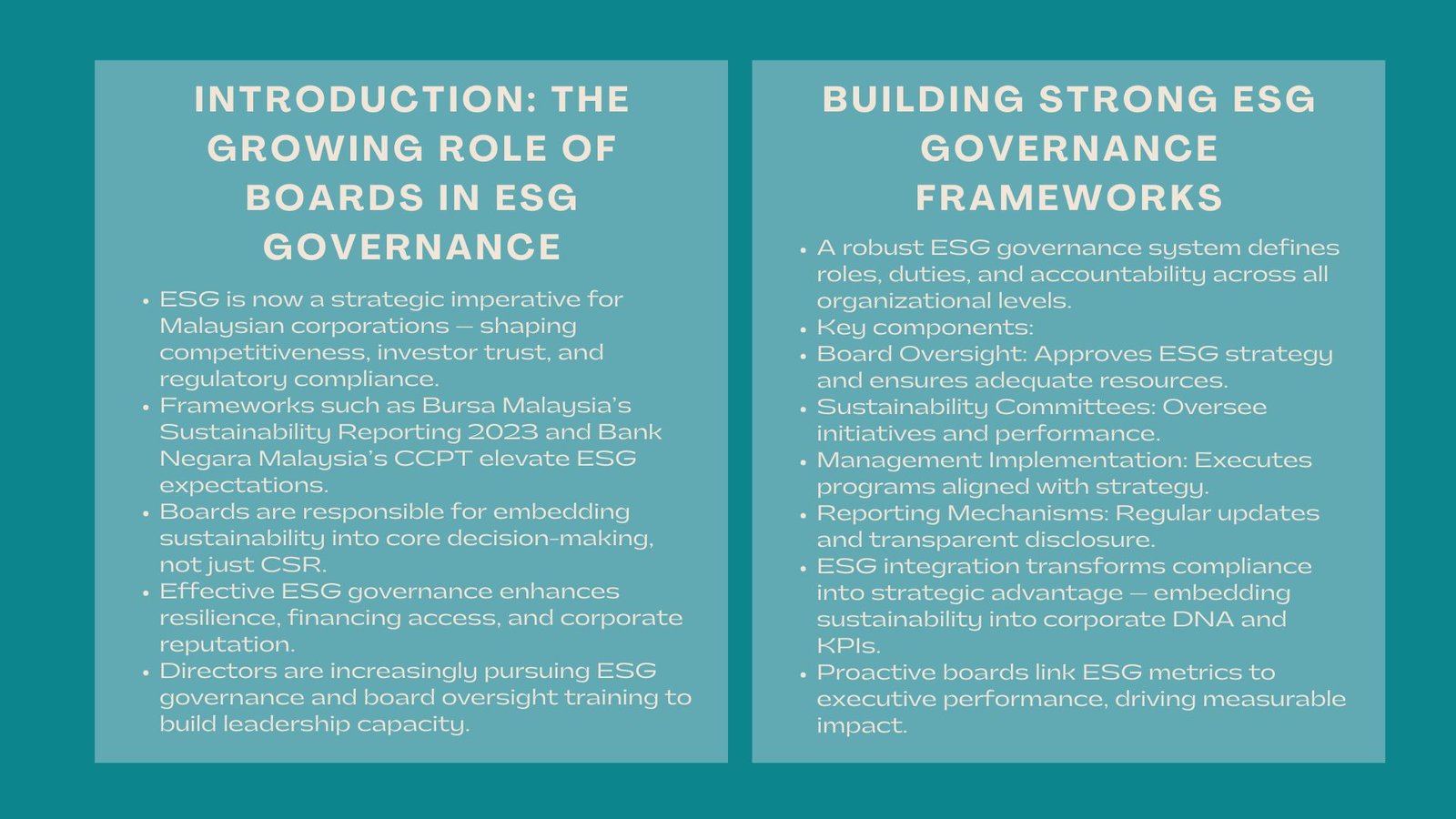
The element of Environmental, Social, and Governance (ESG) is no longer a choice of Malaysian corporations, but it is a strategy determinant that predisposes the competitiveness in the long term, investor trust, and adherence to regulation. With expectations of ESG being increased by global and regional frameworks like the Bursa Malaysia Sustainability Reporting Framework 2023 and Bank Negara Malaysia CCPT, the board of directors has become instrumental in ensuring the implementation of ESG in the core of corporate decision-making.
Effective governance on ESG is gradually adopted as one way of corporate resilience in Malaysia. Not just focusing on making environmental impact less or making workplace practices better, it is also about leadership responsibility and strategy. Early adoption of ESG principles by boards increases their chances of handling the emerging risks, attract sustainable financing, and improve the reputation of their company in the market.
The Changing nature of Board in ESG Governance.
The Malaysian corporate boards had a traditional role that was largely centered on a financial performance, regulatory compliance, and risk management. Nonetheless, that role has increased with the ESG integration. The modern directors should be aware of the risks of the climate, social effects, and governance requirements that affect the long-term corporate sustainability.
Board members should make sure that sustainability is not the prerogative of the CSR department but instead it should be incorporated in the fundamental business strategy of the organization. This should be well informed in terms of ESG framework, stakeholder expectations and international standards. Many directors are now pursuing esg governance and board oversight training for corporate directors to develop the competencies needed to navigate this new landscape.
This kind of training can assist the board members to recognize and address the ESG risks, disclose sustainability and align company objectives to national and global sustainability priorities- like the 2050 net-zero target of Malaysia and the United Nations sustainable development goals (SDGs).
Creating a Strong ESG Governance Framework.
Malaysian companies should have an effective and well-designed ESG governance structure in order to guide them well on sustainability. This structure stipulates positions, duties and accountability system throughout the organization.
An effective ESG governance system will generally entail:
- Board Oversight: The top-down approach is board approval of ESG strategies, which are followed by proper resourcing.
- Sustainability Committes: Special committees or sub committees oversee the ESG initiatives and the performance measures.
- Management Implementation: The senior management will implement programs based on strategies approved by the board.
- Reporting Mechanisms: Frequent ESG reports are made to the board to keep the board on track and carbonated.
By integrating such structures, it is possible to make decisions more easily, and sustainability will be a part of the corporate DNA. It also shows the investors that the organization is governed by the right people to deal with the non-financial risks.
Corporate Strategy Incorporation of ESG.
The transition of the reactive compliance to the proactive strategy is one of the largest changes in ESG governance. Rather than considering ESG a regulatory requirement, companies that are in the forefront in Malaysia are increasingly drawing it in the business planning, capital allocation, and performance management.
Boards should make sure that ESG metrics are part of key performance indicators (KPIs) of top executives. Such alignment assists in motivating accountability and making sure that outcomes of sustainability processes are pegged on organizational success.
Boards are becoming more strategic in areas like banking, manufacturing and energy where risks to the environment and the social aspects are especially high. They are ordering materiality tests, creating science-grounded objectives, and creating financing plans beside sustainability.
This proactive strategy will turn ESG into a cost center to growth driver and appeal to investors seeking responsible business activities.
Developing Capacity and Knowledge amongst Directors.
With the changing nature of the ESG expectations, the issue of the necessity of perpetual learning on the board level makes itself highly important. The traditional backgrounds of many directors in Malaysia are in terms of the finance or operational world and they may not have the ability to decipher the ESG data or analyse risks to sustainability yet.
This is where sustainability leadership and board responsibility workshop for malaysian companies play a vital role. The programs provide board members with the empirical knowledge on global ESG trends, new regulations, and governance best practices.
Scenario analysis, case studies, and peer discussions are frequently found in workshops to make the participants realize how ESG issues, such as climate change, human rights, and data privacy, can have a material impact on their business. They also emphasize on how boards may strike a balance between both short-term financial objectives and long-term sustainability requirements.
In such initiatives, the directors acquire the attitude and technical expertise required to manage intricate ESG strategies.
Empowering Oversight and Accountability Systems.
ESG oversight should not be symbolic to attain the credibility, but quantitative. Boards must put up accountability mechanisms that are clear in tracking progress, checking accuracy of data and in ensuring that the standards are met, both locally and internationally.
These encompass the establishment of internal audit mechanism to sustainability reporting and utilization of external assurance providers to authenticate ESG reporting. Board meetings should also include regular updates on ESG, and the performance metrics should be assessed in addition to financial reports.
The risk committee of the board is becoming more critical in this matter particularly in determining the impact of the climate risks, supply chain disruption, or social controversies on business continuity. Board ownership of ESG management will help organisations to show regulators, stockholders and other stakeholders that their firms are committed to sustainable governance.
ESG Governance and Investor Expectations.
When evaluating potential investments, investors are currently putting more emphasis on governance and transparency. They desire to observe that boards are involved in working on sustainability strategy and that ESG factors are part of risk management and performance evaluation.
The institutional investors, the sovereign funds, and the banks in Malaysia are all streamlining their due diligence programs to align with the ESG standards. This implies that firms that have poor governance or poor reporting standards stand the risk of losing investor confidence and accessibility to capital.
Conversely, companies that have effective ESG governance systems tend to have reduced financing rates, brand equity and reputation in the market. They can also be more ready to adjust to the new global standards like the International Sustainability Standards Board (ISSB) disclosure standards.
It is necessary to resolve ESG Governance Challenges.
Nevertheless, the emergence of awareness has not helped many boards in Malaysia to establish effective ESG governance. Weak ESG literacy, absence of standardized measurements, and disjointed reporting arrangements may be a drag.
In order to overcome these difficulties, companies need to pay attention to:
- Strengthening ESG Competency: Frequent board training and external advisory.
- Enhancing Data Infrastructure: Investing in real-time ESG performance tracking digital tools.
- Participation of Stakeholders: Transparency in communication with the investors, regulators, and communities.
Through such measures, the boards in Malaysia will be able to close the divide between compliance with regulations and the actual leadership of sustainability.
Balancing ESG Governance and the National Sustainability Goals.
Malaysia has made green finance, responsible business practices, and inclusive growth as the national agenda of sustainable development. Corporate boards are very instrumental in ensuring their strategies of the company are aligned to these national objectives.
With effective governance, businesses can contribute to the realization of the goals of Malaysia in the Twelfth Malaysia Plan, especially in such fields as the use of renewable energy, gender equality, and corporate transparency.
The boards working with ESG principles in their governance models are not only having a fulfillment of their fiduciary responsibilities but are also playing a role in the overall transformation of sustainability within the country.
The Path Forward
The Malaysian boards should be agile and proactive as global ESG standards keep on changing. There should be a shift in the governance practices, where compliance-based models should be replaced by the value-based strategies in which long term environmental and social consequences are taken into account.
Those companies that invest in education of their boards, strong governance systems, and open-minded reporting will find it easier to navigate the sustainable business future. This is a process that demands a life long learning, dedication and top management leadership.
Conclusion
The importance of boards in the development of the ESG strategy and governance in Malaysia is as critical as it has never been. As esg governance is integrated with the corporate directors board oversight training and sustainability leadership and board responsibility workshop, corporate leaders of the malaysian companies will be able to enhance their perception of sustainability risks, decision making and achieve long-term corporate resilience.
The emphasis on ESG governance today is not merely ensuring that the boards in Malaysia are satisfying the requirements of the regulatory bodies, but it is also establishing the next generation of responsible and sustainable corporate leadership within the region.